
Part of the generative engine optimization guide and AEO Hub.
I have bought, trialed, or been pitched most of the tools on this list over the past eighteen months, partly because I run AEO on attrifast.com and three client SaaS properties, and partly because people kept asking me which one to buy and I got tired of guessing. This is the comparison I wish someone had handed me before I spent a few thousand dollars learning the hard way that "AEO tool" is not one product. It is at least three products wearing the same three-letter acronym.
So this is not a "top 10, all of them are great" listicle. Every tool here gets a specific weakness, because every one of them has one. I will tell you where each fits, where it does not, and — the part most of these comparisons skip — where the entire category quietly breaks: revenue measurement. If you only read one section, read the one on why AI traffic numbers from a GA4 integration are systematically wrong, because it changes how you should read every other table in this article.
For the strategic framing of why AEO matters at all, and the honest split between AEO and classic SEO effort, start with AEO vs SEO in 2026. The trade press has tracked the generative-engine-optimization tooling landscape as it formed, which is useful context for how new most of these products are [26]. This piece is the buyer's guide that comes after you have decided AEO is worth a line item.
The three jobs an AEO tool can do (and why no tool does all three well)
Before any pricing table, you need the mental model, because the single most expensive mistake in this category is buying a tool for the wrong job. "AEO tool" collapses three genuinely different functions:
| Job | Question it answers | What it actually measures | Tools that lead here |
|---|---|---|---|
| Monitoring | Did AI engines cite or mention me? | Citation share, share-of-voice, sentiment across prompts | Profound, Peec, Otterly, Scrunch, Evertune |
| Optimization | How do I get cited more? | Content gaps, schema issues, prompt opportunities | Goodie, AirOps, Geoptie, AthenaHQ |
| Attribution | Did the cited traffic pay me? | Sessions joined to revenue, RPV by engine | Attrifast (revenue), AthenaHQ/Goodie (estimated) |
Almost every vendor claims all three. Almost none deliver all three to the same depth. The monitoring tools are genuinely good at monitoring and weak-to-absent on real revenue attribution. The optimization tools bolt monitoring on top of a content workflow. The one job that is consistently underserved is the third one, because doing it properly requires a payment-processor join that a GA4 integration cannot fake. Hold that thought; it is the spine of this whole comparison.
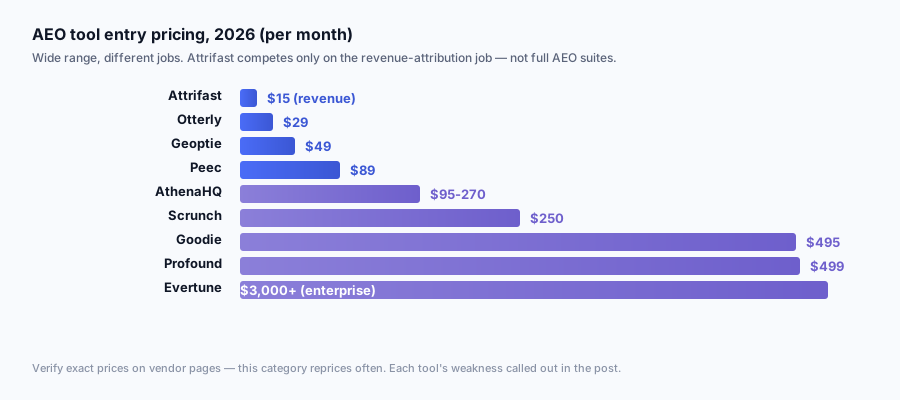
Here is the spread of every tool covered, sorted by published entry price, so you can see the shape of the market before we go tool by tool.
| Tool | Entry price | Primary job | Self-serve trial? |
|---|---|---|---|
| Otterly.ai | $29/mo | Monitoring | Yes, 14-day |
| Attrifast | $15/mo | Attribution (revenue) | Yes, free trial |
| Geoptie | $49/mo | Optimization + monitoring | Yes, 14-day |
| SEOcrawl | EUR 49/mo (~$53) | SEO + GEO suite | Yes, 7-day |
| Peec AI | $89/mo | Monitoring | Yes, 14-day |
| SE Ranking AI | $119/mo (add-on) | SEO suite + AI tracking | Yes (suite trial) |
| AirOps | $0 / $200+/mo | Content ops + visibility | Free Solo tier |
| Scrunch AI | $250/mo | Monitoring (enterprise) | No |
| AthenaHQ | ~$95-$270/mo | Optimization + monitoring | No |
| Goodie | $495/mo | Optimization + monitoring | Demo-led |
| Profound | $499/mo (sales-led) | Monitoring (enterprise) | No |
| Evertune | $3,000+/mo | Monitoring (enterprise) | No |
| Bluefish | Quote only (closed pilot) | Enterprise agentic | No |
Prices and tiers move fast in this category — several of these tools repriced in the last two quarters — so treat every number as "verify on the vendor page before you sign." I have linked each pricing page in the References section.
How to read these tables: the AI-engine coverage problem
One column on every comparison site is "AI engines supported," and it is the most misleading number in the category. The reason: base tiers almost never include the engines the homepage advertises, and the long-tail engines (Gemini, Google AI Mode, Claude, Copilot, Grok, DeepSeek, Meta AI) are where the add-on fees hide.
Here is the honest engine coverage by tool, noting which engines are gated behind paid add-ons:
| Tool | ChatGPT | Perplexity | Google AI Overviews | Gemini | Claude | Copilot | Long-tail (Grok/DeepSeek/Meta) |
|---|---|---|---|---|---|---|---|
| Profound | Yes (all tiers) | Growth+ | Growth+ | Higher tiers | Higher tiers | Higher tiers | Enterprise |
| Otterly.ai | Yes | Yes | Yes | Add-on ($9-$149/mo) | Limited | Yes | No |
| Peec AI | Yes | Yes | Yes | Add-on (+$30-$140/mo) | Add-on | Add-on | Limited |
| Scrunch AI | Yes | Yes | Yes | $500 tier | $500 tier | Yes | $500 tier (Meta) |
| AthenaHQ | Yes | Yes | Yes | Yes | Yes | Yes | Yes (Grok) |
| Evertune | Yes | Yes | Yes | Yes | Yes | Yes | Yes (DeepSeek, Meta) |
| Goodie | Yes | Yes | Yes | Yes | Yes | Yes | Yes (all) |
| Geoptie | Yes | Yes | Yes | Yes | Yes | No | No |
| SEOcrawl | Yes | Yes | Yes | Yes | Yes | Yes | Limited |
| Attrifast | Yes (referral) | Yes (referral) | Yes (referral) | Yes (referral) | Yes (referral) | Yes (referral) | Detected via referer list |
Two cautions on this table. First, Attrifast is in a different column conceptually — it does not "monitor citations," it detects referral sessions from those engines and ties them to revenue, which is the attribution job, not the monitoring job. Second, "supports an engine" can mean anything from "samples it 100 times for statistical significance" (Evertune) to "checks it once a week" (cheaper tiers). Sampling frequency matters as much as the engine list, because LLM answers are probabilistic and a single daily snapshot is noisy.
Now, tool by tool. I will keep the same shape for each: who it is for, real pricing, what it does well, the specific weakness, and a verdict.
1. Profound — the enterprise category leader
Profound is the name most people reach for when they say "AEO platform," and for enterprise it is the defensible default. It tracks brand visibility across ChatGPT, Perplexity, Google AI Overviews, and more, with a polished dashboard, a content-influence layer, and the kind of compliance posture (SOC 2, SSO/SAML) that enterprise procurement requires.
Who it is for: Fortune 500 and large brands with a dedicated GEO or organic-search team and budget that absorbs four figures a month.
| Plan | Price | Prompts | Seats | Engine coverage |
|---|---|---|---|---|
| Lite | $499/mo | 50 | 1 | ChatGPT only |
| Growth | ~$399-$499/mo (repriced) | 100 | 3 | ChatGPT + Perplexity + AI Overviews |
| Enterprise | $2,000-$5,000+/mo | Custom | Unlimited view-only | Full, + ChatGPT Shopping, GA integration |
Pricing has moved around — Profound has at points published a lower Lite tier and at others pushed nearly everything into custom enterprise pricing, signaling a clear move upmarket [2][3]. As of this writing the public posture is enterprise-first.
What it does well: Depth and polish. The competitive share-of-voice views, the breadth of the prompt library, and the ChatGPT Shopping visibility are genuinely ahead of the cheaper tools. On G2 it carries roughly a 4.5-star rating across a large review base, which for this category is a meaningful sample size [4].
The specific weakness: No free trial, no free tier, no self-serve signup — every plan, including Lite, is sales-led, and time-to-first-usable-data runs one to three weeks [3]. For a bootstrapped SaaS that wants to poke at the data this week, that is dead time and a price floor that does not match the budget. And like every monitoring tool here, its revenue picture leans on a GA integration, which inherits GA4's Direct/(none) blind spot.
| Profound at a glance | Rating |
|---|---|
| Monitoring depth | Excellent |
| Engine breadth (full tier) | Excellent (7+) |
| Ease of starting | Poor (sales-led, no trial) |
| SMB fit | Poor |
| Revenue truth | Estimate only (via GA) |
Verdict: Buy Profound if you are enterprise, have a GEO team, and the multi-week onboarding is acceptable. Skip it if you are SMB or want to start measuring today.
2. Evertune — enterprise monitoring at statistical scale
Evertune is the other serious enterprise contender, founded in 2024 by ex–Trade Desk executives and backed by roughly $19M in funding [5]. Its differentiator is statistical rigor: it samples each prompt up to 100 times to capture true model behavior rather than a single noisy snapshot, and it separates "foundational knowledge" responses (what the model inherently knows) from "consumer app" responses (live search results).
Who it is for: Fortune 500 brands with enterprise marketing budgets — Evertune publicly references customers like Roku, Miro, and WPP.
| Plan | Price | Engine coverage | Notable feature |
|---|---|---|---|
| Entry | from $3,000/mo | ChatGPT, Gemini, Claude, Perplexity, Meta AI, Copilot, DeepSeek, AI Overviews, AI Mode | 100x prompt sampling |
| Content Studio | included at scale | n/a | ~150 tested messages per brief |
| Shopping Intelligence | included | product recommendation tracking | direct purchase-link tracking |
Evertune argues it is roughly 18x more cost-effective per thousand prompts than Profound (around $2.40 vs ~$44 per thousand prompts), which, if your prompt volume is genuinely enterprise-scale, is a real argument [5].
What it does well: The 100x sampling is the most statistically honest approach to a probabilistic problem in this whole list. If you care whether your "share of voice" number is signal or noise, this is the methodology to beat. Shopping Intelligence is also strong for retail brands.
The specific weakness: The $3,000/mo floor puts it out of reach for everyone but large brands, and there is no self-serve path at all. For a mid-market or SMB team it is simply the wrong tool — not because it is bad, but because you cannot buy a small slice of it.
| Evertune at a glance | Rating |
|---|---|
| Sampling rigor (100x/prompt) | Best in category |
| Engine breadth | Excellent (9) |
| Price floor | Highest here ($3,000+/mo) |
| SMB fit | None (no small slice to buy) |
| Revenue truth | Estimate (via integration) |
Verdict: Best-in-class methodology for enterprise. Irrelevant for anyone under a serious marketing budget.
3. Peec AI — the mid-market sweet spot
Peec AI is the tool I most often recommend to mid-market teams that want real monitoring without enterprise pricing or enterprise sales cycles. It tracks how often your brand appears in ChatGPT, Perplexity, and Google AI Overviews, benchmarks against competitors, and — unusually — does so regionally across 115+ languages, which is a genuine differentiator for multi-market brands.
Who it is for: Mid-market in-house teams and agencies where speed and usability beat exhaustive engine coverage.
| Plan | Price | Prompts | Countries | Models included |
|---|---|---|---|---|
| Starter | $89/mo | 25 | 3 | 3 of your choice |
| Pro | $199/mo | 100 | 5 | 3 of your choice |
| Enterprise | $499/mo | 300+ | 10+ | configurable |
All plans include unlimited seats, daily tracking, and a 14-day free trial [6]. Yearly billing saves up to 15%.
What it does well: Fast setup, clean UI, unlimited seats (rare at this price), and the regional/multilingual tracking is the standout. The Actions feature (beta) turns visibility data into a prioritized to-do list, which nudges it slightly toward the optimization job.
The specific weakness: Extra models are add-ons — +$30/mo on Starter, +$70/mo on Pro, +$140/mo on Advanced per additional model — so the real cost of broad engine coverage climbs well past the sticker [6]. If you need Gemini, Claude, and Copilot all tracked, the $89 Starter quietly becomes a $200+ plan.
| Peec pros | Peec cons |
|---|---|
| Unlimited seats on every tier | Extra models are paid add-ons |
| Regional + 115-language tracking | Base tier only 3 engines |
| Fast setup, clean UI | No revenue join (visibility only) |
| 14-day trial, self-serve | Real cost climbs past sticker |
Verdict: The best value monitoring tool for mid-market, as long as you budget for the model add-ons up front.
4. Otterly.ai — the most accessible monitoring tool
Otterly.ai is the lowest credible entry point for pure AI-visibility monitoring. At $29/mo it monitors brand mentions across ChatGPT, Perplexity, and Google AI Overviews, with setup measured in minutes and a 14-day free trial that needs no credit card.
Who it is for: Solo operators, small teams, and anyone who wants to dip a toe into AI monitoring without a sales call.
| Plan | Price | Prompts | GEO Audit |
|---|---|---|---|
| Lite | $29/mo | 15 | No |
| Standard | $189/mo | 100 | Yes (5,000 URL audits/mo) |
| Premium | $489/mo | 400 | Yes (10,000 URL audits/mo) |
| Pro | $989/mo | 1,000 | Yes |
Otterly tracks which URLs are actually cited, so if ChatGPT mentions your brand but links a competitor's comparison article, that shows up — useful for content-gap work [7]. On G2 it carries one of the highest ratings in the category at around 4.9/5, though on a smaller review base than Profound [4].
What it does well: Price, speed, and the citation-URL detail. The 14-day no-card trial is the easiest way in the whole category to see your own data fast.
The specific weakness: 15 prompts on the Lite tier is genuinely tight — it covers one brand check and little else — and Gemini plus Google AI Mode are paid add-ons ($9 to $149/mo depending on tier) [7]. The jump from Lite ($29) to Standard ($189) is also steep, so the moment you outgrow 15 prompts the price more than 6x's.
| Otterly pros | Otterly cons |
|---|---|
| Lowest entry ($29) + no-card trial | 15 prompts on Lite is very tight |
| Citation-URL detail | Gemini/AI Mode are add-ons |
| Setup in minutes | Lite to Standard is a 6x price jump |
| High G2 rating (~4.9) | No revenue attribution |
Verdict: Best cheap entry for monitoring. Expect to graduate to Standard quickly, and price the engine add-ons before you commit.
5. Scrunch AI — monitoring plus an agent-experience layer
Scrunch AI is a monitoring platform with an interesting extra: the Agent Experience Platform (AXP), an infrastructure layer that sits between your site and AI crawlers and serves compressed, structured content optimized for LLM consumption. It also leans into hallucination detection — flagging when AI engines describe your brand inaccurately.
Who it is for: Mid-to-enterprise brands and agencies that want monitoring plus a technical layer for AI crawlers.
| Plan | Price | Prompts | Engines |
|---|---|---|---|
| Core | $250/mo | 125 | ChatGPT, Perplexity, AI Overviews, Copilot (4) |
| Growth | $500/mo | 700 | + Gemini, AI Mode, Meta, Claude (8) |
| Agency Core | $500/mo | 250 | 3 brand workspaces, unlimited seats |
| Enterprise | Custom | Custom | + multi-domain bot tracking |
It is SOC 2 compliant with white-glove onboarding, and carries roughly a 4.6/5 on G2 across a solid review base [8].
What it does well: The AXP crawler layer and hallucination detection are features most monitoring tools lack, and the 8-engine Growth tier is reasonably priced for the coverage.
The specific weakness: No free trial at all — you subscribe to a paid plan to see anything, and the $250 floor is steep for a tool you cannot evaluate first [8]. The AXP layer also adds an integration surface (it intermediates your content delivery to crawlers) that some teams will not want in their stack.
| Scrunch differentiators | Where it lags |
|---|---|
| AXP crawler-layer control | No free trial at all |
| Hallucination detection | $250 floor to evaluate anything |
| 8 engines on Growth tier | AXP adds integration surface |
| Agency workspaces, SOC 2 | No transaction-level revenue |
Verdict: Strong for teams that specifically want crawler-layer control and hallucination monitoring. The no-trial wall makes it a harder first purchase than Peec or Otterly.
6. AthenaHQ — monitoring with an optimization agent and revenue claims
AthenaHQ positions itself as "agents to win on AI search," blending monitoring with a content-optimization agent and a unified GEO score that combines citation count, sentiment, traffic impact, and query types. Notably, it advertises revenue attribution via direct Shopify and GA4 integrations — one of the few monitoring-side tools to claim the attribution job.
Who it is for: Mid-market and growth-stage brands that want monitoring and optimization in one tool, especially ecommerce on Shopify.
| Plan | Price | Engines | Notable |
|---|---|---|---|
| Discover/Lite | ~$95-$270/mo | 8 LLMs (ChatGPT, Perplexity, Gemini, AI Mode, AI Overviews, Claude, Copilot, Grok) | 3,600 credits, GEO score |
| Growth | ~$545/mo | 8 LLMs | Content Optimization Agent, ACE citation engine |
| Enterprise | $2,000+/mo | 8 LLMs | White-glove, SAML/OIDC SSO, dedicated GEO specialist, API |
Engine coverage is broad on every tier — eight major LLMs including Grok — which is unusual for the price [9].
What it does well: Genuinely broad engine coverage at the entry tier, a coherent single GEO score, and a content-optimization agent that pushes it into the optimization job. The Shopify/GA4 attribution integration is a real attempt at the revenue question.
The specific weakness: No free trial, and the headline pricing is confusing — sources show entry figures from ~$95/mo to ~$270/mo depending on billing terms and promotions [9]. More importantly for the revenue claim: attribution via GA4 inherits GA4's Direct/(none) AI blind spot, so "turning AI citations into a performance channel" via GA4 is an estimate, not a transaction-level number.
| AthenaHQ pros | AthenaHQ cons |
|---|---|
| 8 engines even on entry tier | No free trial |
| Single unified GEO score | Confusing headline pricing |
| Content optimization agent | GA4 revenue is modeled, not booked |
| Shopify + GA4 integrations | Premium positioning, no SMB tier |
Verdict: One of the strongest monitoring-plus-optimization tools for mid-market ecommerce, but verify the exact entry price for your billing terms, and treat its GA4-based revenue numbers as modeled, not booked.
7. Goodie — the deepest optimization and broadest engine coverage
Goodie leans hardest into the optimization job. Alongside visibility monitoring it ships an AI Optimization Hub, an AEO Content Writer, sentiment analysis, and a Topic Explorer — and it covers the broadest engine list of anyone here: ChatGPT, Gemini, AI Overview, AI Mode, Claude, Perplexity, Grok, DeepSeek, Meta AI, Copilot, and Rufus.
Who it is for: Brands that want monitoring and built-in content creation in one platform, and care about long-tail engine coverage (DeepSeek, Grok, Rufus).
| Plan | Price | Engines tracked | Notable |
|---|---|---|---|
| Standalone | $495/mo | 11+ (broadest in this list) | AEO Content Writer, Optimization Hub |
| Enterprise | Custom (demo-led) | 11+ | Competitive benchmarking, traffic attribution |
Goodie publicly cites a SteelSeries case study claiming a 3.2x increase in AI search conversions over six months [10], and its own pricing and platform pages detail the 11+ engine coverage and content layer [24].
What it does well: Breadth. The 11+ engine list — including emerging models most tools ignore — plus an actual content writer and an optimization hub makes it more of an execution platform than a dashboard. For a brand that wants one tool to both see and act, it is compelling.
The specific weakness: The $495/mo entry price is high for SMB, and there is no self-serve free trial — it is demo-led. Bundling broad engine coverage with a content writer also means you pay for the writer even if you already have a content workflow you like.
| Goodie pros | Goodie cons |
|---|---|
| Broadest engine list (11+) | $495/mo entry is steep for SMB |
| Built-in AEO Content Writer | No self-serve free trial |
| Sentiment + Topic Explorer | Pay for content layer even if unused |
| Covers Rufus, Grok, DeepSeek | Revenue attribution is estimated |
Verdict: The most complete dedicated optimization-plus-monitoring tool, if you can justify $495/mo and want the content layer. Overkill (and over-budget) for a small team that just needs visibility numbers.
8. Geoptie — the affordable all-in-one (and the keyword incumbent)
Geoptie is worth a careful look both because it is genuinely cheap and because it ranks for the exact "best AEO tools" queries this article targets — it publishes its own well-regarded comparison content. At $49/mo it combines AI-visibility tracking with content optimization, a GEO audit, a content studio, and a keyword finder, plus seven free standalone tools and a 14-day trial.
Who it is for: Beginners and budget-conscious SMBs that want monitoring and lightweight optimization in one affordable package.
| Plan | Price | Prompts | Engines | Extras |
|---|---|---|---|---|
| Entry | $49/mo | 25-200 (by tier) | ChatGPT, Claude, Perplexity, AI Overviews, Gemini | Content Studio, Technical Audit, GEO Checklist |
Geoptie's standout is the GEO Checklist — a prioritized list of fixes designed around how LLMs extract and cite content — plus technical audit reports that some pricier tools omit [11].
What it does well: Price-to-feature ratio. At $49/mo you get monitoring plus a content studio plus technical audits, which several $200+/mo tools do not bundle together. The free tools and trial make it low-risk to evaluate.
The specific weakness: Fewer engines than the premium tools — no Copilot, and none of the long-tail models (Grok, DeepSeek, Meta) — and prompt caps that top out lower than enterprise platforms. Depth of monitoring is shallower than Profound or Evertune by design.
| Geoptie pros | Geoptie cons |
|---|---|
| $49/mo bundles monitor + content + audit | No Copilot, no long-tail engines |
| GEO Checklist (prioritized fixes) | Shallower monitoring depth |
| Seven free tools + 14-day trial | Lower prompt caps than enterprise |
| Beginner-friendly | Visibility only, no revenue join |
Verdict: Best affordable all-in-one for SMBs who want to both see and act without a $200+/mo bill. Not the tool if you need exhaustive engine coverage or enterprise-grade sampling.
9. SE Ranking AI Visibility Tracker — AI tracking bolted onto a mature SEO suite
SE Ranking is a long-established SEO platform that added an AI Visibility Tracker. The pitch: you keep your existing keyword tracking, audits, and rank tracking, and layer AI-engine visibility on top, starting around $119/mo for the AI tracker.
Who it is for: Teams already living in (or shopping for) a full SEO suite who want AI tracking in the same login.
| Component | Price | Covers |
|---|---|---|
| AI Visibility Tracker | from $119/mo | Brand/competitor visibility in AI Overviews, ChatGPT prompts |
| In-suite AI Results Tracker | prompt-capped add-on | scales by query volume |
| Core SEO suite | separate tiers | rank tracking, audits, backlinks |
Worth knowing: SE Ranking sells AI visibility two different ways from the same company — a standalone AI Visibility Tracker and an in-suite AI Results Tracker — and they are not the same product, which is the most important thing to sort out before buying [12].
What it does well: If you want one vendor for classic SEO and AI tracking, the integration is the value — no second tool to manage. Users frequently call it the most well-rounded AI SEO tool for teams that need both.
The specific weakness: The two-product split is genuinely confusing, and some users describe AI tracking as a "money trap" because LLM responses are probabilistic and prompt-based pricing adds up [12]. As an AEO-first tool it is shallower than the dedicated monitors; AI visibility is a feature here, not the product.
| SE Ranking pros | SE Ranking cons |
|---|---|
| AI tracking inside a full SEO suite | Two confusingly-similar AI products |
| One vendor for SEO + AI | Prompt-based pricing adds up |
| Mature rank tracking and audits | AI module shallower than dedicated monitors |
| Self-serve, suite trial | No revenue attribution |
Verdict: Good if you want AI tracking inside a mature SEO suite. Sort out which of the two AI products you are actually buying before you pay.
10. SEOcrawl — SEO + GEO in one platform, no engine add-ons
SEOcrawl is a European SEO platform that folds Search Console, GA4, technical crawling, and AI-visibility tracking into one tool, with the selling point that all LLMs are included with no per-engine add-ons.
Who it is for: SEO teams (especially in Europe) who want GEO tracking integrated with their core search-data stack at a low price.
| Plan | Price | Notable |
|---|---|---|
| Starter | EUR 49/mo (~$53) | GSC + GA4 + crawl + LLM tracker |
| Elite | EUR 99/mo (~$107) | more capacity |
| Enterprise | EUR 199/mo (~$215) | larger sites |
| Next Level | EUR 399/mo (~$430) | agencies/large |
All tiers include a 7-day free trial, and annual billing saves around 33% [13]. The LLM Tracker covers Claude, Gemini, Copilot, and ChatGPT.
What it does well: Bundling GSC, GA4, crawling, and AI tracking with no per-engine surcharge is a real value play, especially against tools that nickel-and-dime each model. For a team that wants its AI data next to its Search Console data, the integration is the point.
The specific weakness: AI visibility is a newer, still-maturing module here (its LLM Tracker improvements are on the 2026 roadmap), so depth lags the dedicated monitors. The euro pricing and EU-centric focus also mean US buyers should double-check feature parity and currency.
| SEOcrawl pros | SEOcrawl cons |
|---|---|
| All LLMs included, no per-engine fee | AI module still maturing |
| GSC + GA4 + crawl in one tool | EU-centric; US parity to verify |
| Flat, predictable pricing | Shallower than dedicated monitors |
| 7-day trial, 33% annual saving | GA4-based revenue is an estimate |
Verdict: Strong value for SEO-led teams who want GEO without add-on fees. Not the deepest AI monitor, and the AI module is still catching up to the suite's mature SEO side.
11. AirOps — content operations with AI-search visibility on top
AirOps is fundamentally a content-operations platform — a drag-and-drop workflow builder and a grid-based content calendar that can run AI workflows — with AI-search visibility added on the paid tiers. Think of it as an optimization/execution tool first, monitoring second.
Who it is for: Content teams that want to automate research, drafting, and publishing at scale, and track AI visibility as part of that workflow.
| Plan | Price | Tasks | AI search visibility |
|---|---|---|---|
| Solo | $0/mo | 20,000 | Basic ChatGPT insights only |
| Solo (paid) | $200/mo | higher | limited |
| Pro | $2,000/mo | high | yes |
| Scale/Agency | Custom (~$299-$500+/mo entry) | volume-based | Multi-Engine Insights |
The drag-and-drop workflow builder is the core — you chain Google research, competitor scraping, AI drafting, internal linking, and meta generation into one pipeline [14].
What it does well: As a content-execution engine it is genuinely powerful — the Grids interface turns a content calendar into a run-it-from-here workflow, and the Brand Kit governs voice across everything you publish. If your bottleneck is producing AEO-ready content at volume, this is the strongest tool here for that job.
The specific weakness: The multi-engine AI-search visibility lives only on custom-priced plans, and there is a brutal cliff: a team that outgrows the free Solo tier faces a roughly 10x jump to unlock multi-engine insights and integrations [14]. As a monitoring tool it is thin; as an attribution tool it does not pretend to play.
| AirOps pros | AirOps cons |
|---|---|
| Powerful content-execution engine | ~10x cliff from free to capable |
| Free Solo tier to start | Multi-engine gated to custom plans |
| Grids + workflow automation | Thin as a monitoring tool |
| Brand Kit voice governance | No revenue attribution |
Verdict: Buy AirOps to produce content at scale, not to monitor visibility or measure revenue. The pricing cliff between free and capable is the thing to budget around.
12. Bluefish — enterprise agentic platform, still gated
Bluefish is an "agentic marketing platform for enterprises" focused on how brands appear inside ChatGPT, Perplexity, Claude, Gemini, Copilot, and Amazon's Rufus. As of mid-2026 it spans five pillars: AI Monitoring, GEO Optimization, GEO Measurement, AI Commerce, and AI Accuracy (hallucination monitoring) [23].
Who it is for: Large enterprises willing to go through a closed-pilot, quote-based engagement.
| Aspect | Detail |
|---|---|
| Pricing | Quote only — not published, sales conversation required |
| Access | Closed pilot program |
| Engines | ChatGPT, Perplexity, Claude, Gemini, Copilot, Rufus |
| Standout | AI Accuracy (real-time hallucination/inaccuracy monitoring) |
What it does well: The five-pillar scope is ambitious, and AI Accuracy — monitoring AI hallucinations and inaccurate brand mentions in real time — is a feature enterprises with reputation exposure will want. AI Commerce coverage including Rufus is forward-looking.
The specific weakness: It is a closed pilot with quote-only pricing, so you cannot evaluate cost or product without a sales process, and as of early 2026 its SOC 2 audit was reportedly still in progress (not yet Type II certified) — a real consideration for security-conscious buyers.
| Bluefish pros | Bluefish cons |
|---|---|
| Ambitious five-pillar scope | Closed pilot, quote-only pricing |
| Real-time AI Accuracy monitoring | Cannot evaluate cost without sales |
| AI Commerce incl. Rufus | SOC 2 reportedly still in progress |
| Enterprise positioning | Not a first-purchase tool today |
Verdict: One to watch for enterprise, but the closed-pilot gating and in-progress compliance make it hard to recommend as a first purchase today.
13. Attrifast — the revenue-truth layer the monitoring tools leave open
Now the honest part, since I built this one. Attrifast is not an AEO monitoring tool and I am not going to pretend it is. It does not rank your share-of-voice in ChatGPT or grade your schema. It does one job the twelve tools above mostly leave open: it tells you whether the AI-referred visit actually paid you, by joining the session to a real Stripe invoice.
Who it is for: SMB SaaS and ecommerce teams that already do their own AEO (or buy a monitor for it) and need to prove the cited traffic converted to revenue — cookielessly, without a GA4 estimate.
| Aspect | Detail |
|---|---|
| Price | $15/mo flat |
| Job | Attribution — AI-engine session joined to Stripe revenue |
| Cookies | None; first-party, no consent banner in most jurisdictions |
| Engine detection | ChatGPT, Perplexity, Claude, Gemini, Copilot via server-side referer fingerprinting |
| What it is NOT | A citation monitor, a schema grader, or a content writer |
Why it exists: Every monitoring tool here that reports "AI revenue" derives it from a GA4 integration. GA4 buckets 65-82% of ChatGPT visits into Direct/(none) because the AI client strips the Referer header [1], so that revenue figure is a systematic undercount dressed as a measurement. Attrifast does server-side referer fingerprinting against a known AI-engine domain list, behavioral fingerprinting for unreferred deep-page entries, and a server-side join from the session to a Stripe Checkout via metadata. The output is revenue per AI engine you can reconcile to your payout, not a model. Across the customer base in Q1 2026, ChatGPT-attributed sessions showed median RPV of $0.84 versus $0.51 for Google organic on the same pages — a number that only exists once the session is tied to a transaction.
The specific weakness — and I mean this: Attrifast does not do the monitoring job at all. It will not tell you your citation share, grade your content, or suggest prompts. If your question is "am I getting cited?", buy Peec, Otterly, or Profound — Attrifast cannot answer it. It only answers "did the citation pay me?" It is also Stripe-native, so if you do not run payments through Stripe, the revenue join does not apply to you today.
| Attrifast pros | Attrifast cons |
|---|---|
| Real Stripe revenue per AI engine | Does no monitoring at all |
| Cookieless, no consent banner | Stripe-native only (no Stripe, no join) |
| Flat $15/mo, no metering | Will not grade content or schema |
| Self-serve, data this week | Narrow by design, not a suite |
Verdict: The right tool for the attribution job, paired with a monitor for the visibility job. It is deliberately narrow. See the mechanics in revenue attribution, and the engine-specific guides for tracking ChatGPT traffic, Perplexity traffic, and Google AI Overviews.
The master comparison matrix
Here is everything in one place. Read it with the three-jobs framing: a tool that is great at monitoring is not a substitute for one that does attribution.
| Tool | Entry price | Primary job | Engines (base/full) | Free trial | Self-serve | Real revenue join |
|---|---|---|---|---|---|---|
| Profound | $499/mo | Monitoring | 1 / 7+ | No | No | Via GA (estimate) |
| Evertune | $3,000+/mo | Monitoring | 9 | No | No | Via integration (estimate) |
| Peec AI | $89/mo | Monitoring | 3 / 6+ (add-ons) | Yes | Yes | No |
| Otterly.ai | $29/mo | Monitoring | 3 / 5 (add-ons) | Yes | Yes | No |
| Scrunch AI | $250/mo | Monitoring | 4 / 8 | No | No | No |
| AthenaHQ | ~$95-$270/mo | Monitor + optimize | 8 | No | No | Via GA4/Shopify (estimate) |
| Goodie | $495/mo | Monitor + optimize | 11+ | No | No | Traffic attribution (estimate) |
| Geoptie | $49/mo | Monitor + optimize | 5 | Yes | Yes | No |
| SE Ranking AI | $119/mo | SEO suite + AI | 4+ | Yes | Yes | No |
| SEOcrawl | EUR 49/mo | SEO + GEO | 4+ | Yes | Yes | Via GA4 (estimate) |
| AirOps | $0 / $200+/mo | Content ops | 1 / 3+ | Free tier | Partial | No |
| Bluefish | Quote only | Enterprise agentic | 6 | No | No | GEO Measurement (modeled) |
| Attrifast | $15/mo | Attribution (revenue) | 5+ (referral) | Yes | Yes | Yes (Stripe join) |
For the trust-but-verify crowd, here is where these tools land on third-party review sites, and how fast you can actually get data flowing. Review counts matter as much as the star number — a 4.9 on 12 reviews is noisier than a 4.5 on 800.
| Tool | G2 rating | Review base | Capterra/other listing |
|---|---|---|---|
| Profound | ~4.5/5 | Large (800+) | Listed |
| Otterly.ai | ~4.9/5 | Smaller | Software Advice listed |
| Scrunch AI | ~4.6/5 | Mid (~55) | Capterra listed |
| AthenaHQ | ~4.6-4.9/5 | Small (~15-27) | Capterra listed |
| Peec AI | Listed | Growing | G2 alternatives page |
| Goodie | Listed | Small | Software Advice listed |
| SEOcrawl | Listed | Mid | GetApp listed |
| Evertune | Listed | Small | SourceForge listed |
| Tool | Time to first data | Onboarding model |
|---|---|---|
| Otterly.ai | Minutes | Self-serve, no card |
| Peec AI | Minutes-hours | Self-serve, 14-day trial |
| Geoptie | Minutes | Self-serve, 14-day trial |
| Attrifast | Minutes (after script + Stripe key) | Self-serve |
| SEOcrawl | Minutes | Self-serve, 7-day trial |
| Profound | 1-3 weeks | Sales-led |
| Evertune | Sales cycle | Sales-led |
| Bluefish | Pilot intake | Closed pilot |
The "Real revenue join" column is the one I want you to stare at. Every "estimate" in that column means the tool is inferring revenue from GA4 or a similar analytics integration that does not see the majority of AI referrals. That is not a knock on those tools at the monitoring job they are built for — it is a warning not to treat their revenue number as ground truth.
Pricing-only comparison (so you can budget honestly)
The sticker price and the real price diverge most on the metered tools. Here is the honest budget picture including the add-ons people forget.
| Tool | Sticker entry | Real entry with common add-ons | Why the gap |
|---|---|---|---|
| Otterly.ai | $29/mo | $40-$180/mo | Gemini/AI Mode add-ons, fast graduation to Standard |
| Peec AI | $89/mo | $120-$230/mo | +$30-$140/mo per extra model |
| Geoptie | $49/mo | $49/mo | Bundled; few add-ons |
| SEOcrawl | ~$53/mo | ~$53/mo | All LLMs included, no per-engine fee |
| Scrunch AI | $250/mo | $500/mo | 8-engine coverage needs Growth tier |
| Profound | $499/mo | $2,000+/mo | Full coverage is enterprise-tier |
| AirOps | $0 | $200-$2,000/mo | Multi-engine insights gated to paid/custom |
| AthenaHQ | ~$95/mo | ~$270-$545/mo | Promo vs standard billing, optimization agent on higher tier |
| Attrifast | $15/mo | $15/mo | Flat; no per-engine or per-prompt metering |
The pattern: the cheapest sticker prices (Otterly, Peec, AirOps) carry the most metering, so the real monthly cost depends heavily on how many engines and prompts you need. The flat-rate tools (Geoptie, SEOcrawl, Attrifast) are more predictable. Predictability has real value when you are bootstrapped.
Which AEO tool by use case
Map the tool to your situation, not to the longest feature list.
| Your situation | Recommended tool(s) | Why |
|---|---|---|
| Enterprise brand, GEO team, four-figure budget | Profound or Evertune | Depth, sampling rigor, compliance |
| Mid-market, want visibility fast and cheap | Peec AI | Best monitoring value, unlimited seats |
| Solo/small team, dipping a toe in | Otterly.ai | $29 entry, no-card trial |
| Want monitoring + content creation in one | Goodie or AthenaHQ | Built-in optimization/content layer |
| Budget all-in-one, beginner-friendly | Geoptie | $49 monitor + content + audit |
| Already live in an SEO suite | SE Ranking or SEOcrawl | AI tracking in the same login |
| Need content produced at scale | AirOps | Workflow/grid execution engine |
| Enterprise, want crawler control + hallucination monitoring | Scrunch AI | AXP layer, accuracy monitoring |
| SMB SaaS/ecommerce, need revenue truth | Attrifast | Stripe-native session-to-revenue join |
| Reputation-sensitive enterprise, AI accuracy focus | Bluefish | Real-time hallucination monitoring |
A realistic SMB stack (under $130/mo total)
If you are a bootstrapped SaaS or small ecommerce store, you do not need a $2,000/mo enterprise platform. You need three things, and you can assemble them cheaply:
| Layer | Tool | Cost | Job |
|---|---|---|---|
| Monitoring | Otterly.ai or Peec AI | $29-$89/mo | See whether AI cites you |
| Optimization | Your own schema/llms.txt work | $0 | Ship the FAQ schema, Direct Answer, sameAs |
| Attribution | Attrifast | $15/mo | Prove the AI traffic paid you |
That is roughly $44 to $104/mo for a stack that covers all three jobs. The optimization layer is the part you do not need to buy — the GEO tactics playbook walks the schema and llms.txt work you can ship yourself in an afternoon. Spend the budget on the two things you cannot do by hand: monitoring across many prompts, and joining sessions to revenue.
Why every "AI revenue" number you have seen is probably wrong
This is the section that should change how you read the whole category. Every monitoring tool that reports AI-driven revenue derives it from a web-analytics integration, almost always GA4. The problem is structural, not a config error you can fix:
| Step | What happens | Result |
|---|---|---|
| 1 | AI engine cites your page | User clicks through |
| 2 | AI client (ChatGPT app, etc.) strips the Referer header | No referer reaches your server |
| 3 | GA4 sees empty referer, no UTM | Visit classified as Direct/(none) |
| 4 | 65-82% of ChatGPT visits land in Direct | AI engine credited for a fraction of real traffic |
| 5 | Tool reads GA4, multiplies by conversion rate | "AI revenue" = undercounted traffic x estimated rate |
So the revenue figure these tools show is the product of an undercounted traffic number and an estimated conversion rate. It is directionally useful and completely fine as a trend line. It is not a number you can reconcile to your bank account.
The fix is not a better GA4 channel rule. It is a different data source: a first-party, cookieless session record joined server-side to the payment processor. Detect the AI-engine session via referer fingerprinting against a known domain list (chatgpt.com, perplexity.ai, claude.ai, gemini.google.com, copilot.microsoft.com), fall back to behavioral fingerprinting for unreferred deep-page entries, and join the session row to a Stripe Checkout via metadata. That join is the only thing that turns "estimated AI revenue" into "this AI engine generated $X in paid invoices." It is the entire reason Attrifast exists, and it is the one job none of the twelve monitoring/optimization tools above does at the transaction level.
| Approach | Traffic accuracy | Revenue accuracy | Cookieless? |
|---|---|---|---|
| GA4 default | Low (most AI in Direct) | Estimate | n/a |
| Monitoring tool + GA4 | Low-medium | Estimate | n/a |
| Server-side referer + UTM | Medium-high | Estimate (no join) | Yes |
| Server-side + Stripe join | High | Booked revenue | Yes |
For the full mechanics, see tracking ChatGPT traffic, AI traffic analytics in 2026, and the multi-LLM visibility tracker breakdown.
What the market context says about timing
Two numbers frame why this category exists and why it is repricing every quarter. ChatGPT crossed 900 million weekly active users in early 2026, within striking distance of a billion, with 50 million paying subscribers [15]. And Google AI Overviews now trigger on roughly 30-50% of US queries depending on the measurement methodology, up sharply year over year [16]. Pew finds roughly a third of US adults have already used ChatGPT, so the audience asking these engines buying questions is mainstream, not fringe [27]. Even a single-digit referral rate against those bases produces material traffic for any brand cited in AI answers.
That is the bull case for buying any tool in this list. The bear case — and the reason I keep harping on attribution — is that the traffic is real but mostly invisible to default analytics, so the brands spending the most on monitoring are often the ones least able to prove it paid off. The visibility tools tell you that you are winning the citation game. They mostly cannot tell you whether winning the citation game is winning you revenue. That gap is the most important thing to plan around, whatever you buy.
Common buying mistakes (so you do not repeat mine)
I made most of these myself before I understood the three-jobs framing. Here is the short list, with the fix.
| Mistake | Why it hurts | Fix |
|---|---|---|
| Buying one tool for all three jobs | No tool does all three well | Stack a monitor + your own optimization + an attribution tool |
| Reading the sticker, not the metering | Add-ons can double the price | Price your exact engine + prompt needs before signing |
| Trusting GA4-derived AI revenue | Undercounts AI by 65-82% | Reconcile to a payment-processor join |
| Paying for engines you do not need | Long-tail engines inflate tiers | Confirm which engines your buyers actually use |
| Going enterprise as an SMB | Multi-week setup, four-figure floor | Start self-serve, scale up if the data warrants |
| Confusing citation share with revenue | High visibility can mean zero conversion | Track RPV by engine, not just share-of-voice |
How I would actually choose, in one paragraph
If I were starting today as a bootstrapped SaaS founder: I would buy Otterly.ai or Peec AI for monitoring depending on whether I needed multi-region (Peec) or just the cheapest credible start (Otterly), ship my own schema and llms.txt work for the optimization job using the GEO playbook, and run Attrifast for the revenue join so I could see actual dollars per engine. Total under $130/mo, all three jobs covered, no sales call, data this week. If I were an enterprise with a GEO team and a four-figure budget, I would shortlist Profound and Evertune, weight Evertune's sampling methodology heavily, and still bolt on a real attribution layer because the enterprise monitors estimate revenue through GA the same way the cheap ones do. The acronym is the same. The jobs are not.
FAQ
What is the best AEO tool in 2026?
There is no single best AEO tool, because the category splits into three jobs no platform does equally well. For enterprise monitoring at scale, Profound and Evertune lead. For mid-market visibility, Peec AI and Otterly.ai are the best value. For SMB revenue attribution, a Stripe-native tool like Attrifast closes the measurement gap the monitors leave open. Buy for the job you have.
How much do AEO tools cost in 2026?
Published entry prices range from $15/mo (Attrifast) and $29/mo (Otterly Lite) to $3,000+/mo (Evertune). Mid-market sits between $89/mo (Peec) and $499/mo (Profound, Goodie). Enterprise tiers run $2,000 to $5,000+/mo, usually sales-led. Budget for per-engine and per-prompt add-ons, which can double the sticker price on Otterly and Peec.
What is the difference between AEO, GEO, and AI visibility tools?
The labels are mostly marketing — AEO and GEO describe the same practice of structuring content so AI engines cite it, and AI visibility tools are the monitoring half. The genuine functional split is monitoring, optimization, and attribution. Few tools do all three well, and almost none do attribution with real revenue data.
Which AEO tools track ChatGPT, Perplexity, and Gemini?
Nearly every tool covers ChatGPT, Perplexity, and Google AI Overviews in the base tier. Gemini, Claude, Copilot, and the long-tail models diverge — AthenaHQ, Goodie, Evertune, and Scrunch's higher tier cover eight or more, while Otterly and Peec gate Gemini behind add-ons. Check the exact per-tier engine list before buying.
Do AEO tools measure revenue from AI traffic?
Most do not at the transaction level. The monitoring tools estimate revenue via a GA4 integration, which buckets the majority of AI referrals into Direct/(none). AthenaHQ and Goodie advertise GA4/Shopify attribution, but that is still modeled. Only a Stripe-native tool joins the AI session directly to a paid invoice for booked revenue.
Is there a free AEO tool?
Partially. AirOps has a free Solo tier with basic ChatGPT insights but gates multi-engine visibility. Geoptie offers seven free standalone tools alongside its $49/mo platform. HubSpot's free AEO Grader gives a one-off snapshot. Serious monitoring requires a paid plan because each prompt run costs the vendor real API money.
What is the cheapest AEO tool that actually works?
For monitoring, Otterly.ai Lite at $29/mo with a 14-day no-card trial is the lowest credible entry, though 15 prompts is tight. Geoptie at $49/mo adds a content studio and audits. For the attribution job, Attrifast is $15/mo flat. Cheapest depends on which job you are buying for.
Should an SMB SaaS buy an enterprise AEO platform like Profound?
Usually no. Profound, Evertune, and Scrunch are built for large brands with GEO teams and four-figure budgets, with multi-week sales-led onboarding. A better SMB stack is a $29-$99/mo monitor, your own schema work, and a Stripe-native attribution tool — under $130/mo total, covering all three jobs.
How do I know if an AEO tool's traffic numbers are accurate?
Cross-check against server logs and your payment processor. Any tool deriving AI traffic from GA4 inherits the Direct/(none) blind spot, so the estimate is systematically low. The only fully trustworthy number is one tied to a transaction — a session traceable to a paid Stripe invoice or Shopify order.
Can I use multiple AEO tools together?
Yes, and most serious teams do, because there is no all-in-one winner. The common stack is one monitor, one optimization/content tool, and one attribution tool. Map each to a distinct job before signing two contracts, and avoid double-paying for the same prompt-tracking feature.
Why do AEO tool prices jump so much between tiers?
Every prompt run hits multiple LLM APIs the vendor pays for, so high-volume multi-engine plans cost far more to operate. Higher tiers also bundle human services (GEO specialists, white-glove setup, SSO, SOC 2) unrelated to software cost. AirOps is the clearest example, jumping roughly 10x from free to capable. Read the per-prompt and per-engine metering.
What AEO metric actually predicts revenue?
Citation share and share-of-voice are leading indicators, not revenue. The metric closest to revenue is RPV by AI engine, which requires joining the session to a transaction. ChatGPT-attributed sessions showed median RPV of $0.84 versus $0.51 for Google organic on the same pages in our Q1 2026 data — visible only once tied to Stripe.
Do I need an AEO tool if I already do SEO?
If you do disciplined SEO, you have done roughly 70-80% of AEO already. The additive layer you can ship yourself per page. A tool earns its keep on the measurement you cannot do by hand: monitoring citations across dozens of prompts, and attributing the resulting traffic to revenue. See our AEO vs SEO breakdown.
Related reading from the Attrifast research stack
For the citation-monitoring side of the question, see the multi-LLM visibility tracker breakdown; for the revenue side Attrifast actually ships, see revenue attribution.
References
- Attrifast measurement of ChatGPT referral attribution in GA4 (65-82% landing in Direct/(none), Q1-Q2 2026). https://attrifast.com/blog/chatgpt-referral-analytics-guide
- Profound pricing page (current tiers and enterprise positioning). https://www.tryprofound.com/pricing
- Profound review and pricing analysis (Lite/Growth/Enterprise tiers, sales-led, 1-3 week onboarding). https://trakkr.ai/reviews/profound-review
- G2: Profound and Otterly.ai ratings and reviews. https://www.g2.com/products/profound/reviews
- Evertune platform, funding, and per-prompt pricing analysis. https://www.evertune.ai/
- Peec AI pricing page (Starter/Pro/Enterprise, model add-ons, 14-day trial). https://peec.ai/pricing
- Otterly.ai pricing page (Lite/Standard/Premium/Pro, engine add-ons, GEO Audit). https://otterly.ai/pricing
- Scrunch AI pricing and G2 reviews (Core/Growth/Agency/Enterprise, AXP, SOC 2). https://www.g2.com/products/scrunch-ai/pricing
- AthenaHQ plans and pricing (8-engine coverage, GEO score, Shopify/GA4 attribution). https://athenahq.ai/plans
- Goodie GEO platform review (11+ engines, AEO Content Writer, SteelSeries case study). https://bermawy.com/blog/goodie-ai-geo-platform-review
- Geoptie pricing and feature analysis ($49/mo, GEO Checklist, content studio, technical audits). https://geoptie.com/blog/best-geo-tools
- SE Ranking AI Visibility Tracker review (two AI products, $119/mo, prompt-capped). https://www.rankability.com/blog/se-rankings-ai-visibility-tracker-review/
- SEOcrawl pricing page (Starter/Elite/Enterprise/Next Level, all LLMs included, 7-day trial). https://seocrawl.ai/pricing
- AirOps pricing and review (free Solo tier, multi-engine on custom plans, workflow builder). https://www.airops.com/pricing
- TechCrunch: ChatGPT reaches 900M weekly active users (February 2026). https://techcrunch.com/2026/02/27/chatgpt-reaches-900m-weekly-active-users/
- BrightEdge / Search Engine Land: AI Overviews appearance on US queries, 2025-2026 tracking. https://www.demandsage.com/ai-overviews-statistics/
- G2: Capterra and AEO software category listings. https://www.capterra.com/p/10030173/AthenaHQ/
- G2: Scrunch AI reviews (4.6/5). https://www.g2.com/products/scrunch-ai/reviews
- Capterra: Scrunch AI software pricing and alternatives. https://www.capterra.com/p/10030499/Scrunch-AI/
- Otterly.AI software reviews and pricing. https://www.softwareadvice.com/product/522152-Otterly-AI/
- Attrifast: AEO vs SEO effort split for 2026. https://attrifast.com/blog/aeo-vs-seo-2026
- Attrifast: revenue attribution feature and Stripe-native join. https://attrifast.com/features/revenue-attribution
- Bluefish AI: agentic marketing platform pillars and enterprise positioning. https://www.bluefish.ai/
- Goodie AI pricing and platform overview (engine coverage, AEO Content Writer). https://www.higoodie.com/pricing
- Schema.org: FAQPage and Article structured data for AEO-ready content. https://schema.org/FAQPage
- Search Engine Land: Generative engine optimization and the AEO tooling landscape. https://searchengineland.com/library/generative-engine-optimization-geo
- Pew Research Center: share of US adults who have used AI chatbots like ChatGPT. https://www.pewresearch.org/short-reads/2025/06/25/34-of-us-adults-have-used-chatgpt/