
Part of the generative engine optimization guide and AEO Hub.
A founder I work with spent a quarter "optimizing for ChatGPT." He shipped schema on everything, wrote a tidy llms.txt, rewrote a dozen posts into FAQ shapes. By month two he was genuinely cited in ChatGPT search for three commercial queries — I verified it by running the prompts myself. He was thrilled. Then his CFO asked the obvious question: how much did it make us? He had no answer. GA4 showed the clicks landing in Direct/(none), indistinguishable from someone typing the URL. He had successfully ranked in ChatGPT and could not prove it was worth a single dollar.
That is the gap this article is built around, and it is also the reason I keep insisting that "how to rank in ChatGPT" is a trick question. Ranking is two separate games with two separate clocks, and even when you win both, the win evaporates unless you can measure it down to revenue. This is the longer, more opinionated companion to the get-cited-by-AI-engines playbook and the AI search ranking factors breakdown. If you have read those, skim the schema and structure sections here; the two-mechanics framing and the measurement close are the new ground.
Quick Facts
| Metric | Value | Source |
|---|---|---|
| ChatGPT weekly active users (Q4 2025) | ~400 million | OpenAI [1] |
| Sources cited per ChatGPT search answer (typical) | 3-5 | OpenAI search docs [2] |
| Year ChatGPT search launched | October 31, 2024 | OpenAI [2] |
| AI visibility lift from citing sources + statistics | ~30-40% | Princeton GEO paper [3] |
| FAQ schema items on AI-cited pages (median) | 4+ | Ahrefs / Semrush GEO research [5][6] |
| sameAs surfaces for ~3x citation lift | 4+ matched profiles | Ahrefs entity research [5] |
| llms.txt adoption (public SaaS, Q1 2026) | ~7% | Attrifast sample / llmstxt.org [8] |
| OpenAI documented crawlers | 3 (GPTBot, ChatGPT-User, OAI-SearchBot) | OpenAI bot docs [4] |
| GA4 default attribution accuracy for ChatGPT clicks | ~0% (lumped as Direct/(none)) | Google Analytics docs [9] |
| Share of US adults who have used ChatGPT (2025) | ~34% | Pew Research [10] |
| ChatGPT RPV vs Google organic (B2B SaaS) | 1.4-2.1x | Attrifast aggregate, Q1 2026 |
| Wikipedia / Reddit weighting in LLM citations | Disproportionately high | Citation studies [11][12] |
Two of those numbers carry the argument. The 3-5 sources per answer tells you the slots are scarce — you are not trying to be in a top-10, you are trying to be one of a handful. The ~0% GA4 accuracy tells you that even when you win a slot, your analytics will lie to you about whether it mattered. The first number is why ranking is hard. The second is why measuring it is the part nobody wants to do.
The two ranking mechanics nobody separates
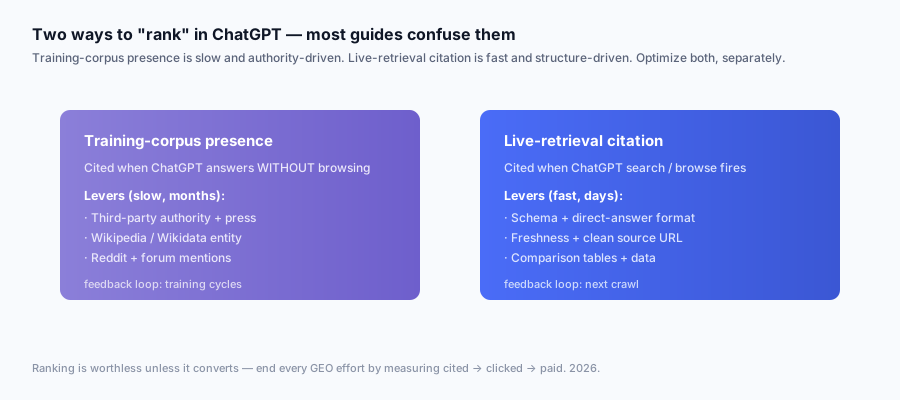
Here is the direct answer, because the rest of this article hangs on it. "Ranking in ChatGPT" is two unrelated mechanics wearing the same name. Training-corpus presence governs the answers ChatGPT generates from memory, with no browsing — it is slow to earn, decided by authority signals, and updates only when OpenAI ships a new model. Live-retrieval citation governs ChatGPT search and browse mode, which fetch live pages at query time — it is fast to earn, decided by page structure and freshness, and can pick up a new page within days. Optimize both. Expect different clocks.
Almost every "rank in ChatGPT" guide treats the model as a single black box you feed schema into. That is wrong, and the error is expensive because it leads people to expect fast results from slow levers and to give up on fast levers that were actually working. The two mechanics differ on nearly every axis that matters.
| Dimension | Training-corpus presence | Live-retrieval citation |
|---|---|---|
| Governs | No-browse chat answers from model memory | ChatGPT search + browse mode answers |
| Primary inputs | Authority, entity data, third-party mentions | Page structure, schema, freshness |
| Crawler involved | GPTBot (training ingestion) | OAI-SearchBot, ChatGPT-User |
| Time to first effect | Months to a year (next knowledge cutoff) | Days to weeks (next crawl) |
| Decay behavior | Slow, sticky once you are in the corpus | Fast, freshness-sensitive |
| Who you compete with | The whole indexed web, historically | Pages crawled recently on this query |
| Best levers | Reddit, Wikipedia, sameAs, press, age | Direct answer, FAQ schema, tables, updates |
| Measurability of effort | Very low (corpus is opaque) | Low-medium (crawl logs + prompt testing) |
| Honest expectation | Compounding, patient | Responsive, but volatile |
Read the "time to first effect" row twice. A page you publish today can be cited in ChatGPT search next week and still be completely unknown to the no-browse model for a year, because the no-browse model's knowledge froze at its last cutoff. This is why a reader will sometimes tell you "ChatGPT cited me!" and another will say "ChatGPT has never heard of my company" — they are describing two different surfaces.
The mapping from user behavior to mechanic matters too, because it tells you which one is even reachable for a given query.
| User asks ChatGPT… | Which mechanic answers | Can a new page win? |
|---|---|---|
| A timeless factual question, no browse | Training corpus | No, not until next cutoff |
| "What's the best X in 2026" with search on | Live retrieval | Yes, if structured + fresh |
| To "look up" or "find" something | Live retrieval (browse) | Yes |
| A question about a recent event | Live retrieval (forced) | Yes |
| About your brand by name, no browse | Training corpus (entity) | Only if you were in the corpus |
| A comparison it can answer from memory | Training corpus | No |
| A comparison it chooses to verify | Hybrid (memory + retrieval) | Partially |
The strategic consequence is simple and most people miss it: if your goal is to be recommended for "best [category] tool" queries, you are mostly fighting the live-retrieval game, and structure plus freshness win it on a weekly clock. If your goal is for ChatGPT to "know who you are" when asked directly with no browsing, you are fighting the training-corpus game, and only authority and time win it. Pick your battle per query, and never expect a schema change to fix a training-corpus problem.
That last node — measure cited to clicked to paid — is where the whole playbook lands, and it is the part the rest of the industry skips. Hold that thought; we will spend the back third of the article there.
The 10-step playbook overview
Here is the direct answer for the impatient. The ten steps below are ordered roughly fastest-to-slowest by time-to-effect, which also happens to be retrieval-levers first and training-corpus-levers later. Steps 1-3 and 6-8 buy you live-retrieval citations in days to weeks. Steps 4-5 and 9-10 buy you training-corpus presence and entity strength over months. Do them in order if you want early wins to fund patience for the slow ones.
| # | Step | Primary mechanic | Time to effect | Cost | Lift |
|---|---|---|---|---|---|
| 1 | Schema markup (Article + FAQPage) | Retrieval | Days-weeks | Free | High |
| 2 | Direct-answer formatting | Retrieval | Days-weeks | Free | High |
| 3 | Freshness + updated dates | Retrieval | Days | Free | Medium |
| 4 | Authority (links, press, age) | Training | Months | $$ | High |
| 5 | Reddit + Wikipedia seeding | Both | Weeks-months | Time | High |
| 6 | Comparison tables | Retrieval | Days-weeks | Free | Medium-high |
| 7 | Original data + statistics | Both | Weeks | Time | High |
| 8 | llms.txt | Retrieval | Days | Free | Low-medium |
| 9 | Entity disambiguation (sameAs) | Training | Weeks-months | Free | Medium-high |
| 10 | Internal links + topical depth | Both | Weeks | Free | Medium |
Notice how many of the high-lift moves are free. The GEO vendor market is largely selling labor and dashboards on top of work that costs hours, not dollars. The one thing money genuinely buys is step 4 — real authority — and even that is mostly earned, not purchased. The deeper version of this list, with the per-tactic effectiveness data, is in the GEO tactics playbook; what follows is one H2 per step.
Step 1: Schema markup that LLMs can actually extract
The direct answer: ship Article and FAQPage JSON-LD on every page, with at least four FAQ items whose name fields exactly match your visible H2 or H3 questions, plus Person and Organization blocks linked by @id. AI-cited pages carry four or more FAQ schema items on average versus one or two on uncited pages, per the Ahrefs and Semrush GEO research. Schema does not write good content for you, but it makes good content cheaply extractable, which is half the retrieval game.
Three schema types do the work for ranking in ChatGPT, and two more make them trustable.
| Schema type | What it does for ChatGPT | Priority |
|---|---|---|
FAQPage | Pre-extracts question-answer pairs matching query phrasing | Critical |
Article | Establishes headline, author, publish/modified dates | Critical |
HowTo | Supplies ordered steps for procedural queries | High on how-tos |
Person | Anchors author entity + credentials via sameAs | High |
Organization | Anchors brand entity for disambiguation | High |
The mechanical rule that trips everyone up: the FAQ schema name must match the visible on-page heading character-for-character. Drift between the rendered HTML and the JSON-LD gets flagged as inconsistent and the rich result drops. Here is the drop-in graph I put on every Attrifast post.
<script type="application/ld+json">
{
  "@context": "https://schema.org",
  "@graph": [
    {
      "@type": "Article",
      "@id": "https://yoursite.com/blog/your-slug#article",
      "headline": "Your Headline",
      "datePublished": "2026-05-26",
      "dateModified": "2026-05-26",
      "author": { "@id": "https://yoursite.com/about#person" },
      "publisher": { "@id": "https://yoursite.com/#organization" }
    },
    {
      "@type": "FAQPage",
      "mainEntity": [
        {
          "@type": "Question",
          "name": "Exact match to your on-page H3?",
          "acceptedAnswer": { "@type": "Answer", "text": "40-80 word answer." }
        }
      ]
    },
    {
      "@type": "Person",
      "@id": "https://yoursite.com/about#person",
      "name": "Your Name",
      "sameAs": [
        "https://www.linkedin.com/in/you/",
        "https://x.com/you",
        "https://github.com/you"
      ]
    },
    {
      "@type": "Organization",
      "@id": "https://yoursite.com/#organization",
      "name": "Your Brand",
      "sameAs": [
        "https://www.linkedin.com/company/yourbrand",
        "https://www.crunchbase.com/organization/yourbrand"
      ]
    }
  ]
}
</script>
What I do not ship: Review schema unless there is a real review on the page (faking it is a manual-action path), BreadcrumbList on flat blog posts (noise), or multiple Article blocks on one URL. One canonical Article, one FAQPage, one HowTo when relevant. Validate against Google's Rich Results test before shipping; it catches the overwhelming majority of structured-data errors. Schema-validation false negatives are rare; the common failure is silent drift between HTML and JSON-LD, which only a side-by-side check catches.
| Schema mistake | Consequence | Fix |
|---|---|---|
FAQ name differs from visible H3 | Rich result drops, weaker extraction | Copy heading verbatim |
No dateModified | Freshness signal lost | Update on every real edit |
Person and Org not linked by @id | Disconnected entity graph | Cross-reference with @id |
| Fewer than 4 FAQ items | Below the cited-page median | Write 4-6 real Q-A pairs |
Faked Review/Rating | Manual-action risk | Only mark up genuine reviews |
Step 2: Direct-answer formatting in the first 100 words
The direct answer, which is itself an example of the technique: lead every page and every H2 with a self-contained 40-80 word answer to the exact question the heading poses, then expand. LLMs lift these blocks nearly verbatim because they are pre-extracted, quotable, and survive being pulled out of context. This is the highest-leverage prose-level move for the retrieval surface, and the Princeton GEO research found quotation- and statistic-dense, directly-answering content meaningfully outperformed flowery alternatives.
The format has a specific shape worth being literal about.
| Element | Rule | Why ChatGPT likes it |
|---|---|---|
| Position | First 100-120 words of the section | Models weight lead passages |
| Length | 40-80 words | Fits a citation snippet cleanly |
| Self-containment | No "as discussed above" references | Survives extraction out of context |
| Header match | H2 phrased as the user's question | Matches query embedding |
| Specificity | A number or named entity if possible | Reads as canonical, not vague |
Question-shaped headers do real work here. "How do I rank in ChatGPT" out-performs "Ranking strategies" because it matches how people phrase prompts. Compare the two framings:
| Weak header | Strong header |
|---|---|
| Citation strategies | How do I get cited by ChatGPT? |
| Schema overview | What schema markup helps me rank in ChatGPT? |
| Measurement notes | How do I measure ChatGPT-driven revenue? |
| Pricing | How much does ChatGPT attribution cost? |
The honest caveat I have to repeat from my own experiments: prose-level rewrites alone — shorter sentences, more lists, more "what is X" framing — did not move citation rate above noise on my sites. The direct-answer block moved it; cosmetic tone changes did not. Structure beats style. Spend your editing time on the first 80 words of each section, not on sprinkling list items through the body.
Step 3: Freshness signals and the recrawl loop
The direct answer: on the live-retrieval surface, freshness is one of the more reliable signals you control. OAI-SearchBot and ChatGPT-User favor recently-modified pages on time-sensitive and "best in [year]" queries, and a genuine content update plus a visible "updated" date re-triggers crawling within days. Freshness does little for the training corpus in the short term, so treat it as a fast-surface lever, not a memory-surface one.
The mechanism is a loop, not a one-time push.
What counts as a real update versus a date-bump that crawlers increasingly discount:
| Update type | Counts as fresh? | Risk |
|---|---|---|
| Rewrote a section with new 2026 data | Yes | None |
| Added a new comparison row + sources | Yes | None |
Changed only the dateModified field | Weakly, decreasingly | Looks like date-spoofing |
| Added a "Last updated" line, no body change | No | Erodes trust if patterned |
| Genuinely revised stats and examples | Yes, strongly | None |
There is a query-class split worth planning around. On evergreen factual queries, freshness barely matters and a three-year-old canonical page can out-cite a new one. On "best X 2026," "is Y still worth it," or anything event-adjacent, freshness is close to decisive. Map your target queries to this split before you decide how often to refresh.
The practical workflow I run on my own properties is a quarterly refresh pass on the dozen or so pages that target year-stamped or comparison queries, plus an as-needed pass whenever a number in the body genuinely changes. The trap is treating freshness as a content-calendar checkbox — bumping every page's date on the first of the quarter whether or not anything changed. Crawlers have gotten better at noticing that pattern, and a page that claims to be updated monthly but never changes its body starts to look like exactly what it is. The signal that actually compounds is the one where crawl frequency rises on pages that get cited, which then surface more, which then earn more crawls. You want to feed that loop with real revisions, not cosmetic ones.
| Query class | Freshness weight | Refresh cadence |
|---|---|---|
| "Best [category] 2026" | High | Quarterly |
| "[Tool] vs [tool]" | Medium-high | Semi-annual |
| "How does X work" (evergreen) | Low | When genuinely stale |
| "Is X still good in 2026" | High | Quarterly |
| Definitional ("what is X") | Low | Rarely |
Step 4: Authority — the slow lever the corpus actually weights
The direct answer: training-corpus presence is bought with authority, and authority is mostly links, press, third-party mentions, and time — the same signals that have always mattered for Google, plus disproportionate weighting toward a few high-trust corpora. There is no fast version of this lever. A page on a domain with strong, earned authority gets pulled into training and retrieval more readily than an identical page on an unknown domain, and no amount of schema closes that gap on its own.
What "authority" decomposes into, ranked by how much it appears to move LLM behavior in the research:
| Authority signal | Effect on ranking | How to earn it |
|---|---|---|
| High-quality editorial backlinks | High (both mechanics) | Original data, useful tools |
| Presence in trusted corpora (Wikipedia, major media) | Very high (training) | Be genuinely notable |
| Brand-name search volume | Medium-high | Product + content over time |
| Domain age + consistency | Medium | Time; do not rebrand domains |
| Third-party reviews (G2, Capterra) | Medium | Real customers, real reviews |
| Topical depth on one subject | Medium-high | Cluster of canonical pages |
The honest part: if your article is the forty-seventh explainer of a saturated topic, perfect schema will not save you against a Wikipedia paragraph and three high-authority editorial pages. Structure amplifies authority; it does not manufacture it. This is why the bootstrapped-SaaS move is to pick narrow sub-topics where the authority bar is low and you can be the canonical page, rather than fighting incumbents on head terms. The AI search ranking factors breakdown goes deeper on how authority and structure trade off by query competitiveness.
| Your situation | Authority strategy |
|---|---|
| New domain, no links | Win narrow long-tail with structure + freshness |
| Some authority, broad topic | Build topical clusters, earn data-driven links |
| Strong domain, saturated head terms | Compete head-on; structure as tiebreaker |
| Strong domain, you own the niche | Defend with depth and original data |
Step 5: Reddit and Wikipedia seeding (the training-corpus shortcut)
The direct answer: Reddit and Wikipedia are disproportionately weighted in LLM training data and frequently cited in live answers, so an accurate, well-placed mention in either is one of the highest-leverage training-corpus moves available. This is not "spam Reddit." It is participating genuinely where your category is discussed, and ensuring the factual record about your brand on Wikipedia-adjacent properties is accurate and well-sourced. Done badly it backfires; done honestly it compounds.
The weighting is real and observed across multiple citation analyses — Reddit and Wikipedia show up in AI answers far out of proportion to their share of the web.
| Source | Why LLMs over-weight it | Realistic move |
|---|---|---|
| High human-discussion density, real opinions | Answer real threads in your niche honestly | |
| Wikipedia | Curated, sourced, entity-linked | Earn notability; let editors cover you |
| Wikidata | Machine-readable entity graph | Ensure your entry, if any, is accurate |
| Stack Overflow / GitHub | Authoritative for technical topics | Genuine answers, real repos |
| Quora | Moderate weight, declining | Low priority |
The discipline that separates this from spam:
| Do | Do not |
|---|---|
| Answer questions you genuinely know | Drop links in unrelated threads |
| Disclose affiliation when relevant | Astroturf with fake accounts |
| Add value before any mention | Lead with the pitch |
| Correct factual errors about your brand | Edit your own Wikipedia page directly |
| Cite primary sources in answers | Fabricate stats or reviews |
The deeper mechanics of how Reddit citations translate into measurable revenue are in the Reddit AI citations analysis, and the parallel for Wikipedia in the Wikipedia effect on AI visibility. Both make the same uncomfortable point I will make later: a citation that does not get measured to revenue is a story, not a result.
Step 6: Comparison tables LLMs love to lift
The direct answer: include at least one genuine, specific comparison table on any page targeting "X vs Y" or "best tool for Z" queries. LLMs parse tables into clean structured representations and preferentially lift them when a user asks a comparison question, because the table already contains the structured answer the model wants to return. In my tests, pages with an honest comparison table were cited noticeably more often on commercial-comparison queries than prose-only equivalents.
The shape that gets lifted versus the shape that gets skipped:
| Good comparison table | Bad comparison table |
|---|---|
| Specific, named competitors | Vague "Tool A / Tool B" |
| Honest about your weaknesses | Every row favors you |
| Concrete values (price, limits) | "Yes / No" with no nuance |
| 4-8 rows, scannable | 30 rows, unparseable |
| Real differentiators | Marketing adjectives |
A worked example of the difference, using the AI-attribution tool category I know best — note that it concedes real ground, which is exactly what makes it citable rather than dismissible as an ad:
| Tool | Measures clicks? | Measures revenue? | Cookieless? | Entry price |
|---|---|---|---|---|
| Attrifast | Yes | Yes (Stripe join) | Yes | $15/mo |
| Profound | No (citation monitoring) | No | n/a | $499+/mo |
| Plausible | Yes (referer only) | No | Yes | $9+/mo |
| GA4 + custom channel | Partial (referer only) | Partial | No | Free |
The reason that table is citable is the same reason the bad pattern is not: it tells the truth about what each tool does and does not do, including that GA4 is free and Plausible is cheaper. A model lifting it is giving its user a genuinely useful answer, which is the entire bar. A table where every row is a checkmark for your product reads as marketing and gets passed over for a more honest source.
The deeper reason tables out-cite prose on comparison queries is mechanical. When a user asks ChatGPT "what is the difference between X and Y," the model is trying to assemble a structured comparison, and a page that has already done that assembly hands it a finished answer it can lift with high confidence. Prose that buries the same comparison across three paragraphs forces the model to reconstruct the structure, which is lower-confidence work it would rather offload to a source that did it cleanly. So the table is not just easier to parse — it is closer to the exact output shape the model wants to produce, which is why it gets pulled. The corollary: put the comparison the user is actually asking about in a table, not the comparison you wish they were asking about. A pricing table when the query is about features wins you nothing.
Step 7: Original data and statistics
The direct answer: original statistics and data are one of the strongest citation magnets, because LLMs preferentially cite concrete numbers and a brand that owns a specific statistic becomes the canonical source for it. The Princeton GEO paper (Aggarwal et al, 2024) found that adding statistics and citing sources lifted AI visibility by roughly 30-40% — among the largest effects they measured. If you can publish a number nobody else has, you can become the answer to every query that number resolves.
The hierarchy of data, by citation value:
| Data type | Citation value | Effort |
|---|---|---|
| Original survey / study you ran | Very high | High |
| Aggregate from your own product data | Very high | Medium |
| Recomputed analysis of public data | High | Medium |
| Curated stat roundup with sources | Medium-high | Low-medium |
| Restated competitor stats | Low | Low |
This is the move behind a lot of what I publish about AI-engine attribution: numbers like "ChatGPT-attributed sessions convert at 1.4-2.1x Google organic on B2B SaaS" come from the Attrifast customer base, are disclosed with methodology, and are mine to own. When someone asks ChatGPT about ChatGPT conversion rates, a specific sourced number out-competes a hedge. The discipline that keeps this honest:
| Statistic discipline | Why it matters |
|---|---|
| Disclose sample size and period | Credibility; avoids overclaiming |
| State the methodology inline | Reproducibility signal |
| Update when the data changes | Stale stats erode trust |
| Never round up dishonestly | One caught fabrication kills authority |
| Link the underlying data when possible | Primary-source trust |
Step 8: llms.txt — small lever, zero downside
The direct answer: publish a curated llms.txt at your site root listing your most LLM-relevant pages with one-line descriptions. It is not a ranking signal the way a backlink is — it is a curated index that some AI crawlers read when present. Adoption is near 7% of public SaaS sites, so the marginal crawler that reads yours finds little competition. Thirty minutes of work for an unknown-but-plausibly-nonzero retrieval lift, and the downside is genuinely zero.
A working file for a SaaS:
# Attrifast

> Attrifast is a Stripe-native, cookieless revenue attribution tool for SMB SaaS and ecommerce. It splits ChatGPT, Perplexity, Claude, and Gemini referrals into revenue.

## Core pages
- [Revenue attribution](https://attrifast.com/features/revenue-attribution): How channel attribution works without third-party cookies.
- [Track ChatGPT traffic](https://attrifast.com/track-chatgpt-traffic): Detecting AI-engine referrals server-side.

## Recent posts
- [How to rank in ChatGPT](https://attrifast.com/blog/how-to-rank-in-chatgpt): The two ranking mechanics and the 10-step playbook.
Honest limitations, so nobody oversells it:
| llms.txt reality | Implication |
|---|---|
| Not every engine reads it | Treat as bonus, not core |
| No public "indexed" confirmation | You cannot verify lift directly |
| Informal spec | May change |
| Trivial to write | Do not pay a vendor for it |
I do not pay for "llms.txt automation" tooling. The file is markdown. Hand-write it once, review it quarterly. The full reasoning is in the get-cited playbook.
Step 9: Entity disambiguation so ChatGPT knows who you are
The direct answer: the model needs to tell your brand apart from similarly-named entities, and it does that through your sameAs graph — matched, consistent profiles across LinkedIn, X, GitHub, Crunchbase, and ideally Wikidata. Brands with four or more matched sameAs surfaces were roughly 3x more likely to be cited than disambiguation-poor brands in the Ahrefs entity research. This is mostly a training-corpus lever, and it is free.
The minimum viable matched set for a SaaS:
| Surface | Priority | Notes |
|---|---|---|
| LinkedIn company page | Required | Anchor entity |
| X / Twitter handle | Required | Common citation source |
| GitHub organization | High | Even if mostly empty |
| Crunchbase | High | Strong entity link |
| Wikidata | Highest impact, hardest | Earn notability first |
| Wikipedia | Aspirational | Need press citations first |
| G2 / Capterra | Medium | Real reviews only |
The whole game is mechanical consistency: the same brand name, the same canonical URL, the same handle everywhere, marked in both Organization.sameAs and Person.sameAs. Drift is what makes the entity ambiguous and lets the model confuse you with a near-collision name.
| Consistency check | Failure mode |
|---|---|
| Same legal name everywhere | "Attrifast" vs "Attrifast Inc" splits entity |
| Same canonical domain | www vs non-www dilutes signal |
| Same handle pattern | Different handles read as different orgs |
| sameAs in JSON-LD + bios | One-sided links are weaker |
Step 10: Internal links and topical depth
The direct answer: internal links and topical depth tell both ChatGPT mechanics that you are a serious, comprehensive source on a subject rather than a one-post tourist. A tight cluster of canonical pages that interlink — one page per concept, no duplicate cannibalizing pages — raises your odds of being the cited source on any query in that cluster. This compounds slowly and is free.
The structure that works:
| Pattern | Effect | Anti-pattern |
|---|---|---|
| One canonical URL per concept | Concentrates authority | Three near-duplicate posts |
| Pillar + supporting cluster | Topical depth signal | Orphan one-offs |
| Descriptive anchor text | Clarifies relationships | "Click here" |
| Links from high-authority pages | Passes internal equity | Footer link dumps |
| Cross-links between siblings | Maps the topic graph | No interlinking |
This article practices it: it links to track-chatgpt-traffic, the get-cited playbook, AI search ranking factors, the GEO tactics playbook, the ChatGPT referral analytics guide, Reddit AI citations, the Wikipedia effect, and revenue attribution — because the cluster, not the single post, is what ranks.
The cannibalization trap is the one that quietly costs you: if three of your pages target the same query, the model has to pick one and may pick none cleanly, splitting your authority. Audit for it.
| Symptom | Likely cause | Fix |
|---|---|---|
| Two pages rank for one query | Cannibalization | Consolidate or differentiate |
| Deep page never cited | Orphaned, no internal links | Link from pillar |
| Pillar too broad to cite | Trying to cover everything | Split into specific children |
The ranking-factor effectiveness table
Pulling it together. Here is every factor from the playbook scored on effectiveness, effort, time-to-effect, and which mechanic it serves. "Effectiveness" is qualitative — nobody publishes hard AI-citation CTR — and reflects my own tests plus the cited research. "High" means I have seen it move citation rate 2x or more or it shows large effects in the Princeton/Ahrefs/Semrush data; "medium" is measurable but smaller; "low" is real but noise-prone.
| Ranking factor | Effectiveness | Effort | Time to effect | Mechanic | Cost |
|---|---|---|---|---|---|
| Direct-answer block | High | Low | Days-weeks | Retrieval | Free |
| FAQPage + Article schema | High | Low | Days-weeks | Retrieval | Free |
| Original data / statistics | High | High | Weeks | Both | Free-$$ |
| Editorial backlinks (authority) | High | High | Months | Both | $$ |
| Wikipedia presence | Very high | Very high | Months+ | Training | Time |
| Reddit genuine participation | High | Medium | Weeks-months | Both | Time |
| Comparison tables | Medium-high | Low | Days-weeks | Retrieval | Free |
| Entity disambiguation (sameAs) | Medium-high | Low | Weeks-months | Training | Free |
| Freshness / updated dates | Medium | Low | Days | Retrieval | Free |
| Topical depth / internal links | Medium | Medium | Weeks | Both | Free |
| Question-shaped headers | Medium | Low | Days-weeks | Retrieval | Free |
| Inline primary-source citations | Medium | Low | Weeks | Both | Free |
| llms.txt | Low-medium | Low | Days | Retrieval | Free |
| Page speed / clean HTML | Low-medium | Medium | Weeks | Retrieval | Free |
| HowTo schema (procedural) | Medium | Low | Days-weeks | Retrieval | Free |
Two readings. First, the highest-effectiveness moves split cleanly: the free, fast ones (direct answer, schema, tables) win the retrieval surface, and the expensive, slow ones (Wikipedia, backlinks, Reddit) win the training corpus. You can buy early momentum with the first group while you wait out the second. Second — and this is the decision tree most people need — the right next move depends on which surface you are losing on.
If you are cited in search but invisible in no-browse answers, stop touching schema — that is a training-corpus problem and schema will not fix it. If you are invisible everywhere, start with structure because it is the cheapest and fastest signal to move.
How to measure if it is working (revenue, not just citations)
Here is the direct answer, and it is the whole reason this article exists. Ranking in ChatGPT is worthless if you cannot prove it drove revenue, and you cannot prove that with GA4, because GA4 buckets essentially 100% of ChatGPT clicks into Direct/(none) — the ChatGPT client strips the Referer header on outbound clicks and GA4 has no rule matching chatgpt.com. So the real success metric is not "are we cited" but "did cited turn into clicked turn into paid," measured server-side and cookieless. Most operators measure the first link of that chain and quietly skip the other two.
There are two measurement layers, and you need both.
| Layer | Question it answers | How |
|---|---|---|
| Presence | Do we rank / get cited? | Weekly manual prompt testing |
| Revenue | Did ranking make money? | Server-side AI-referrer + Stripe join |
Presence measurement is the layer the GEO industry actually does. Run your 20-30 target prompts through ChatGPT chat and ChatGPT search weekly, log whether your domain appears in the cited sources, and track the trend.
| Presence metric | What it tells you | Limitation |
|---|---|---|
| Citation rate (% of prompts citing you) | Whether you rank at all | No traffic, no revenue |
| Citation position (1st vs 5th source) | Slot quality | Volatile run-to-run |
| Share of voice vs competitors | Competitive standing | Snapshot only |
| Crawl frequency (OAI-SearchBot in logs) | Retrieval interest | Crawl ≠ citation |
Presence is necessary but it is a vanity metric on its own. Crawl is not citation; citation is not a click; a click is not a sale. Each arrow leaks.
Revenue measurement is the layer almost nobody closes, and it is Attrifast's whole reason for existing. The chain breaks at the click-to-site step because the referer is gone — so you need server-side detection that fingerprints the AI-engine referrer when present and infers it behaviorally when absent, then joins the session to a Stripe checkout.session.completed event. The mechanics are walked step by step in the track-ChatGPT-traffic guide and the ChatGPT referral analytics guide.
| Measurement approach | Catches | Misses | Revenue-joinable? |
|---|---|---|---|
| GA4 default | Almost nothing (all Direct) | ~100% of ChatGPT clicks | No |
| GA4 + custom channel regex | 15-20% with referer | The 80% stripped-referer slice | Partial |
| Manual prompt logging | Presence only | All traffic and revenue | No |
| Server-side first-party (Attrifast) | 85-95% of clicks + Stripe join | Voice, true zero-click | Yes |
The payoff of closing the loop is that "we rank in ChatGPT" becomes a dollar figure you can defend. Across the Attrifast base in Q1 2026, ChatGPT-attributed sessions converted at 1.4-2.1x equivalent Google organic on B2B SaaS — but that number only exists because the cited-to-clicked-to-paid chain was instrumented. The revenue attribution feature is the part that turns a ranking story into a defensible line item.
There is a sequencing point worth being explicit about, because operators get it backwards. Instrument the revenue layer before you start the ranking work, not after. If you wait until you are cited to turn on measurement, you have no baseline — you cannot tell whether the AI-attributed revenue that shows up was caused by your GEO work or was already there, hidden in Direct, the whole time. The founder in the opening anecdote learned this the expensive way: he had genuinely moved the needle, but with no pre-work baseline he could not separate his contribution from the background AI traffic the site was already getting. Turn on the cookieless first-party tracking in week zero, let it establish a baseline against your existing Direct bucket, then run the ten steps and watch the AI-engine line move against a number you can trust. The measurement is not the victory lap; it is the control group.
| What you can say with each layer | Defensible at a board meeting? |
|---|---|
| "We're cited in ChatGPT for 12 queries" | Weakly — it's a vanity stat |
| "ChatGPT sent us 1,800 sessions" | Better, but where's the money? |
| "ChatGPT drove $1,545/mo at $0.84 RPV" | Yes — this survives scrutiny |
Common mistakes when trying to rank in ChatGPT
Eight patterns I see often enough to name, with the fix for each.
| # | Mistake | Why it fails | Fix |
|---|---|---|---|
| 1 | Conflating the two mechanics | Expecting schema to fix no-browse invisibility | Diagnose which surface you're losing |
| 2 | Blocking GPTBot to "protect content" | Kills training presence, keeps live-fetch | Allow all three crawlers |
| 3 | Measuring citations, never revenue | Vanity metric; no defense at review | Instrument cited→clicked→paid |
| 4 | Date-bumping without real updates | Crawlers discount fake freshness | Genuinely revise the body |
| 5 | One sprawling pillar for everything | Too broad to cite on specifics | Split into narrow canonical children |
| 6 | Faking reviews or stats | One catch destroys authority | Only mark up genuine data |
| 7 | Self-serving comparison tables | Reads as ad, gets skipped | Concede real weaknesses |
| 8 | Cannibalizing pages | Splits authority, model picks none | Consolidate per concept |
A few deserve a sentence more. Mistake 1 is the master mistake the whole article fights: someone reads "schema gets you cited," ships schema, sees no change in no-browse answers, and concludes GEO is fake — when the truth is they applied a retrieval lever to a training-corpus problem. Mistake 3 is the one that costs money invisibly: you can do everything right, genuinely rank, and still get the channel defunded because GA4 attributed all of it to Direct and nobody could prove it earned anything. And mistake 2 is the self-inflicted wound I see most on developer-heavy teams who reflexively block crawlers — blocking GPTBot specifically is the worst option because it keeps you crawlable for live answers while quietly removing you from the training corpus that powers the no-browse recommendations.
| Crawler | Block it? | Consequence of blocking |
|---|---|---|
| GPTBot | No | Loses training-corpus presence |
| ChatGPT-User | No | Loses live-fetch citations |
| OAI-SearchBot | No | Loses ChatGPT search index presence |
What this looks like inside Attrifast
A short, honest note on the product, because the article cannot pretend the author is disinterested. Attrifast does not do GEO. It does not generate your schema, write your llms.txt, or seed your Reddit threads — the ten steps above are yours to run, and most are free. What Attrifast does is the measurement layer underneath: when someone clicks a ChatGPT citation, lands on your site with the referer stripped, and pays via Stripe two weeks later, the 4 KB cookieless script and the Stripe webhook join surface that as chatgpt in your channel column instead of (direct).
| Attrifast does | Attrifast does not do |
|---|---|
| Detect AI-engine referrers server-side | Generate schema or content |
| Join sessions to Stripe revenue | Write your llms.txt |
| Split ChatGPT / Perplexity / Claude / Gemini | Monitor citations (use Profound for that) |
| Run cookieless, no consent banner | Promise you rankings |
Cost is $15/mo. The first-person reason I built it is that I was the founder in the opening anecdote, watching Direct/(none) climb and unable to say whether it was a brand moment or unattributed AI traffic. It was unattributed AI traffic. The revenue attribution feature page walks the architecture; the track-ChatGPT-traffic guide has the detection code.
Limitations
Five things this article does not cover, so you do not extrapolate past the evidence.
- OpenAI does not publish a ranking algorithm. Every "ranking factor" here is correlational, drawn from third-party GEO research and my own tests, not a confirmed mechanism. Treat them as informed bets, not deterministic levers.
- The training-corpus timeline is opaque. Nobody outside OpenAI knows exactly when or how the next corpus cuts. The "months to a year" estimate is inferred from observed model-release cadence and could change.
- Voice-mode answers are unmeasurable. When ChatGPT speaks an answer without rendering a clickable link, the recommendation happens but no traffic does. No reliable attribution story exists for voice yet.
- The RPV multiplier is a Q1 2026 SaaS snapshot. As ChatGPT's user base broadens toward general-consumer, the intent-quality premium will likely compress. Re-measure quarterly; treat 1.4-2.1x as directional.
- Numbers are US-English-skewed. The citation-weighting, freshness, and conversion observations come mostly from US English data. Multilingual GEO likely follows the same structural rules with different empirical lifts.
FAQ
How do I rank in ChatGPT?
There is no single "rank." Ranking in ChatGPT is two separate mechanics. Training-corpus presence is slow and earned through authority signals — Wikipedia, Reddit, consistent entity data, third-party mentions — and it governs answers the model produces without browsing. Live-retrieval citation is fast and earned through structure — schema, direct-answer formatting, freshness, and clean canonical URLs — and it governs the ChatGPT search and browse surfaces. Most guides conflate the two. Optimize for both, but expect the structural plays to show results in weeks and the authority plays to show results in months.
How long does it take to start appearing in ChatGPT answers?
It depends which mechanic you are targeting. The live-retrieval surface (ChatGPT search, browse mode) can pick up a well-structured, freshly-published page within days to a few weeks of OAI-SearchBot crawling it. The training-corpus surface lags far behind, because it only updates when OpenAI ships a new model or knowledge cutoff — that is a multi-month-to-annual cadence. So a brand-new page can be cited in browse mode next week and still be invisible to the no-browse model for a year. Plan for both timelines.
Does ChatGPT have ranking factors like Google?
Not in the documented, deterministic sense Google has. There is no published algorithm and no rank-tracking API from OpenAI. But across the GEO research from Ahrefs, Semrush, and the Princeton GEO paper (Aggarwal et al, 2024), a consistent set of observable factors correlates with citation: question-shaped headers, a direct answer in the first 100-120 words, FAQ and Article schema, inline citations to primary sources, statistics and quotations, entity disambiguation via sameAs, and freshness. Treat these as correlational ranking factors, not a confirmed algorithm.
What is the single most effective thing I can do to get recommended by ChatGPT?
For the fast, live-retrieval surface: ship a self-contained direct-answer block of 40-80 words at the top of the page, in front of FAQPage and Article JSON-LD whose questions exactly match your visible H2s. That combination is the highest-leverage structural move in every test I have run and in the Princeton GEO results, where citing sources and adding statistics lifted visibility 30-40%. For the slow, training-corpus surface: get an accurate, well-sourced mention into Reddit and Wikipedia-adjacent properties, because those two corpora are disproportionately weighted in LLM training data.
Should I block GPTBot if I want to rank in ChatGPT?
No, not if ranking is the goal. GPTBot is the training crawler — blocking it removes you from future training corpora, which slowly degrades how often the no-browse model recommends you. It does not block ChatGPT-User (the live-fetch agent) or OAI-SearchBot (the search index crawler), so blocking GPTBot is the worst of both worlds: you keep getting crawled for live answers but lose your long-term training presence. Allow all three unless you have a specific legal or licensing reason not to.
How do I know if my ChatGPT ranking efforts are actually working?
Two layers. Presence: weekly, run your 20-30 target prompts through ChatGPT (chat and search modes) and log whether your domain is cited. That tells you whether you rank. Revenue: instrument server-side first-party attribution that detects AI-engine referrers and joins the session to a Stripe payment. That tells you whether ranking is worth anything. Most operators measure only presence and never close the loop to revenue, which is how a "we rank in ChatGPT now" win quietly becomes a channel nobody can defend at the next board meeting.
Does llms.txt help me rank in ChatGPT?
Modestly, and not the way most people assume. llms.txt is not a ranking signal the way a backlink is. It is a curated index of your most LLM-relevant pages that some AI crawlers read when present. Adoption is low (~7% of public SaaS sites in Q1 2026), so the marginal crawler that reads it finds little competing content. It is 30 minutes of work for an unknown-but-plausibly-nonzero lift on the retrieval surface. It does almost nothing for training-corpus presence. Ship it because the downside is zero, not because it is a silver bullet.
Why do I rank in ChatGPT search but not in the default no-browse answers?
Because those are two different mechanics. ChatGPT search and browse mode retrieve live pages at query time, so a fresh, well-structured page can surface within days. The default no-browse answer is generated from the model's frozen training corpus, which only updated at the last knowledge cutoff. If your page was published after that cutoff, the no-browse model literally does not know it exists yet. The fix is patience plus authority signals (Reddit, Wikipedia, consistent entity data) that increase the odds you make the next training cut.
Do comparison tables help me get cited by ChatGPT?
Yes, disproportionately. LLMs parse tables into clean structured representations, and a head-to-head comparison table is exactly the shape a model wants to lift when a user asks "X vs Y" or "best tool for Z." In my own tests, pages with at least one genuine comparison table were cited noticeably more often on commercial-comparison queries than prose-only equivalents. The caveat: the table has to be honest and specific. A vague or self-serving table reads as marketing and gets skipped.
Can I pay to rank higher in ChatGPT?
Not in the organic citation surface, as of early 2026. OpenAI has experimented with ads and commerce surfaces, but the inline source citations in chat and search answers are not a paid placement you can buy your way into. Ranking there is earned through structure, authority, and freshness. Treat any vendor promising "guaranteed ChatGPT rankings" for a fee the same way you would treat one promising guaranteed Google #1 — with deep suspicion.
How many sources does ChatGPT cite per answer, and how do I become one of them?
ChatGPT search answers typically cite 3-5 sources, sometimes more on broad queries. The slots are scarce, so you are competing for a top-handful position, not a top-10. To win a slot you need to be the most canonical-shaped, most directly-answering, freshest page on the specific sub-question — not the broadest page on the general topic. Narrow, specific, well-structured pages out-cite sprawling pillar pages on the exact long-tail queries users actually type into ChatGPT.
Does updating old content help me rank in ChatGPT?
Yes, for the live-retrieval surface. Freshness is one of the more reliable observable signals: OAI-SearchBot and ChatGPT-User favor recently-modified pages on time-sensitive queries, and a visible "updated" date plus a genuinely revised body re-triggers crawling. It does little for the training-corpus surface in the short term. The honest version: update content because the page is stale and users deserve current information, and take the retrieval-freshness bump as a bonus, not the reason.
Is ranking in ChatGPT worth it for a small SaaS or store?
Often yes, but only if you measure it. ChatGPT-attributed sessions converted at 1.4-2.1x equivalent Google organic on the B2B SaaS sites I measure, because the visitor arrives pre-educated by a partial answer. For DTC ecommerce the multiple inverts — Google organic converts better because impulse mechanics favor it. So "worth it" is category-dependent and only knowable once you instrument cited→clicked→paid. Ranking without measurement is a vanity metric.
Related reading from the Attrifast research stack
For more on connected topics, see How to Analyze Your Competitors' AI Visibility (and Beat Them in 2026), ChatGPT Cited My Competitor, Not Me: An Honest Diagnosis, How to Submit Content to AI Search Engines for Faster Discovery in 2026, and How to Get Recommended by ChatGPT: A 10-Step Playbook for 2026.
For the practical detection code that turns these citations into attributed revenue, see the track-ChatGPT-traffic guide and the ChatGPT referral analytics guide. For the broader factor breakdown, the AI search ranking factors post and the GEO tactics playbook are the companions. To close the loop from citation to dollars, the revenue attribution feature page walks the architecture end to end.