
Part of the AI Search Hub — browse all 35 AI Search guides.
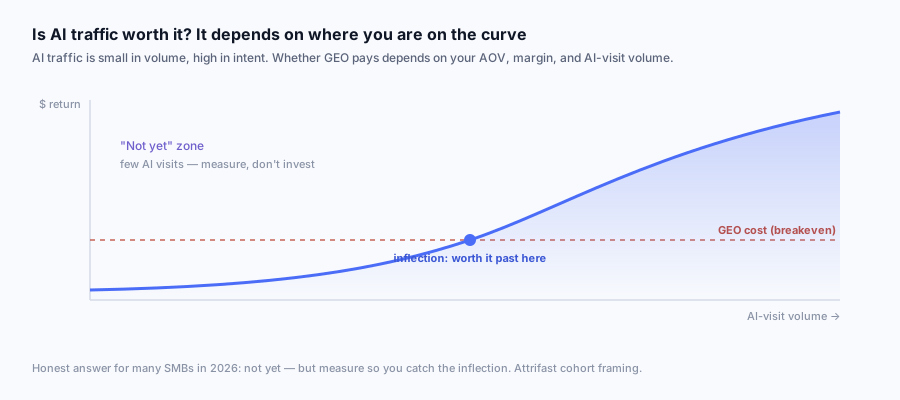
In late 2024 I almost killed a content program that was quietly working.
I was running my own SaaS, and the blog was a cost center on the spreadsheet. Long-tail posts ranked nowhere notable in Google, organic clicks to them were a trickle, and the obvious move on the quarterly review was to stop writing and reallocate the hours to paid. I had the defunding slide built. The only reason I did not pull the trigger was that my Direct/(none) bucket had grown from 19% to 31% over two quarters with no campaign behind it, and the inconsistency bugged me enough to dig in before cutting.
The "Direct" growth was AI. ChatGPT and Perplexity had started citing exactly those low-Google-traffic long-tail posts, and the clicks were arriving with no referer, so Google Analytics filed them under Direct. When I finally stitched the sessions to Stripe payments, the posts I was about to defund turned out to be the highest revenue-per-visitor pages on the site. I had been one slide away from cutting the thing that was actually converting.
That experience is why I am suspicious of confident answers to the question this article is about. "Is AI traffic worth it?" gets two equally useless responses in 2026. The hype camp says AI is the future and you must invest now or die. The dismissive camp says it is a rounding error and a distraction from real SEO. Both are wrong in the same way: they answer a question that has no single answer. The right answer depends on what you sell, what a customer is worth to you, and whether your buyers have already moved their research into AI tools. This piece is my attempt to answer it honestly, with the revenue data from 200 Stripe-connected sites behind it[], and with a decision framework and a breakeven calculation you can run on your own numbers in ten minutes.
If you want the full dataset behind the numbers I cite here, it lives in the 2026 AI search revenue benchmark. This article is the decision-making companion to that data dump: less "here is every cut of the numbers," more "here is how to decide what to do about them."
The short, honest answer
Is AI traffic worth it? For most SMBs in 2026 the honest answer is "it depends, and for a meaningful share of you the answer right now is 'not yet, but soon.'" AI traffic is small in absolute volume but unusually high in intent and revenue per visit. Whether the GEO investment pays back hinges on three things: your average order value, your margin, and how much your buyers already use AI tools to research what you sell.
I am going to spend the rest of this article defending that paragraph, because the nuance in it is the whole point. The hype answer and the dismissive answer are both attempts to collapse a genuinely conditional question into a one-word verdict, and that collapse is exactly where operators make expensive mistakes — either over-investing in GEO for a business AI does not serve, or defunding content AI is quietly monetizing.
Here is the same answer as a decision table, which is how I actually think about it with the businesses I talk to.
| Your situation | Is AI traffic worth it? | What to do |
|---|---|---|
| B2B SaaS, buyers research in AI, >300 AI sessions/mo | Yes, clearly | Measure + modest GEO investment now |
| B2B SaaS, early stage, <50 AI sessions/mo | Not yet, but soon | Measure now, defer GEO spend |
| Services / agency, considered purchase | Usually yes | Measure + GEO on commercial pages |
| Ecommerce, considered / high-AOV products | Maybe | Measure; GEO secondary to SEO |
| Ecommerce, pure impulse / low-AOV | Mostly no | Instrument cheaply, do not re-architect |
| Local services (HVAC, plumbing, dentist) | Mostly no | AI does not own the surface; skip GEO |
| Regulated YMYL (healthcare, legal, finance) | Rarely, varies | AI often declines; measure, do not invest |
The table is the article in miniature. Everything below is the reasoning and the data that puts each row where it is.
It also helps to name the two unhelpful answers explicitly, because you will hear both, often from people selling something.
| Camp | Their claim | What they get right | What they get wrong |
|---|---|---|---|
| Hype | "AI is the future, invest now" | Growth rate is real and fast | Ignores volume and cost reality |
| Dismissive | "AI is a rounding error" | Volume is genuinely small today | Ignores intent, revenue, trajectory |
| Honest (this article) | "It depends; measure first" | Both data points; decides per business | Less tweetable than either |
The honest position is less satisfying than either extreme, which is precisely why it is right. The extremes are easy to state because they refuse to look at your specific numbers. The honest answer requires your numbers, which is the work most people skip.
Volume vs value: AI traffic's defining tension
AI traffic's defining characteristic in 2026 is that it is small in volume and large in value. Across my 200-site cohort, AI engines drive a median ~6% of sessions, dwarfed by Google. But they over-index on revenue — 9.4% of sessions converting to 13.7% of revenue on B2B SaaS — because conversion rates and order values both run higher. Judging AI traffic on volume alone is the most common analytical mistake I see.
The single biggest reason people get this question wrong is that they evaluate AI traffic the way they evaluate every other channel: by counting sessions. By that measure AI looks tiny. Google still handles roughly 8.5 billion searches a day[]. ChatGPT's query volume, even at 800 million weekly active users[], is a fraction of that. If you rank channels by raw clicks, AI sits near the bottom for most sites, and the dismissive camp's "rounding error" framing looks correct.
But sessions are an input, not an outcome. The outcome is revenue, and AI traffic's revenue contribution is consistently larger than its session share. Here is the over-indexing pattern across my cohort by vertical[].
| Vertical | AI share of sessions | AI share of revenue | Over-index ratio |
|---|---|---|---|
| B2B SaaS | 9.4% | 13.7% | 1.46x |
| Services / agencies | 6.2% | 8.4% | 1.35x |
| Creators / publishers | 7.8% | 6.1% | 0.78x |
| Ecommerce | 4.1% | 5.8% | 1.41x |
| Cohort blended | ~6% | ~8.7% | ~1.45x |
Three of four verticals show AI revenue share exceeding AI session share — meaning each AI session is worth more than the average session. Creators/publishers are the exception, and the reason is instructive: their revenue depends on retained, habitual readers reached through email, and AI traffic skews single-session, so it under-converts relative to their baseline. The over-indexing is not magic; it is intent quality showing up in the numbers, and where intent quality does not help (single-session-hostile business models), the over-index disappears.
The volume-vs-value tension produces a counterintuitive rule: the smaller AI traffic is as a share of your sessions, the more carefully you should value each one. A channel that is 6% of sessions but 1.45x over-indexed on revenue is worth roughly 9% of revenue — which would put it ahead of email and paid search at many SMBs. You do not get to that conclusion by counting clicks.
Here is the same tension expressed as the two questions you actually need to answer.
| Question | What it measures | Why it matters for "worth it" |
|---|---|---|
| How many AI sessions do I get? | Volume | Sets the ceiling on total AI revenue |
| What is each AI session worth? | Value (RPV) | Sets whether the volume is worth chasing |
| How fast is the volume growing? | Trajectory | Sets whether to invest now or wait |
| What does the investment cost? | Effort + tooling | Sets the breakeven threshold |
Most "is AI worth it" debates only argue about the first question. The answer lives in the interaction of all four.
To make the per-engine value concrete, here is the blended revenue-per-visitor ranking across my cohort, which is the cleanest single expression of "value per session."
| Engine | Blended RPV | Session share | The tension in one row |
|---|---|---|---|
| Perplexity | $1.42 | 8% | Highest value, smallest reach |
| Claude | $1.18 | 6% | High value, niche reach |
| ChatGPT | $0.87 | 71% | Moderate value, dominant reach |
| Gemini | $0.41 | 12% | Low value, search-like behavior |
| AI Overviews | $0.29 | 3% | Lowest value, embedded surface |
The inversion between value and reach is the whole tension in one table: the engine that sends the most traffic (ChatGPT, 71%) is not the engine with the highest value per visit (Perplexity, $1.42). A worth-it analysis that only looks at the biggest engine misjudges the channel.
Does AI traffic convert? The conversion data
Yes, on considered purchases — and that is the crux of the worth-it question. On 118 B2B SaaS sites, blended AI traffic converts to a Stripe payment at 2.7% versus 1.4% for Google organic on the same landing pages, roughly 1.9x higher. The driver is intent: an AI visitor has already read a synthesized answer. But the pattern reverses on ecommerce, where Google organic out-converts AI. Conversion is vertical-dependent, not universal.
This is the number that turns "is AI traffic worth it" from a vibe into a calculation. If AI traffic converted like average traffic, the small volume would make it genuinely ignorable. It does not. Here is the per-engine conversion picture on B2B SaaS, the vertical where the effect is strongest[].
| Engine | Conversion rate (B2B SaaS) | Lift vs Google organic |
|---|---|---|
| Claude | 4.7% | +2.8x |
| Perplexity | 4.1% | +2.4x |
| ChatGPT | 3.2% | +1.9x |
| Gemini | 1.6% | -0.1x |
| AI Overviews | 1.4% | -0.2x |
| Google organic (reference) | 1.7% | 1.0x |
Two things jump out. First, the chat-native engines (Claude, Perplexity, ChatGPT) all beat Google organic, and the gap is large. Second, Gemini and AI Overviews — both Google-surface AI — convert below Google organic, because their traffic behaves more like a degraded search result than a high-intent citation click. "AI traffic" is not one thing; the chat engines and the search-embedded AI surfaces are different channels with different conversion profiles.
Now the ecommerce picture, which is where the dismissive camp gets a real point.
| Engine | Conversion rate (ecommerce) |
|---|---|
| Perplexity | 2.4% |
| Claude | 1.9% |
| ChatGPT | 1.7% |
| Gemini | 1.1% |
| AI Overviews | 0.9% |
| Google organic (reference) | 2.1% |
On ecommerce, Google organic (2.1%) sits in the middle of the AI pack — beating ChatGPT, Gemini, and AI Overviews, beaten only by Perplexity and roughly tied with Claude. The intent-quality advantage that dominates on B2B SaaS largely evaporates on impulse retail, where the buying journey is short and retargeting and cart mechanics do the heavy lifting — a pattern echoed in retail analytics on AI-sourced shopping traffic[]. This is exactly why the honest answer to "does AI traffic convert" is "depends what you sell." It converts beautifully for considered purchases and unremarkably for impulse ones.
The intent mechanism is worth stating plainly, because it explains both the upside and the boundary conditions.
The pre-reading is the whole story. A blue-link clicker arrives cold. An AI-citation clicker arrives having already absorbed a partial answer that frequently includes a comparison, a recommendation, or a framing that pre-qualifies them. On a considered purchase that pre-qualification compounds into higher conversion, higher order value, and lower churn. On an impulse purchase there was nothing to pre-qualify, so the advantage does not materialize.
There is one more conversion nuance that decides whether AI traffic clears the bar on a given page: AI traffic lands deep, not on the homepage, and converts only when the deep page can close on its own.
| Landing-page type | AI conversion rate | Notes |
|---|---|---|
| Pricing / checkout | 8.1% | Highest-intent entry |
| Top-nav inner page (feature, comparison) | 4.7% | Strong if context is clear |
| Deep blog page with inline CTA | 3.2% | The common AI entry point |
| Deep blog page with no inline CTA | 0.9% | The leak most SMBs have |
| Homepage | 2.3% | Rare for AI traffic |
The 0.9% vs 3.2% gap on the same deep-blog page type — one with an inline CTA, one without — is a 3.5x swing, and it is the single cheapest conversion fix for AI traffic. Since 71% of ChatGPT sessions land on a deep page, a blog template designed for the old homepage-first world quietly throttles AI conversion. Fixing it is mechanical and helps before you spend a dollar on GEO content.
I cover the conversion mechanics in more depth in the AI traffic conversion rate benchmarks piece, and the head-to-head intent comparison in ChatGPT vs Google traffic quality. For this article the takeaway is narrow: AI traffic converts well enough on considered purchases that its small volume becomes worth chasing, and not well enough on impulse retail to justify re-architecting around it.
The intent premium: order value and retention
AI traffic does not just convert more often on considered purchases — it buys bigger and stays longer. In my cohort, AI-sourced first-time buyers spent 43% more than Google-organic buyers on ecommerce and 54% more on SaaS first-month value, and they churned and refunded less. The "is it worth it" math has to count these second-order effects, not just the conversion rate, or it understates AI's value.
If you stop at conversion rate you miss half the value. The same intent-quality effect that lifts conversion also lifts order value and retention, and those compound over a customer lifetime. Here is the first-purchase premium.
| Source | Ecommerce AOV | SaaS first-month value |
|---|---|---|
| Perplexity | $112.40 | $51.20 |
| Claude | $96.20 | $57.40 |
| ChatGPT | $87.40 | $44.10 |
| Direct (de-AI-ed) | $73.10 | $39.80 |
| $69.80 | $36.50 | |
| Google organic | $61.20 | $28.70 |
| Gemini | $58.30 | $23.40 |
| Paid search | $48.60 | $26.40 |
And the retention side, which matters most for subscription businesses where lifetime value is the real prize.
| Source | 30-day refund rate (ecom) | 30-day churn rate (SaaS) |
|---|---|---|
| AI-engine (blended) | 3.8% | 9.2% |
| Direct (de-AI-ed) | 4.2% | 11.3% |
| 4.7% | 10.4% | |
| Google organic | 6.1% | 14.4% |
| Paid search | 8.4% | 18.9% |
| Organic social | 11.2% | 22.7% |
AI-sourced SaaS customers churn at 9.2% in the first 30 days versus 14.4% for Google organic. On an LTV horizon that gap is larger than the conversion-rate gap, because retention compounds. A customer who is 35% less likely to churn in month one is worth materially more than the headline conversion number alone implies.
So when you ask "is it worth it," the value side of the ledger has three stacked premiums, not one.
| Premium | B2B SaaS | Ecommerce | Why it exists |
|---|---|---|---|
| Conversion rate | ~1.9x | ~0.8x | Pre-informed buyers decide faster |
| First-purchase value | +54% | +43% | Pre-informed buyers pick bigger plans |
| Retention (lower churn) | -36% churn | -38% refunds | Better-matched buyers stick |
The conversion premium is the one people cite. The order-value and retention premiums are the ones that make AI traffic genuinely undervalued when you run the worth-it math correctly — and the ones that vanish on impulse retail, where there is no considered decision to reward.
The three premiums stack into a lifetime-value gap that is much larger than any single metric suggests.
The diagram is the argument against judging AI traffic by conversion rate alone: each step down the AI path compounds on the last, so by the time you reach lifetime value the gap is several multiples, not the 1.9x the conversion number shows. A blended LTV-per-session estimate makes the stacking concrete.
| Source | Relative conversion | Relative first-purchase | Relative retention | Implied LTV-per-session index |
|---|---|---|---|---|
| AI (B2B SaaS, blended) | 1.9x | 1.54x | 1.36x | ~4.0x |
| Google organic (reference) | 1.0x | 1.0x | 1.0x | 1.0x |
| AI (ecommerce, blended) | 0.8x | 1.43x | 1.06x | ~1.2x |
The LTV index is a rough multiplication of the three premiums, not a measured number, so read it as directional. But even discounted heavily, the B2B SaaS figure says an AI session is worth multiples of a Google-organic session over a customer lifetime — which is the real reason the small volume is worth chasing.
The cost side of GEO (the part hype articles skip)
GEO is not free, and the honest worth-it answer requires costing it. The real costs are content time, structural formatting work, tooling, and the opportunity cost of not spending those hours on SEO that serves a larger audience today. For most SMBs the fully-loaded GEO cost is modest — a few content hours a month plus cheap tooling — but it is not zero, and below a volume threshold it exceeds the AI revenue it produces.
Almost every article telling you AI traffic is worth it forgets to put a price tag on the work. You cannot answer a worth-it question without the cost side. Here is what GEO actually costs an SMB, broken out.
| Cost component | Typical SMB range | Notes |
|---|---|---|
| Content formatting for citation | 1-3 hrs per article | FAQ blocks, clear claims, tables |
| New AI-targeted content | 4-8 hrs per piece | Net-new, on top of SEO content |
| Structural / template work | 4-12 hrs one-time | Inline CTAs on deep pages, schema |
| Measurement tooling | $9-$499/mo | From Plausible to Attrifast to Profound |
| Citation monitoring (optional) | $99-$499/mo | Profound, Otterly, etc. |
| Opportunity cost | Variable | Hours not spent on higher-volume SEO |
The opportunity-cost row is the one hype articles never mention. Every hour you spend optimizing for a channel that drives 6% of sessions is an hour not spent on the channel driving the other 94%. For a site with low AI volume that trade is a net loss, full stop. The reason GEO is still usually worth doing is that most of the work overlaps with SEO — a well-structured, factually-clear, FAQ-equipped article ranks better in Google and gets cited more in AI, so the hours are not purely GEO hours. But the overlap is not 100%, and pretending the marginal GEO work is free is how people talk themselves into over-investing.
Here is the cost framing that actually matters: the fully-loaded monthly GEO cost for a typical SMB doing a modest program.
| Effort level | Monthly content hours | Tooling | Fully-loaded cost (at $75/hr) |
|---|---|---|---|
| Measure only | 0 | $15/mo | ~$15/mo |
| Light (format existing) | 4 | $15/mo | ~$315/mo |
| Moderate (format + some net-new) | 8 | $15/mo | ~$615/mo |
| Heavy (dedicated GEO content) | 20 | $114/mo | ~$1,614/mo |
The "measure only" row is the one I push hardest for low-volume sites, and it is the entire wedge of my argument: measurement is cheap, optimization is not, so the correct sequence for an uncertain business is measure first, then let the data tell you when to spend on optimization. You do not need to guess whether AI traffic is worth it. You need to instrument it cheaply and let the breakeven math answer the question with your own numbers.
It is also worth comparing the tooling tiers honestly, because "GEO tooling" spans a 50x price range and the expensive tiers are not for SMBs deciding the worth-it question.
| Tool tier | Example | What it answers | Price | Right for "is it worth it"? |
|---|---|---|---|---|
| First-party analytics | Plausible, Fathom | Are AI sessions arriving? | $9-$15/mo | Partial (no revenue join) |
| Revenue attribution | Attrifast | Do AI sessions convert + RPV? | $15/mo | Yes — answers the math directly |
| Citation monitoring | Profound, Otterly | Is my brand cited in answers? | $99-$499/mo | No (upstream of revenue) |
| Enterprise GEO suite | Profound Pro | Citation share at scale | $499+/mo | Overkill for SMB decision |
For the worth-it decision specifically, you need the revenue join — sessions plus conversion plus RPV — which is the $15/mo tier. The citation-monitoring tools answer a different and earlier question (am I mentioned), not the question this article is about (does it pay).
The breakeven calculation
The worth-it question reduces to one formula: monthly AI sessions × conversion rate × revenue per conversion = monthly attributable AI revenue, compared against your fully-loaded GEO cost. Run it on your recovered AI session count — not the GA4 number, which under-counts by a median 64% — and the answer for your specific business falls out in ten minutes. AOV and conversion rate are the dominant swing factors.
This is the part I wish more people did before forming an opinion. The math is not hard, and it converts a debate into an answer specific to your business.
The formula:
Monthly attributable AI revenue = AI sessions × conversion rate × revenue per conversion

Worth it if: AI revenue > fully-loaded monthly GEO cost
Let me run it across a range of realistic SMB profiles so you can find the row closest to yours.
| Profile | AI sessions/mo | Conversion | Rev/conv | AI revenue/mo | GEO cost/mo | Worth it? |
|---|---|---|---|---|---|---|
| Early SaaS, low volume | 50 | 2.5% | $44 | $55 | $315 | No, not yet |
| Growing SaaS | 300 | 2.5% | $44 | $330 | $315 | Breakeven |
| Established SaaS | 800 | 2.7% | $90 | $1,944 | $615 | Yes, clearly |
| High-ACV B2B SaaS | 200 | 3.0% | $400 | $2,400 | $615 | Yes, strongly |
| Mid ecommerce | 600 | 1.6% | $87 | $835 | $615 | Marginal yes |
| Low-AOV impulse ecom | 1,000 | 1.5% | $22 | $330 | $615 | No |
| Services / agency | 150 | 3.7% | $600 | $3,330 | $615 | Yes, strongly |
| Local services | 30 | 2.0% | $300 | $180 | $315 | No |
Read the table for the patterns, not the exact dollars. The high-ACV B2B SaaS row clears the bar at just 200 sessions because each conversion is worth $400 — AOV is doing the heavy lifting. The low-AOV impulse ecom row fails at 1,000 sessions because each conversion is worth only $22. The early SaaS row fails not because AI is bad but because the volume is not there yet — which is exactly the "not yet, but soon" case.
The breakeven session threshold, holding GEO cost at a moderate $615/mo, looks like this by revenue-per-conversion.
| Revenue per conversion | Conversion rate | Breakeven AI sessions/mo |
|---|---|---|
| $20 | 2.0% | ~1,538 |
| $50 | 2.5% | ~492 |
| $90 | 2.7% | ~253 |
| $200 | 3.0% | ~103 |
| $400 | 3.0% | ~51 |
| $600 | 3.7% | ~28 |
The spread is enormous: a $600-per-conversion services business breaks even at 28 AI sessions a month, while a $20 impulse product needs over 1,500. This is why there is no universal answer. Your AOV and conversion rate move the breakeven by a factor of 50x. Anyone who tells you AI traffic is or is not worth it without asking what you sell is guessing.
There is one more lever worth isolating, because it is the cheapest one to pull: margin. The breakeven math above uses revenue per conversion, but for a margin-sensitive business you should run it on contribution margin per conversion instead, which shifts the threshold.
| Gross margin | Effective rev/conv (at $90 sticker) | Adjusted breakeven sessions/mo |
|---|---|---|
| 90% (software) | $81 | ~281 |
| 70% (services) | $63 | ~362 |
| 50% (mixed) | $45 | ~506 |
| 30% (physical goods) | $27 | ~844 |
| 15% (thin-margin retail) | $13.50 | ~1,687 |
High-margin software businesses clear the bar at low session counts because almost every dollar of AI revenue is contribution. Thin-margin retail needs far more volume because each conversion contributes little. This is the second reason — alongside AOV — that the worth-it answer is so vertical-dependent: a 90%-margin SaaS and a 15%-margin store can have identical AI session counts and opposite verdicts.
One caution that determines whether this entire calculation is valid: run it on your recovered AI session count, not your GA4 number. Across my cohort the median site under-counts AI traffic by 64% in GA4[], because most AI clicks arrive with no referer and get filed under Direct — GA4's default channel grouping has no AI rule to catch them[]. If you plug the GA4 number into the breakeven formula you will systematically conclude AI is not worth it when it often is. The measurement comes first for a reason. The mechanics of why GA4 misses this are in the ChatGPT referral analytics guide and the dark AI traffic in GA4 piece; the short version is that the input to your worth-it math is wrong by default.
When AI traffic is NOT worth it
AI traffic is not worth investing in when your category lives on a surface AI does not own, when you operate in a regulated YMYL space where AI declines to recommend, when your absolute volume is below roughly 50 sessions a month, or when you sell pure impulse retail that Google and retargeting out-convert. In all four cases the right move is cheap instrumentation and a quarterly revisit — not a GEO program.
The most credible thing I can do in an article like this is tell you when my own product's category does not apply to you. Here are the four cases where the honest answer is no, or at least not yet.
Case 1: Local services. Plumbers, HVAC, dentists, locksmiths. The buying journey runs through Google Maps, local pack results, and review sites, not through a chat assistant. When someone's water heater fails they open Maps, not ChatGPT. AI engines do not own that surface and may never. In my cohort, local-services-adjacent sites showed AI at roughly 2-3% of sessions with no over-indexing. GEO investment here is misallocated effort; spend it on local SEO and reviews.
Case 2: Regulated YMYL. Healthcare, legal, financial advice. AI engines deliberately hedge or decline specific recommendations in these spaces — "consult a professional" is the standard answer — so the citation-to-click pathway is throttled at the source. You can still get cited for informational content, but the high-intent commercial citations that drive revenue elsewhere are suppressed. Measure it, do not build a program around it.
Case 3: Sub-threshold volume. If you have 30-50 AI sessions a month, no realistic conversion or RPV improvement produces enough revenue to clear even a light GEO cost. This is the "not yet" case, and it is the most common one I see at early-stage SaaS. The mistake is not ignoring AI — it is over-investing in it before the volume is there. Instrument it for $15/mo, watch the trend, and spend when volume crosses your breakeven.
Case 4: Pure impulse retail. Low-AOV, high-frequency, decision-in-seconds products. The intent-quality advantage that makes AI traffic valuable on considered purchases does not exist when there is no consideration. Google and retargeting out-convert AI here, as the ecommerce conversion table above showed. AI is a measure-and-monitor channel, not an invest channel, for this profile.
Here is the "not worth it" landscape as a single reference.
| Disqualifying condition | Why AI underperforms | Right move |
|---|---|---|
| Local / map-based buying | AI does not own the surface | Local SEO + reviews |
| Regulated YMYL | AI declines to recommend | Measure, do not invest |
| <50 AI sessions/mo | Revenue too small to clear cost | Instrument, wait for inflection |
| Pure impulse retail | No intent advantage to capture | Monitor, prioritize SEO |
| Single-session-hostile model | AI traffic skews single-session | Fix retention first |
It is worth being precise about which "no" cases are permanent and which are merely temporary, because the action differs.
| "No" case | Permanent or temporary? | What would flip it to yes |
|---|---|---|
| Local services | Mostly permanent | AI taking over local discovery (unlikely soon) |
| Regulated YMYL | Temporary / policy-dependent | AI engines loosening recommendation policy |
| Sub-50 sessions/mo | Temporary | Channel growth crossing breakeven |
| Pure impulse retail | Semi-permanent | A shift toward AI-assisted shopping |
| Single-session model | Fixable | Improving retention so AI traffic monetizes |
Notice that three of the five "no" cases are really "not yet" or "not heavily" rather than permanent. Surfaces shift, volumes grow, and AI engines' YMYL policies evolve. The constant across all of them is: measure cheaply so you catch the change, even when the investment answer is no. That is the difference between a permanent no and a temporary one.
The vertical breakdown: who AI traffic is actually worth it for
AI traffic's worth-it answer is sharply vertical-dependent. B2B SaaS, developer tools, and considered-purchase services are the clear yes cases — high AOV, buyers already in AI, strong conversion premium. Ecommerce is a maybe that leans on AOV. Local and regulated verticals are mostly no. The single best predictor is whether your buyers research the purchase in an AI tool before deciding.
The cohort data lets me rank verticals by how clearly AI traffic clears the worth-it bar. The ranking tracks two things: how much the buyers use AI for research, and how high the order value is.
| Vertical | AI buyer adoption | Typical AOV/ACV | Conversion premium | Verdict |
|---|---|---|---|---|
| Developer tools | Very high | Med-High | Highest (Claude leads) | Strong yes |
| B2B SaaS (technical) | High | Med-High | High (~1.9x) | Strong yes |
| Analytics / security SaaS | High | High | High | Strong yes |
| Services / agencies | Med-High | Very High | High | Strong yes |
| B2B SaaS (general) | Medium | Medium | Moderate | Yes |
| Considered ecommerce (high-AOV) | Medium | Med-High | Slight | Maybe |
| Creators / publishers | Medium | Low | Negative | Marginal |
| Impulse ecommerce | Low | Low | Negative | Mostly no |
| Healthcare SaaS (regulated) | Low | Variable | Suppressed | Rarely |
| Local services | Very low | Variable | None | No |
The developer-tools row sits at the top for a specific reason worth pulling out: Claude has the highest revenue per visitor of any engine on B2B SaaS in my data, at $1.94, despite being only 6% of AI session volume[]. Anthropic's user base is concentrated in technical buying roles, so a senior engineer asking Claude "best secrets manager for a small Node team" converts unusually well. If you sell to developers, AI traffic is not just worth it — it is plausibly your highest-intent acquisition channel, and it is invisible in GA4. The B2B SaaS AI visibility piece goes deeper on this segment.
The breakeven volume by vertical, holding a moderate GEO program cost constant, makes the ranking concrete.
| Vertical | Typical rev/conv | Breakeven AI sessions/mo | Most sites above threshold? |
|---|---|---|---|
| Services / agencies | $600 | ~28 | Yes, easily |
| High-ACV B2B SaaS | $400 | ~51 | Yes |
| Developer tools | $200 | ~103 | Usually |
| General B2B SaaS | $90 | ~253 | Often |
| Considered ecommerce | $87 | ~492 | Sometimes |
| Creators / publishers | $30 | ~1,370 | Rarely |
| Impulse ecommerce | $22 | ~1,538 | Rarely |
The verticals at the top clear the bar at session volumes most sites already have. The verticals at the bottom need volumes most SMBs in those categories will not reach for a while. That gradient is the worth-it answer, vertical by vertical.
The measurement-first wedge: why you should measure before you invest
For any business uncertain whether AI traffic is worth it, the correct first move is not to invest in GEO — it is to measure AI traffic correctly and cheaply, then let the breakeven math decide. Measurement costs $15/mo; a GEO program costs hundreds. Measuring first means you never over-invest in a channel that is not ready, and never miss the inflection when it becomes ready. It is the only move that is right in every scenario.
This is the core of my honest answer, and it is the one piece of advice that holds regardless of your vertical, AOV, or current volume. Whether the eventual answer is yes, no, or not-yet, the first action is the same: measure.
The logic is a simple dominance argument. Consider the four possible states of the world and what happens under each strategy.
| State of the world | If you measure first | If you invest first | If you ignore AI |
|---|---|---|---|
| AI already worth it | Catch it, invest with data | Right answer, lucky | Miss the revenue |
| AI not worth it yet | Defer spend, save money | Waste GEO budget | Fine, but blind |
| AI becomes worth it later | Catch the inflection | Already invested, ok | Miss the inflection |
| AI never worth it for you | Saved the GEO spend | Wasted the GEO spend | Fine, but blind |
"Measure first" is the only column that is never wrong. In every state of the world, measuring cheaply produces the best or tied-best outcome. Investing first wins only if AI happens to already be worth it for you, and loses real money otherwise. Ignoring AI is fine only in the states where AI never matters — and you cannot know which state you are in without measuring, which is the whole point.
The reason this wedge matters so much in 2026 specifically is the growth rate. AI-attributed traffic grew at a compounded 13.4% monthly across my cohort while Google organic grew 1.1%[] — a trajectory consistent with the broader AI-referral growth third-party panels report[]. A business that is in the "not yet" bucket today can cross its breakeven threshold in a quarter or two without doing anything, purely from the channel's growth. If you are not measuring, you will not see the crossing, and you will keep treating AI as a rounding error well past the point where it became your second-largest revenue channel. That is exactly the mistake I almost made with the content program in 2024 — I was not measuring, so I nearly defunded the thing that was working.
The cost asymmetry is the punchline. Measurement is roughly $15/mo. A moderate GEO program is roughly $615/mo. Measuring first for a quarter before deciding costs you about $45 and removes essentially all of the risk of over-investing. There is no version of this where measuring first is the wrong call. The detailed how-to of standing up cookieless AI detection is in the track AI traffic without GA4 guide and the measure GEO ROI piece; the product that does it with the Stripe revenue join is at revenue attribution and track ChatGPT traffic.
SEO vs GEO: where the marginal hour should go
For most SMBs in 2026 the right allocation is roughly 80% SEO, 20% GEO, with the GEO portion concentrated on work that serves both surfaces. SEO returns more absolute dollars today because Google volume is larger; GEO's advantage is its growth rate and conversion premium. The smartest move is dual-purpose content — factually clear, FAQ-equipped, table-rich pages that rank in Google and get cited by AI — so a single hour earns on both channels.
The worth-it question is really an allocation question: not "AI or not" but "how much of my finite content time goes to AI versus search." Here is how I think the allocation should shift by vertical.
| Vertical | SEO share | GEO share | Rationale |
|---|---|---|---|
| Developer tools | 60% | 40% | Buyers already AI-native |
| Technical B2B SaaS | 70% | 30% | High AI conversion premium |
| General B2B SaaS | 80% | 20% | Balanced, dual-purpose content |
| Services / agencies | 75% | 25% | High AOV justifies GEO lean |
| Considered ecommerce | 85% | 15% | SEO still dominant |
| Impulse ecommerce | 95% | 5% | Measure only |
| Local services | 98% | 2% | AI does not own surface |
The critical nuance, again, is that GEO and SEO work overlap heavily. The formatting that makes content citable by AI — clear claims, structured tables, FAQ blocks answering natural-language questions, schema markup like FAQPage and Article[] — is largely the same formatting that the Princeton GEO research found lifts source visibility in generative engines[], and that performs well in Google. So the "20% GEO" allocation is not 20% of your hours spent on AI-only work; it is more like 5% genuinely AI-specific work plus a formatting discipline applied to the SEO content you were writing anyway.
| Work type | Helps SEO? | Helps GEO? | Marginal GEO cost |
|---|---|---|---|
| Clear factual claims | Yes | Yes | ~0 (do it anyway) |
| FAQ blocks (natural-language Q&A) | Yes | Yes | Low |
| Comparison tables | Yes | Yes | ~0 (do it anyway) |
| Schema markup | Yes | Yes | Low, one-time |
| Inline CTAs on deep pages | Slightly | Yes (conversion) | Low |
| AI-citation-specific net-new content | Slightly | Yes | High |
| llms.txt and AI-crawler config | No | Yes | Low, one-time |
Only the bottom three rows are genuinely incremental GEO cost. The top four are things a good SEO program does regardless. This overlap is why I push back on both the "ignore AI entirely" and the "go all-in on GEO" camps — the right answer for most SMBs is to do excellent dual-purpose content and let it earn on whichever surface the buyer happens to use.
The return profile of the two channels differs in shape, not just size, which is the part worth internalizing before you allocate.
| Dimension | SEO today | GEO today |
|---|---|---|
| Absolute traffic volume | Large | Small |
| Conversion rate (considered buys) | Baseline | Higher (~1.9x) |
| Growth rate (cohort) | +1.1%/mo | +13.4%/mo |
| Time to first return | Slow (months) | Slow (months) |
| Marginal cost (dual-purpose content) | Baseline | Near-zero overlap |
| Defensibility | Backlinks + authority | Citation presence + freshness |
SEO wins on volume now; GEO wins on growth and per-visit value. Because the content work overlaps so heavily, you rarely have to choose — you choose the formatting discipline once and harvest both. The only real fork is the small slice of genuinely AI-only work (llms.txt, AI-specific net-new content), and that fork is where the vertical-by-vertical allocation table above earns its keep. The strategic split is covered at more length in does GEO actually drive revenue, which frames the same allocation question through the lens of what actually shows up on the bank statement.
A decision framework you can run today
The worth-it decision comes down to five questions: do your buyers use AI to research this purchase, what is a customer worth to you, how many AI sessions do you actually get, what would a GEO program cost you, and is the answer changing fast. Answer those five honestly — using measured data, not GA4 defaults — and the verdict for your specific business is unambiguous.
Here is the framework as a sequence. Work it top to bottom; the first hard "no" usually settles it.
| Step | Question | If yes | If no |
|---|---|---|---|
| 1 | Do your buyers research this in AI tools? | Continue | Likely not worth it — local/impulse |
| 2 | Is your category one AI will recommend? (not regulated YMYL) | Continue | Measure only — AI suppresses citations |
| 3 | Have you measured your real (recovered) AI sessions? | Use that number | Measure first — do not guess from GA4 |
| 4 | Does breakeven math clear at your AOV and volume? | Invest in GEO | Defer, keep measuring |
| 5 | Is your AI volume growing month over month? | Revisit threshold soon | Revisit quarterly |
The framework has a deliberate property: steps 1 and 2 can produce a fast no for the verticals where AI genuinely does not apply, while steps 3 through 5 force everyone else to decide with data rather than vibes. Most of the bad decisions I see come from skipping step 3 — running the worth-it judgment on the GA4 number, which under-counts AI by a median 64%, and concluding the channel is too small when it is several times larger than it appears.
Let me put real businesses through the framework so you can see how it resolves.
| Business | Step 1 | Step 2 | Step 3 (real sessions) | Step 4 (breakeven) | Verdict |
|---|---|---|---|---|---|
| $40k MRR dev-tools SaaS | Yes | Yes | 1,100/mo | Clears at $200/conv | Invest |
| $3k MRR early SaaS | Yes | Yes | 45/mo | Fails at low volume | Defer, measure |
| $80 AOV apparel store | No | Yes | 900/mo | Fails at low AOV | Monitor only |
| Marketing agency | Yes | Yes | 180/mo | Clears at $600/conv | Invest |
| Dental practice | No | — | 25/mo | — | Skip GEO |
| $150 AOV supplements | Partly | Yes | 600/mo | Marginal | Light GEO + SEO |
Six businesses, six different answers, all defensible — because the inputs are different. That variance is the honest answer to "is AI traffic worth it." It is not one answer. It is a calculation, and the calculation depends on facts about your business that no industry average can know for you.
What I would actually do, by business stage
If I were advising you directly: at pre-product-market-fit, measure and ignore. At early traction with the right vertical, measure and do dual-purpose content. At scale with proven AI conversion, invest deliberately in GEO and treat AI as a first-class channel. The constant is that measurement comes first at every stage, because the cost of measuring is trivial and the cost of being blind to a compounding channel is not.
Stripping out the nuance, here is the playbook I would hand someone at each stage.
| Stage | AI traffic posture | Concrete first action |
|---|---|---|
| Pre-PMF | Measure, do not optimize | Install cookieless AI detection |
| Early traction (right vertical) | Dual-purpose content | FAQ + tables on existing posts |
| Early traction (wrong vertical) | Measure only | Quarterly trend check |
| Scaling, AI proven | First-class channel | Dedicated GEO + revenue tracking |
| Scaling, AI marginal | Maintain measurement | Reallocate to higher-RPV channels |
At every stage, the first action either is measurement or assumes measurement is already running. That is not a coincidence and it is not a sales pitch dressed up as advice — it is the only thing that is correct regardless of which way the worth-it answer breaks.
The signals that tell you it is time to graduate from "measure only" to "invest" are concrete, and worth watching for.
| Inflection signal | What it indicates | Action |
|---|---|---|
| AI sessions cross your breakeven volume | Channel now pays for optimization | Begin light GEO |
| AI conversion rate beats Google organic on your site | Intent advantage is real for you | Prioritize AI-citable content |
| AI revenue share exceeds session share | Channel over-indexes on revenue | Treat as first-class |
| AI growth outpaces all other channels 3+ months | Durable trend, not noise | Reallocate budget toward it |
| A defunding candidate turns out top-RPV | Hidden AI monetization (my 2024 mistake) | Stop, re-prioritize |
The last row is the one I lived. Watching for these signals is the entire payoff of measuring before you invest — you cannot react to an inflection you cannot see. You cannot make a good decision about a channel you cannot see, and AI traffic is, by default, the channel GA4 makes hardest to see.
The honest summary of my own position, as someone who sells a tool in this space: I do not think every business should invest in GEO in 2026. I think a specific set of businesses — considered-purchase B2B, developer tools, high-AOV services — should invest now, a larger set should measure and wait for the inflection, and a real subset should mostly skip it. What I think every business should do is measure, because the channel is compounding at double digits monthly and the cost of catching that with data is a rounding error against the cost of missing it. That is the measurement-first wedge, and it is the most useful thing I can tell you.
Limitations and honest caveats
Five things this article does not prove, and you should not extrapolate past.
- The cohort self-selected. The 200 sites joined Attrifast largely because they suspected un-attributed AI traffic, which biases the AI-share numbers upward versus a random SMB. The conversion and RPV premiums are more robust to this bias than the share numbers, but treat the "34% of Direct is AI" headline as a cohort figure, not a universal one. A randomly selected SMB likely sees a lower share.
- The intent premium will probably compress. The 1.9x B2B SaaS conversion lift is a Q1-2026 snapshot. As ChatGPT's user base broadens from early-adopter researchers toward the general population, the average intent quality of an AI click will fall. Re-measure quarterly; do not treat the multiplier as a constant.
- The no-referer recovery layer has a ~20% noise floor. The behavioral inference that recovers AI traffic from the Direct bucket validates at roughly 80% precision. That is far better than GA4's "all of this is Direct," but it is not exact, and single-site numbers carry more uncertainty than the cohort aggregate.
- Sample skews bootstrapped SMB and Stripe-native. Largest site is ~$250k MRR. Enterprise sales-assisted motions, non-Stripe billing rails, and ad-heavy DTC are out of scope and would show different patterns. If you are not in the cohort's range, the breakeven thresholds still apply but the conversion benchmarks may not.
- Growth-rate extrapolations are not forecasts. The "crosses 20% in 14 months" style projections assume the compounded monthly growth holds, which growth rates rarely do indefinitely. Use them to understand the trajectory's shape, not to plan a budget to the month.
FAQ
Is AI traffic worth it in 2026?
It depends on what you sell, your average order value, your margin, and how much your buyers already use AI tools. The honest answer for many SMBs in 2026 is "not yet, but soon." AI traffic is small in volume but unusually high in intent: across the 200 Stripe-connected sites I measure, AI engines drive a median 6% of total sessions but over-index on revenue, and on B2B SaaS they convert at roughly 1.9x Google organic. If you are a B2B SaaS or services business with paying customers who research vendors in ChatGPT or Perplexity, AI traffic is already worth measuring and probably worth a modest GEO investment. If you are a $2k MRR product with 50 AI visits a month, it is not worth heavy investment yet — but it is worth instrumenting so you catch the inflection point.
Does AI traffic actually convert, or is it just curiosity clicks?
On the 118 B2B SaaS sites in my cohort, blended AI-engine traffic converts to a Stripe payment at 2.7% versus 1.4% for Google organic on the same landing pages — roughly 1.9x higher. The driver is intent quality: a visitor who clicks through from an AI citation has usually read a synthesized answer and is closer to a buying decision. The pattern is not universal. On ecommerce the relationship reverses: Google organic converts at 2.1% versus AI-engine at 1.6%, because impulse and retargeting outweigh the pre-informed-buyer advantage. So "does AI traffic convert" has a vertical-dependent answer: yes for considered B2B purchases, less so for impulse retail.
Is GEO worth the investment for a small SaaS?
GEO is worth the investment for a small SaaS once two conditions hold: your buyers research vendors using AI tools (true for most B2B, developer, and analytics categories), and you have enough monthly AI sessions that a realistic conversion-rate and RPV improvement pays back the time you spend. The breakeven is not high. At a $0.87 blended ChatGPT RPV and a 2.5% conversion rate, even 300 monthly AI sessions is roughly $260/mo of attributable revenue — enough to justify a few hours of content formatting. Below ~50 AI sessions a month, the smarter move is to measure first and defer the GEO spend until volume crosses the threshold. Measurement is cheap; premature optimization is not.
Should I care about ChatGPT traffic if it is only 2% of my sessions?
Two reasons to care even at 2%. First, the 2% you see in GA4 is almost certainly an under-count: across my cohort a median 34% of the GA4 Direct bucket is actually AI-referred, so your true AI share is usually several times the visible number. Second, AI traffic over-indexes on revenue — on B2B SaaS it is 9.4% of sessions but 13.7% of Stripe-attributed revenue, because conversion rate and order value both run higher. A channel that is 2% of visible sessions can be 6-10% of true sessions and a larger share of revenue. That said, "care" does not mean "invest heavily." Care means measure it correctly before you decide.
How much volume does AI traffic actually drive compared to Google?
Small, in absolute terms, for now. Across my 200-site cohort AI engines drive a median ~6% of total sessions versus Google organic's much larger share; ChatGPT alone delivers about 71% of AI-attributed sessions. Google still handles roughly 8.5 billion searches a day globally, dwarfing AI engine query volume. But two things matter more than the current ratio: AI-attributed sessions grew at a compounded 13.4% monthly across my cohort over six months while Google organic grew at 1.1%, and AI traffic converts and spends higher per visit. The volume gap is large and the growth gap is larger. AI is a high-value minority channel that is compounding fast, not a replacement for search.
What is the ROI of investing in GEO versus traditional SEO?
For most SMBs in 2026 the right split is roughly 80% SEO, 20% GEO — and the GEO 20% should lean on work that helps both at once. GEO ROI is real but smaller in absolute dollars today because AI volume is smaller; SEO ROI is larger today because Google volume is larger. The asymmetry that favors GEO is the growth rate and the conversion premium. The cleanest move is to write content that ranks in Google and is structured to be cited by AI (clear factual claims, FAQ blocks, comparison tables) so a single piece of work earns on both surfaces. Pure-GEO investment only out-returns SEO for a small set of AI-native B2B categories where buyers have already moved their research into ChatGPT and Perplexity.
When is AI traffic NOT worth investing in?
AI traffic is not worth heavy investment when (1) your category lives on a surface AI does not own — local services like plumbing or HVAC, where the buying journey is maps and reviews, not chat; (2) you are in a regulated YMYL space where AI engines decline to give specific recommendations, like much of healthcare and legal; (3) your absolute AI session volume is below roughly 50 a month, so any conversion improvement is rounding-error revenue; or (4) you sell pure-impulse retail where Google and retargeting out-convert AI. In all four cases the right move is to instrument AI detection cheaply and revisit the investment question quarterly, because the surfaces and the volumes are moving fast.
How do I calculate the breakeven for a GEO investment?
Use this formula: monthly AI sessions × conversion rate × average revenue per conversion = monthly attributable AI revenue. Compare that to the fully-loaded cost of your GEO effort (content hours × hourly rate + tooling). For a worked example: 800 monthly AI sessions × 2.5% conversion × $90 average first purchase = $1,800/mo attributable. If your GEO effort costs 8 hours/mo at $75 plus $15/mo tooling, that is roughly $615/mo cost against $1,800 revenue — a clear positive. Flip the inputs to 60 sessions and the revenue drops to $135/mo, below the cost, and the honest answer becomes "not yet." The single biggest mistake is running this math on the GA4 AI number, which is usually an under-count of 3x or more.
Does AI traffic have higher intent than search traffic?
On considered purchases, yes. An AI engine typically gives the user a synthesized answer first and a citation second, so the person who clicks through to your site has already absorbed a partial answer and is deeper in their decision than a typical blue-link searcher. In my cohort this shows up as higher conversion (1.9x on B2B SaaS), higher first-purchase value (43-54% premium), and lower 30-day churn and refund rates. The caveat is that AI traffic skews single-session and deep-page, so it converts well only when the landing page can close without prior brand context. Intent is higher; the page architecture has to match it.
Will AI traffic ever overtake Google traffic for my site?
Probably not in absolute volume for most SMBs within the next few years, but it may overtake on revenue contribution for AI-native B2B categories sooner than the volume numbers suggest. At my cohort's compounded 13.4% monthly growth, AI traffic share crosses 20% of total addressable acquisition traffic for the median site within about 14 months and for the upper-quartile site within 7 — those are extrapolations, not guarantees, and growth rates decay. The honest framing is: AI will not replace Google search, it will become a durable second or third acquisition channel that punches above its volume on revenue. Plan for coexistence, not replacement.
Is the high RPV of AI traffic real or just a small-sample artifact?
It is real but should be read with caveats. The conversion-rate and RPV premiums replicate across six months and across 200 sites, which is more than a small-sample fluke. But the cohort self-selected (sites joined Attrifast because they suspected un-attributed AI traffic), skews bootstrapped SMB and Stripe-native, and the no-referer recovery layer has a roughly 20% noise floor. The premium is also likely to compress as ChatGPT's user base broadens from early-adopter researchers toward the general population. Treat the 1.9x conversion lift and the per-engine RPV ranks as directionally solid Q1-2026 snapshots, not constants — and re-measure on your own data, which is the entire point.
What is the cheapest way to find out if AI traffic is worth it for me?
Measure before you invest. The cheapest first pass is to audit your GA4 Direct/(none) bucket for the trendline: if Direct has climbed more than 15 percentage points over a period with no obvious branding event, the parsimonious explanation is un-attributed AI traffic. The next step is server-side detection that splits AI engines out of Direct and joins them to Stripe revenue, which is the gap Attrifast fills at $15/mo. Once you can see your real AI session count, real conversion rate, and real RPV, the breakeven math answers the worth-it question for your specific business in about ten minutes — instead of guessing from an industry average that may not apply to your vertical.
Does my average order value change whether AI traffic is worth it?
Yes — AOV and margin are the two biggest swing factors. The breakeven math is sessions × conversion × revenue-per-conversion, so a higher AOV makes the same AI session volume worth far more. A $2,000 ACV B2B SaaS needs only a handful of AI-sourced conversions a month to justify serious GEO investment; a $20 impulse product needs hundreds. AI also carries a first-purchase premium in my data (43% higher AOV on ecommerce, 54% on SaaS first-month value), which compounds the effect for high-AOV businesses. If you sell something expensive and considered, AI traffic clears the worth-it bar at much lower volume than if you sell something cheap and impulsive.
How does Attrifast measure whether AI traffic is worth it?
Attrifast detects AI-engine sessions server-side using a four-layer method — UTM tags, bot exclusion, referer fingerprinting against a known AI-domain list, and behavioral inference on no-referer deep-page visits — then joins each session to its Stripe payment event via first-party metadata written at checkout. The result is a per-engine view of sessions, conversion rate, and revenue per visitor that sits next to Google organic, paid, email, and the rest in one dashboard. That lets you run the breakeven math on your own numbers rather than industry averages. It is cookieless, ships without a consent banner under most jurisdictions, and costs $15/mo for the Pro tier.
Related reading from the Attrifast research stack
To dive deeper, explore share of voice in AI search.
Sources
For the full dataset behind these numbers — per-engine RPV, conversion, geographic and time-of-day cuts across 200 Stripe-connected sites — see the 2026 AI search revenue benchmark. For whether GEO drives revenue at all, the evidence-layer treatment is in does GEO actually drive revenue. For the practical ROI measurement, see measure GEO ROI. For the intent-quality head-to-head, ChatGPT vs Google traffic quality and the AI traffic conversion rate benchmarks go deeper. If you want to run the breakeven math on your own numbers rather than my cohort's averages, the revenue attribution feature page and the track ChatGPT traffic guide walk the measurement-first setup end to end.