
A store owner I trade notes with sells outdoor gear, mostly Stripe-direct off a custom storefront with a Shopify catalog feeding the bigger platforms. Sometime in early March he noticed his best-selling insulated flask was getting an odd traffic pattern: a steady trickle of brand-new visitors landing directly on that one product page, no referer, no campaign tag, converting at a rate that made no sense for cold traffic. His first theory was a Pinterest pin going quietly viral. He spent an afternoon digging through Pinterest analytics and found nothing. Then, almost as a joke, he opened ChatGPT and asked it "best insulated flask for keeping coffee hot all day under $40." His flask rendered second in the list, with a photo, a price, a 4.6-star rating, and a one-line rationale. The trickle was ChatGPT Shopping, deep-linking shoppers straight to the SKU. His analytics had filed every one of those sales under Direct, and his Pinterest theory was the wrong explanation for a real and growing channel.
That gap — between "an AI is recommending my specific products" and "I can see and grow that channel on purpose" — is the subject of this article. It is the ecommerce counterpart to the B2B SaaS AI visibility playbook, and the two are won at completely different altitudes. B2B is a brand-and-comparison game played mostly through sources you do not own. Ecommerce is a product-and-feed game played mostly through inputs you do control — which is, in a strange way, both easier and harder. Easier because the levers are on your own catalog. Harder because there are thousands of SKUs and the optimization is structural plumbing, not clever content.
This is also the broader sibling to two narrower pieces: the ChatGPT Shopping revenue attribution guide, which goes deep on attributing settled dollars to ChatGPT-recommended SKUs, and the Perplexity Shopping attribution guide. If you have read those, skim sections 2 through 4 here; sections 5 through 12 are the full multi-surface optimization playbook. If you run on Shopify, the Shopify revenue attribution guide covers the broader stack this plugs into.
Quick Facts
| Metric | Value | Source |
|---|---|---|
| ChatGPT Shopping product-recommendation launch | April 2025, all users | OpenAI / Search Engine Land [1][3] |
| ChatGPT weekly active users (Q4 2025) | ~400 million+ | OpenAI update [4] |
| Perplexity Shop / Buy with Pro launch | Late 2024 | Perplexity / Modern Retail [8][9] |
| Amazon Rufus general availability | 2024-2025 rollout | Amazon / Digital Commerce 360 [10][11] |
| Walmart Sparky AI shopping assistant | 2024-2025 rollout | Walmart / Modern Retail [13] |
| Google Shopping AI / AI Overviews on shopping queries | 2024-2025 expansion | Google / Search Engine Land [18][19] |
| Schema fields most load-bearing for product rec | Product, Offer, AggregateRating | Schema.org / Google merchant docs [16][17] |
| OpenAI stance on Shopping results | Organic, not ads, no general affiliate kickback | OpenAI shopping announcement [2] |
| AI referrer pass-through (human clicks) | Single-digit to ~20% | Plausible measurement [6] |
| GA4 default channel for AI shopping referrals | Direct/(none); no built-in AI rule | Google Analytics docs [7] |
| Median % of AI visits hidden in GA4 Direct (2026) | ~65-82%, median ~71% | Attrifast aggregate, n=38 |
| AI-recommended SKU AOV vs blended organic | +12-22% | Attrifast aggregate, Q1-Q2 2026 |
| Share of US adults who have used ChatGPT (2025) | ~34% | Pew Research [20] |
A few of those rows are industry sources you can audit; a few are my own aggregate measurement across the stores Attrifast instruments, labeled as such. I keep that distinction visible throughout, because "trust me, the data says" is exactly the kind of unfalsifiable claim that should make you suspicious of any vendor, including me. Two numbers frame the whole piece: the April 2025 ChatGPT Shopping launch [1] is the supply-side fact (this has been a live surface for over a year, so ignoring it is now a choice), and the +12-22% AOV lift on recommended SKUs is the demand-side fact (when these shoppers convert, they spend more).
Why ecommerce AI search is won differently from B2B
The one-line answer: ecommerce AI search is a product-level game won on SKU-shaped inputs you mostly control — Product and Offer schema, reviews, clean feeds, accurate price and availability, and platform presence — whereas B2B AI visibility is a brand-level game won on off-domain trust sources you can only influence.
If you read the B2B playbook first, almost none of it transfers cleanly, and that is the point. When a software buyer asks "best CRM for a 10-person sales team," the model is making a brand recommendation it cannot verify, so it reaches for aggregated peer trust: G2, Capterra, Reddit, editorial roundups. When a shopper asks "best insulated flask under $40," the model is assembling a set of product cards — specific SKUs, each with an image, a price, a rating, and a buy link. It still cannot try the products, but the trust signals it reaches for are product-level and frequently sitting right on your own pages and feed.
Here is the structural contrast, axis by axis.
| Axis | B2B SaaS AI visibility | Ecommerce AI search |
|---|---|---|
| Unit of recommendation | The brand / tool | The individual SKU |
| Dominant query shape | "best [category] for [use case]", "X vs Y" | "best [product] under $Y", "[product] for [constraint]" |
| Primary trust sources | G2, Capterra, Reddit, listicles | Reviews, product feed, retail platforms, schema |
| Where the levers live | Mostly off your domain | Mostly on your pages + feed |
| Highest-leverage input | Editorial + peer-review presence | Product/Offer schema + review velocity |
| What you can control | Influence, not control | Mostly direct control |
| Measurement target | MRR per AI engine | Dollars per recommended SKU + halo |
| Conversion shape | Trial → paid over weeks | Click → cart → Stripe in one session (usually) |
The "mostly on your pages and feed" row is the whole reason this is a different discipline. In B2B you cannot directly edit G2's category page; you can only earn your way onto it. In ecommerce you can directly edit the Product schema, the Offer block, the feed attributes, and the review widget on every SKU you sell. That is more controllable — and also more tedious, because it is thousands of SKUs of structural plumbing rather than a dozen pieces of clever content.
A second difference worth naming: the conversion shape. A B2B AI referral starts a trial and converts to paid weeks later, which makes the attribution join span a long window. An ecommerce AI referral usually clicks, carts, and pays inside one session, which makes the join shorter — but introduces the halo problem, where the AI recommended SKU A and the shopper bought SKU B. That halo is where most of the interesting attribution lives, and it is covered in section 11.
What the AI shopping surfaces actually are in 2026
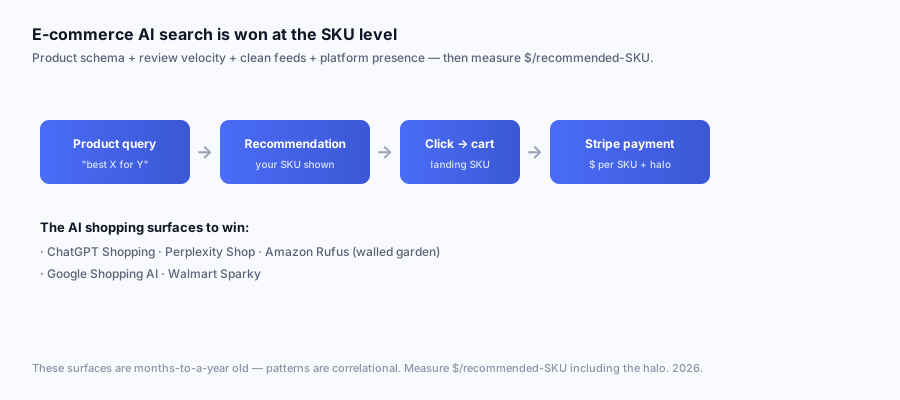
The one-line answer: there are five live AI shopping surfaces — ChatGPT Shopping, Perplexity Shop, Amazon Rufus, Google Shopping AI, and Walmart Sparky — and they split into off-Amazon surfaces where your own pages and feed have leverage, and walled-garden surfaces where the only lever is your listing inside that platform.
Each surface behaves differently, pulls from different sources, and rewards different work. Getting this map right before you spend a dollar is the single most important strategic step, because optimizing your Shopify product schema does nothing for a category whose AI-shopping demand lives inside the Amazon app. The retail-trade coverage of how fast these assistants reshaped product discovery is worth reading before you commit a budget to any one surface [27].
| Surface | What it is | Where it pulls from | Your primary lever |
|---|---|---|---|
| ChatGPT Shopping | Product cards inside ChatGPT [1][2] | Merchant feeds + schema + reviews + open web | Product/Offer schema, reviews, feed |
| Perplexity Shop / Buy with Pro | Product recs with sources, some native checkout [8][9][29] | Merchant feed + structured pages + reviews | Feed + source-rich product pages |
| Amazon Rufus | In-app shopping assistant inside Amazon [10][11] | Amazon catalog, listings, reviews | Your Amazon listing (off your site) |
| Google Shopping AI / AI Overviews | AI on shopping queries in Google [18][19] | Google Merchant Center feed + web | Merchant Center feed hygiene |
| Walmart Sparky | In-app assistant inside Walmart [13] | Walmart catalog + listings | Your Walmart listing (off your site) |
The on-Amazon versus off-Amazon split is the load-bearing distinction. Rufus and Sparky are walled gardens: there is no path from your own storefront into them, so the only optimization is a strong listing inside Amazon or Walmart respectively. ChatGPT Shopping and Perplexity Shop are the surfaces where your own product pages, schema, and feed have the most direct leverage. Google Shopping AI sits in between — it is tied to the Merchant Center feed discipline you likely already half-run for Shopping ads.
| Component a shopper sees | What it is | Attribution relevance |
|---|---|---|
| Product card | Image, name, price, rating, buy link | The click that lands on your SKU page |
| Rationale text | "Good for X because Y" per product | Drives click intent; not directly trackable |
| Comparison view | Side-by-side specs across SKUs | Higher consideration; longer time-to-payment |
| Buy link / outbound click | Deep link to a product page or retailer | The trackable referral event |
| Inline citations / sources | Where the model drew the rec from | Visibility signal; not a click to you |
| Follow-up refinement | "cheaper", "in blue", "under $50" | Re-ranks SKUs; can change recommended SKU mid-session |
The mechanical fact that matters for everything downstream: the buy link is the only component that produces a measurable event on your side, and it deep-links to a specific product URL, not your homepage. That landing-on-a-specific-SKU shape is the strongest behavioral fingerprint you have for an AI product recommendation, and it is the foundation of the SKU-level attribution in section 11.
The surfaces also differ on how trackable they are from your side, which directly shapes where measurement is even possible. A walled-garden purchase never touches your analytics, so for Rufus and Sparky the only "attribution" is the platform's own seller reporting.
| Surface | Sends a click to your site? | Referer often survives? | Where you measure it |
|---|---|---|---|
| ChatGPT Shopping | Yes (deep-link to SKU) | Rarely (~single-digit to 20%) | Your store + Stripe join |
| Perplexity Shop | Yes (and some native checkout) | Sometimes | Your store + Stripe; some in-app |
| Google Shopping AI | Yes (to product/Shopping) | Often (Google referer) | Your store + Stripe join |
| Amazon Rufus | No (purchase inside Amazon) | n/a | Amazon Seller Central only |
| Walmart Sparky | No (purchase inside Walmart) | n/a | Walmart seller reporting only |
The takeaway: the surfaces where your own optimization has the most leverage (ChatGPT, Perplexity, Google Shopping AI) are also the only ones you can attribute to settled dollars on your own store. The walled gardens you optimize from the inside and measure from the inside.
How AI surfaces decide which products to recommend
The one-line answer: for a shopping query, the AI assembles a ranked set of SKUs from structured product data (feeds and schema), quantified trust signals (ratings and review counts), and constraint matching (price, availability, attributes) — so the products that win are the ones whose structured data is complete, accurate, fresh, and well-reviewed.
There are two mechanics underneath every AI product recommendation, and conflating them is the most common ecommerce mistake.
| Mechanic | Governs | Updates | Ecommerce levers |
|---|---|---|---|
| Training corpus (from memory) | No-browse product knowledge | Model knowledge cutoff (months) | Brand presence, review history, durable category authority |
| Live retrieval (browse / feed) | Shopping-mode product cards | Per-crawl / per-feed-refresh (days) | Fresh feed, accurate Offer schema, current price/stock |
Most ecommerce AI shopping happens on the live-retrieval surface, which is good news, because that is the fast clock. When a shopper triggers shopping mode, the model retrieves current product data — your feed, your structured pages, third-party reviews — and assembles cards. Fix the feed and schema and you can see movement in days to weeks, far faster than the training-corpus lag that dominates B2B from-memory recommendations.
Here is the input hierarchy I observe the shopping surfaces leaning on, roughly ordered. Treat it as correlational — no AI vendor publishes a product-ranking algorithm — but it is consistent with the structural logic and the GEO research [12][14][15][28].
| Rank | Input | Why it matters | How you control it |
|---|---|---|---|
| 1 | Structured product feed | The canonical price/availability/identifier source | Clean Merchant Center / Shopify feed |
| 2 | Product + Offer schema | Lets the model parse a card with price | Complete, valid schema across catalog |
| 3 | Reviews + AggregateRating | Quantified trust signal the model can cite | Honest review velocity + recency |
| 4 | Price + availability accuracy | Wrong price = dropped or mis-ranked | Real-time feed sync |
| 5 | Product identifiers (GTIN/MPN) | Matches your SKU to a known product | Populate every SKU |
| 6 | Image + description quality | Renders the card; informs the rationale | Clean images, specific copy |
| 7 | Third-party / retailer presence | Corroborates the product exists and sells | Be on the platforms AI pulls from |
| 8 | Brand authority / mentions | From-memory recommendation weight | Slow brand-building (training corpus) |
Notice how different this is from the B2B trust hierarchy, where your own site sat last and off-domain peer sources sat first. In ecommerce, your own structured data sits at the top, because the model's first job is to render an accurate card with a price, and only you can supply a clean, current feed and valid Offer schema for your SKUs. The trust problem still exists — that is what reviews solve — but it is layered on top of structured data you control, not in place of it.
To make the abstraction concrete, here is a worked example of how a single query gets resolved into a recommendation, and which input decides each step. This is a model of the pipeline, not a leaked algorithm — but it is the right mental model for where each lever acts.
| Step in the pipeline | What decides it | Your lever |
|---|---|---|
| "best insulated flask under $40" parsed | Query understanding | Constraint-shaped page copy |
| Candidate SKUs assembled | Feed + crawled product pages | Clean feed; crawlable schema |
| Your SKU matched to a known product | GTIN/MPN | Populate identifiers |
| Price filter "under $40" applied | Offer.price + priceCurrency | Accurate Offer schema |
| In-stock filter applied | Offer.availability | Real-time stock sync |
| Ranking among survivors | Reviews, rating, relevance | Review velocity + recency |
| Rationale "keeps coffee hot all day" written | Description + reviews + specs | Specific, liftable copy |
| Card rendered with buy link | Image + price + rating present | Complete schema end to end |
Product and Offer schema: the table-stakes foundation
The one-line answer: complete, valid Product and Offer schema is the highest-leverage controllable input in ecommerce AI search, and missing or malformed Offer schema is the single most common reason a product that should qualify fails to surface with a price — so treat catalog-wide schema completeness as table stakes before any content work.
Schema is not a guaranteed ticket to a recommendation. It is the floor you have to stand on before any other lever matters, because the structured surfaces literally cannot render a price-carrying product card from data they cannot parse. Here are the load-bearing fields, grouped by type, with an honest note on why each matters.
| Schema type | Field | Why it is load-bearing |
|---|---|---|
| Product | name | Identifies the product in the card |
| Product | brand | Disambiguates and corroborates |
| Product | gtin / mpn / isbn | Matches your SKU to a known product |
| Product | image | Renders the card image |
| Product | description | Feeds the rationale text |
| Offer | price | Without it, no price renders — common failure |
| Offer | priceCurrency | Required for a valid price |
| Offer | availability | InStock / OutOfStock gating |
| Offer | priceValidUntil | Freshness; prevents stale-price drops |
| Offer | shippingDetails | Total-cost transparency |
| AggregateRating | ratingValue | The star rating in the card |
| AggregateRating | reviewCount | The quantified trust signal |
| Review | author / reviewBody / reviewRating | Individual liftable review content |
The single most common, most fixable failure I see across stores is missing or malformed Offer schema. A product with perfect Product schema but no valid Offer block will frequently fail to render with a price, which on a shopping surface is close to invisible — shoppers and the model both want the price, and a card without one loses to a card with one. The Schema.org Offer definition is unambiguous about which fields a valid price block needs (price, priceCurrency, availability, and ideally priceValidUntil), so most of these failures are omission rather than ambiguity [25]. The second most common failure is a missing GTIN or MPN, which prevents the model from confidently matching your SKU to a product it already knows from a feed.
| Schema failure | Symptom on AI surface | Fix priority |
|---|---|---|
| Missing Offer.price | Card renders without price or not at all | Critical |
| Missing priceCurrency | Price treated as invalid | Critical |
| Stale priceValidUntil | Product dropped as out-of-date | High |
| availability not updated | Out-of-stock SKU recommended (bad UX) | High |
| Missing GTIN/MPN | SKU not matched to known product | High |
| No AggregateRating | No trust signal; harder to recommend | Medium-high |
| Malformed JSON-LD | Entire block ignored | Critical |
| Schema on collection page only | No per-SKU data to recommend | High |
A note on validation, because this is where stores quietly lose: invalid JSON-LD does not degrade gracefully, it gets ignored entirely. A single malformed field can void the whole block. Validate every product template with Google's Rich Results Test and the Schema.org validator [16], and re-validate after any theme or app change, because a Shopify app update silently breaking your schema is a real and recurring failure mode. On Shopify specifically, the theme's default Product schema is often incomplete — it commonly ships without GTIN/MPN and sometimes without a robust Offer block — so audit it rather than assuming the platform handles it [14].
| Platform | Default schema completeness | What you usually still need to add |
|---|---|---|
| Shopify (default theme) | Partial | GTIN/MPN, robust Offer, AggregateRating |
| WooCommerce | Partial (plugin-dependent) | Consistent Offer, validated JSON-LD |
| Custom storefront (Stripe-direct) | Whatever you built | All of it — own the template |
| BigCommerce | Partial | Identifiers, review schema |
| Headless (Next.js, etc.) | Whatever you built | Server-rendered JSON-LD per SKU |
This is correlational, not a documented ranking factor any AI vendor publishes — I infer it from citation patterns, the structural fit, and the GEO research [15][17]. But it is the lever I would fix first on any store, because it is fully within your control, it is cheap to fix once you find the template, and its absence is close to disqualifying on the structured surfaces.
Reviews and ratings: the product-level trust signal
The one-line answer: reviews and ratings are the strongest product-level trust signal an AI can lift, review velocity and recency matter as much as raw count, and a well-reviewed SKU is structurally easier for the model to justify recommending than an identical product with few reviews — but never buy fake reviews, because it poisons the exact signal you are trying to build.
When an AI assembles "best X under $Y," it faces the same problem a human shopper faces: it cannot try the products, so it reaches for quantified peer judgment. Star rating and review count are the most liftable, most citable trust signals in the entire shopping stack, and unlike B2B — where reviews live on G2 at the brand level — ecommerce reviews live at the SKU level, right on the product the model is deciding whether to recommend. Reviews have long been one of the strongest purchase-decision drivers for human shoppers [26]; the AI surfaces inherit that weighting because they parse the same AggregateRating data Google's review-snippet guidelines define [24].
| Review signal | Why the model leans on it | How you build it honestly |
|---|---|---|
| Star rating (ratingValue) | Quantified quality proxy | Earn it; fix the products that drag it |
| Review count (reviewCount) | Volume = confidence | Post-purchase review request flow |
| Review recency | Freshness; product still good | Ongoing cadence, not a one-time push |
| Review velocity | Momentum signal | Consistent request automation |
| Verified-purchase reviews | Higher trust weight | Use a verified-purchase review app |
| Review text specificity | Feeds rationale ("great for X") | Prompt for use-case detail |
| Photo / video reviews | Corroboration, richer card | Incentivize honestly (discount, not pay) |
Velocity is the under-appreciated lever. A SKU that gained 50 fresh reviews in the last 60 days reads as a currently-good, currently-selling product, which is exactly what a shopping surface wants to recommend. A SKU with 500 reviews all from 2023 reads as stale. The mechanic that builds velocity is unglamorous: a reliable post-purchase review request, timed to arrive after the product has been used, with a friction-free submission flow. That is a solved operational problem — the apps exist — and it is one of the few AI-shopping levers that also straightforwardly improves your conversion rate independent of AI.
| Review tactic | Effort | Time-to-effect | Honest expected impact |
|---|---|---|---|
| Post-purchase review request automation | Low (set up once) | Weeks | High; compounds |
| Verified-purchase review widget + schema | Low-medium | Days | High; enables the signal |
| Photo/video review incentives (honest) | Medium | Weeks | Medium-high; richer cards |
| Respond to negative reviews | Low (ongoing) | Ongoing | Medium; trust + recency |
| Seed reviews with free product to reviewers | Medium | Weeks | Medium; disclose per FTC rules |
| Buy fake reviews | — | — | Negative; do not, ever |
I want to be blunt about the fake-review line, because it is tempting on a thin-reviewed catalog. Buying or incentivizing fake reviews does three bad things at once: it violates platform and FTC rules — the FTC's endorsement guidance is explicit that fake and undisclosed-incentive reviews are prohibited [30] — it is increasingly detectable by both platforms and the models, and it corrupts the exact trust signal the mechanic depends on. The whole reason ratings work as an AI input is that they are honest peer signal. Faking it defeats the mechanic and risks the listing. The honest play — a reliable post-purchase request and genuinely good products — is also the durable one.
Honest caveat: I cannot point to a published statement from OpenAI or Perplexity saying "we weight reviewCount." This is inferred from citation patterns, from the obvious structural fit (the model renders a rating in the card, so it must be ingesting one), and from the GEO research. Treat it as a strong, well-grounded hypothesis, not a law.
Where the reviews live matters too, because the AI surfaces pull review signal from different places depending on which surface and where you sell. Do not assume your on-site reviews are the ones the model sees.
| Review location | Read by | Schema needed | Notes |
|---|---|---|---|
| On-site product page | ChatGPT, Perplexity, Google | AggregateRating + Review JSON-LD | The lever you fully control |
| Google Merchant / Product reviews | Google Shopping AI | Merchant Center review feed | Separate from on-site schema |
| Amazon listing reviews | Rufus | None (Amazon's own) | Optimize inside Amazon |
| Third-party review platforms | All (open web) | Platform-dependent | Corroboration signal |
| Walmart listing reviews | Sparky | None (Walmart's own) | Optimize inside Walmart |
Clean product feeds and the Merchant Center discipline
The one-line answer: a clean, complete, frequently-updated structured product feed is the canonical source AI shopping surfaces trust for price, availability, and identifiers, so feed hygiene — accurate prices, real-time stock, populated GTIN/MPN, complete attributes — is foundational, and it is a discipline most stores already half-run for Google Shopping ads.
The product feed is upstream of almost everything else on the structured surfaces. Google Shopping AI pulls heavily from the Google Merchant Center feed [18][19], whose specification spells out the required and recommended attributes a clean feed must carry [23], Perplexity and ChatGPT Shopping blend merchant feeds with schema and the open web, and a feed that is wrong, stale, or incomplete poisons the recommendation at the source. The good news: if you already run Google Shopping ads, you already maintain a Merchant Center feed, and tightening it benefits both your ads and your AI-shopping presence.
| Feed attribute | Why it matters for AI shopping | Common failure |
|---|---|---|
| id / item_group_id | SKU and variant grouping | Variants flattened or duplicated |
| title | Match to query + card display | Keyword-stuffed, unclear |
| price / sale_price | The price in the card | Stale; not synced to live price |
| availability | In-stock gating | Not updated on stock-out |
| gtin / mpn | Match to known product | Missing on long-tail SKUs |
| brand | Disambiguation | Blank on generic SKUs |
| google_product_category | Category placement | Mis-categorized |
| image_link | Card image | Broken or low-res |
| shipping | Total-cost transparency | Omitted |
| product_type | Internal taxonomy for matching | Inconsistent |
Feed freshness is the lever stores under-rate. A price change on your site that takes 24 hours to propagate to the feed means a day of recommendations carrying the wrong price, which leads to either dropped cards (price mismatch) or unhappy shoppers (clicked a $39 card, page says $44). Real-time or near-real-time feed sync is worth the engineering, especially during sales.
| Feed hygiene practice | Effort | Impact on AI shopping |
|---|---|---|
| Real-time price/stock sync | Medium-high | High; prevents drops + mismatches |
| Populate GTIN/MPN catalog-wide | Medium (one-time + maintenance) | High; enables matching |
| Validate feed against Merchant Center spec | Low | High; catches silent rejections |
| Fix disapproved items weekly | Low (recurring) | High; disapproved = invisible |
| Enrich titles with query-shaped language | Medium | Medium-high; improves match |
| Complete shipping + tax attributes | Low | Medium; total-cost transparency |
A specific failure mode worth flagging: disapproved feed items. Merchant Center silently disapproves SKUs for policy or data reasons, and a disapproved item is invisible to the AI surfaces that pull from the feed. Most stores never look at the disapprovals tab. A weekly check is cheap and routinely recovers SKUs that were silently dropped. On Shopify, the Google & YouTube channel or a feed app manages this, but the same audit applies — do not assume "it is connected" means "it is clean" [14][15].
Feed and schema overlap but are not the same job, and a common mistake is fixing one and assuming it covers the other. They are two separate data sources the surfaces read differently.
| Data point | Feed (Merchant Center) | On-page schema (JSON-LD) | If they disagree |
|---|---|---|---|
| Price | Feed value | Offer.price | Mismatch can drop the card |
| Availability | Feed value | Offer.availability | Stale stock = bad UX |
| Identifier | gtin/mpn | Product gtin/mpn | Must match to corroborate |
| Reviews | Merchant review feed | AggregateRating | Both feed the rating |
| Title / name | Feed title | Product.name | Keep consistent |
| Image | image_link | Product.image | Keep consistent |
The principle: the feed and the schema should agree on price, availability, and identifiers, because a surface that reads both and finds them inconsistent has reason to distrust the card. Sync them from the same source of truth rather than maintaining two drifting copies.
Being on the platforms AI pulls from
The one-line answer: AI shopping surfaces pull from a finite set of retail platforms and feeds, some of which are walled gardens you can only win from the inside, so the strategic first move is to figure out where your category's AI-shopping demand actually lives before deciding whether the optimization is on your own site or on Amazon.
This is the most strategic and least glamorous section, and the one most likely to save you from wasted effort. Not all AI-shopping demand expresses itself off-Amazon. For many categories — commodities, replenishables, anything where Amazon is the default — a large share of the shopping queries that trigger an AI surface happen inside the Amazon app, where Rufus answers them from Amazon's own catalog. No amount of Shopify schema work touches that demand. The only lever is a strong Amazon listing.
| Platform | Walled garden? | Who wins | Your move if demand is there |
|---|---|---|---|
| Amazon (Rufus) | Yes | Strong Amazon listings | Optimize your Amazon PDP, reviews, A+ content |
| Walmart (Sparky) | Yes | Strong Walmart listings | Optimize your Walmart listing |
| Google Shopping AI | No (feed-based) | Clean Merchant Center feed | Feed hygiene |
| ChatGPT Shopping | No (blended) | Schema + feed + reviews + web | On-site optimization |
| Perplexity Shop | No (blended) | Source-rich pages + feed | On-site + feed |
| Your own storefront | No | You, directly | Schema, reviews, feed, content |
The decision tree is simple to state and hard to do honestly: figure out where the AI-shopping demand for your specific products lives, then spend there. For an Amazon-default category, the highest-leverage AI-shopping work might be entirely off your own site. For a differentiated DTC product that people research before buying, the off-Amazon surfaces (ChatGPT, Perplexity) where your own pages have leverage are where the return is.
| If your category is... | AI-shopping demand likely lives... | Optimize... |
|---|---|---|
| Commodity / replenishable | Inside Amazon (Rufus) | Amazon listing + reviews |
| Differentiated DTC | Off-Amazon (ChatGPT, Perplexity) | Your pages + feed + reviews |
| Considered / researched purchase | Perplexity, ChatGPT | Source-rich pages, comparison content |
| Gift / discovery | ChatGPT Shopping | Schema + evocative copy + reviews |
| Local / same-day | Google Shopping AI + maps | Merchant Center + local feed |
A hard, honest caveat: you cannot fully control where the model pulls from, and these surfaces change which sources they favor. A category that is off-Amazon today could shift if OpenAI or Perplexity deepens a merchant program, and Rufus could expand what it pulls in ways that change the math. This is why the next layer — measurement — matters more than any single optimization. You find out where your demand actually lives by measuring which surface drives recommended-SKU revenue, not by guessing from a blog post.
On-page optimization for shopping queries
The one-line answer: beyond schema and feeds, the product pages that win AI shopping recommendations match the query shape shoppers actually use — constraint-laden, use-case-specific language ("for wide feet", "under $40", "keeps coffee hot all day") — answered plainly in structured, parseable copy that the model can lift into a rationale.
Schema and feeds get you into the candidate set with an accurate card. On-page content is what lets the model write a good rationale and match your SKU to a specific constraint. Shopping queries are rarely bare product names; they are loaded with constraints, and the products that win are the ones whose pages plainly answer those constraints in liftable language.
| Query constraint type | Example | Page element that wins it |
|---|---|---|
| Price band | "under $40" | Accurate Offer price + value framing |
| Use case | "for keeping coffee hot all day" | Spec answering it, in plain copy |
| Physical fit | "for wide feet" | Sizing/fit detail, structured |
| Audience | "for a 7-year-old" | Age/recipient guidance |
| Material / spec | "stainless, BPA-free" | Materials block, attributes |
| Comparison | "better than [brand]" | Honest comparison content |
| Occasion | "for camping" | Use-case section |
The on-page principle that transfers from general GEO, covered in the how to rank in ChatGPT playbook: answer the question plainly, near the top, in structured language. For a product page that means the spec that satisfies the constraint should be stated in clear prose and in structured attributes, not buried in a marketing paragraph or trapped in an image the model cannot read.
| On-page tactic | Helps AI recommendation | Helps human conversion |
|---|---|---|
| Constraint-shaped copy ("for X", "under $Y") | Strong | Strong |
| Spec table with real attributes | Strong | Strong |
| Plain-text answer to common questions (FAQ) | Strong | Medium |
| Alt text + readable image content | Medium | Low (accessibility win) |
| Use-case sections | Strong | Strong |
| Marketing fluff with no specifics | Negative | Weak |
| Specs trapped in images only | Negative (unreadable) | Weak |
The honest caveat here mirrors the schema one: this improves your odds, it does not guarantee a recommendation, and it interacts with the structured layer. A page with beautiful constraint-shaped copy but no valid Offer schema still struggles to render a card. Fix the structured foundation first, then layer on the content that wins the rationale. Content is the multiplier on a structured base, not a substitute for it.
The complete ecommerce AI search optimization playbook, sequenced
The one-line answer: fix the structured foundation first (schema, feed, identifiers), then the trust layer (reviews), then platform presence and content, and instrument dollars-per-recommended-SKU before and throughout — because the foundation is fully in your control and the measurement tells you which surface is actually paying.
Here is the full sequence, ordered by leverage-per-effort for a store that already has product-market fit and real demand. Row 0 is deliberately measurement, not optimization, because everything after it depends on being able to see which SKUs and surfaces are working.
| # | Move | Effort | Time-to-effect | Why this order |
|---|---|---|---|---|
| 0 | Instrument dollars-per-recommended-SKU | Low (turnkey) | Immediate | Baseline before you change anything |
| 1 | Audit + fix Product/Offer schema catalog-wide | Medium | Days-weeks | Highest control; near-disqualifying if missing |
| 2 | Clean the product feed (price, stock, GTIN/MPN) | Medium | Days | Canonical source; fixes silent drops |
| 3 | Stand up review velocity (post-purchase requests) | Low-medium | Weeks | Strongest product trust signal |
| 4 | Map where your AI-shopping demand lives | Low (analysis) | Immediate | Decides on-site vs Amazon spend |
| 5 | Win the platforms that demand: Amazon / Merchant Center | Medium-high | Weeks | Where walled-garden demand is |
| 6 | Constraint-shaped on-page copy on top SKUs | Medium | Days-weeks | Wins the rationale + matching |
| 7 | Build brand + review history over time | High | Months | Feeds from-memory recommendations |
Two honest caveats on this sequence. First, for a store below product-market fit, most of this is premature except row 0 (instrument early, because the baseline compounds and is cheap to backfill) and row 1 (schema is cheap insurance regardless). Spend your hours on product and demand generation until you have repeatable sales. Second, the time-to-effect column mixes the two mechanics: rows 1-6 mostly buy you live-retrieval and structured-surface recommendations on a fast clock, while row 7 buys training-corpus presence on a slow one. Fund the slow work with the fast wins, and measure throughout.
The same sequence reprioritizes by store maturity. What a brand-new store fixes first is not what a scaled catalog fixes first.
| Store stage | Fix first | Skip / defer | Why |
|---|---|---|---|
| Pre-PMF / new | Row 0 (measure) + Row 1 (schema) | Platform expansion, content | Cheap insurance; baseline compounds |
| Early traction (under $40k/mo) | Schema + feed + review velocity | Brand-building, broad Amazon push | Structured foundation, fast wins |
| Scaling ($40k-250k/mo) | Map demand + win the right platform | Chasing every surface at once | Spend where the data says |
| Scaled (multi-platform) | Halo measurement + brand history | Re-fixing already-clean schema | Optimize the long tail and the halo |
And because effort is finite, here is the leverage-per-hour ranking I would actually follow, separated into the controllable foundation versus the slower, less-controllable brand layer.
| Lever | Controllability | Leverage-per-hour | Layer |
|---|---|---|---|
| Fix Offer.price / priceCurrency catalog-wide | Full | Very high | Foundation |
| Populate GTIN/MPN | Full | High | Foundation |
| Post-purchase review automation | Full | High | Trust |
| Clean disapproved feed items | Full | High | Foundation |
| Constraint-shaped copy on top 20 SKUs | Full | Medium-high | Content |
| Strengthen Amazon listings (if relevant) | Full (on Amazon) | High (if demand there) | Platform |
| Earn brand mentions / authority | Influence only | Low (slow) | Brand |
Measuring dollars per recommended SKU, including the halo
The one-line answer: appearance tracking (does the model show my product) is the vanity layer; the layer almost nobody closes is dollars-per-recommended-SKU including the halo, which you build with server-side AI-referrer detection plus the deep-link-to-SKU fingerprint, a first-party session, and a Stripe webhook join carrying cart line items.
This is the Attrifast wedge, so read the next paragraph with appropriate skepticism: I sell the thing I am about to describe. That said, the architecture is vendor-neutral, you can build it yourself, and the reason most teams do not is not cost — it is that the SKU-level join and the halo logic are genuinely fiddly, and GA4 actively works against you.
The problem in ecommerce specifically is twofold. First, GA4 buckets the AI click as Direct and has no AI channel rule, so the session is mislabeled before you start. Second, even if you label the session correctly, GA4 has no concept of recommended-SKU versus browsed-SKU, so it cannot tell you whether the AI-recommended product is the one that sold or whether the shopper landed on the recommended flask and bought a $90 jacket instead. That second case — the halo — is where a lot of the real value lives, and it is invisible to standard analytics.
| Layer | What it answers | Tooling | The trap |
|---|---|---|---|
| Appearance | Does the model show my product? | Manual prompts, visibility trackers | Vanity if it stops here |
| Referral | Did a click reach my SKU page? | Server-side referer + deep-link fingerprint | GA4 buckets it as Direct |
| Cart | Did the recommended SKU enter the cart? | First-party session + cart event | Lost if not stitched |
| Revenue (direct) | Did the recommended SKU sell? | Stripe webhook + line-item metadata | No GA4 recommended-SKU concept |
| Revenue (halo) | Did a different SKU sell off the rec? | Same join, compare landing vs purchased SKU | Completely invisible in GA4 |
The four data points you need to join, for each AI-referred session: the AI referrer (label the surface), the landing SKU (the deep-linked product the rec pointed to), the time-to-cart (which SKU entered the cart), and the time-to-payment (the settled Stripe charge with line items). Stitched on a first-party session row and joined to the checkout.session.completed webhook carrying cart line items in metadata, those four attribute settled dollars to the recommended SKU — and by comparing landing SKU to purchased SKU, they isolate the halo.
The AI-referrer detection list, the same one across the AI-attribution posts, plus the behavioral fingerprint for the no-referer majority:
| Engine | Referrer domains to fingerprint |
|---|---|
| ChatGPT | chatgpt.com, chat.openai.com, oai.com |
| Perplexity | perplexity.ai |
| Claude | claude.ai |
| Gemini | gemini.google.com |
| Copilot | copilot.microsoft.com |
For the 70-80% of AI clicks that arrive with no referer, the behavioral fingerprint carries the load: a new visitor entering directly on a deep product-detail-page URL, rather than the homepage or a collection page. That landing-on-a-specific-SKU shape is the strongest non-referer signal of an AI product recommendation. It is not perfect — some direct-to-PDP traffic is genuinely direct or from an email — but combined with the referer signal it recovers the bulk of the channel that GA4 files under Direct. The track ChatGPT traffic playbook walks the detection code.
| Metric to report | Why it beats appearance counts |
|---|---|
| Dollars per recommended SKU | The number that survives a finance review |
| Halo revenue per recommended SKU | Captures off-rec purchases AI drove |
| AOV: AI-recommended vs blended organic | Reveals the intent-quality lift |
| Conversion rate by AI surface | Sets the right (lower) bar for AI traffic |
| Revenue by AI surface over time | Detects when a lever started working |
| Recommended-SKU to purchased-SKU mix | Shows the halo composition |
Why this is cookieless and consent-banner-free: the referer fingerprint and the deep-link signal are read server-side, the identifier is first-party scoped to your own domain (outside the cross-site cookie rules ITP and the ePrivacy directive target), and the Stripe join uses checkout metadata. None of the three pieces needs a third-party cookie or a banner under most jurisdictions — verify with your own privacy review. This is the architecture Attrifast ships, and because it joins through Stripe it works identically on a Stripe-direct store and on a Shopify store running Shopify Payments on top of Stripe. The deeper SKU-level mechanics are in the ChatGPT Shopping revenue attribution guide and the Perplexity Shopping attribution guide; the revenue attribution feature page walks the architecture end to end.
One number from the Attrifast base, labeled as my own aggregate: AI-recommended SKUs carried a median AOV roughly 12-22% above the same store's blended organic AOV across the DTC and Stripe-direct stores I measured in Q1-Q2 2026, while converting at a lower rate — the consistent research-led signature. The absolute dollars at a $40k/month store are real money sitting in the Direct bucket, and the halo often adds 20-40% on top of the direct recommended-SKU revenue. Both are invisible without the join.
Here is how the off-Amazon AI surfaces compare on the two metrics that matter, from the same aggregate. These are directional field measurements from the stores I instrument, not a controlled study, and they vary widely by category — treat them as a starting frame, not benchmarks to hold yourself to.
| AI source | AOV vs blended organic | Conversion rate vs Google Shopping | Time-to-payment | Notes |
|---|---|---|---|---|
| ChatGPT Shopping | +12-18% | Lower | Often same session | Largest off-Amazon volume |
| Perplexity Shop | +18-25% | Lower | Often multi-session | Research-led; over-indexes on considered buys |
| Google Shopping AI | +5-12% | Closer to parity | Same session | Most impulse-adjacent of the AI surfaces |
| Gemini (shopping-shaped) | +8-15% | Lower | Mixed | Lower volume; growing |
| Amazon Rufus | Not measurable off-platform | n/a (inside Amazon) | n/a | Walled garden; measure in Seller Central |
The AOV lift and the conversion-rate shape also differ sharply by retail vertical, which is the second cut worth running on your own data before you decide how hard to chase AI shopping. The pattern below is my aggregate and the dispersion is large, so the ranking matters more than the exact numbers.
| Retail vertical | AI-rec AOV lift | AI-shopping fit | Why |
|---|---|---|---|
| Outdoor / gear | High (+18-25%) | Strong | Constraint-heavy queries ("for wide feet", "under $X") |
| Electronics / accessories | Medium-high | Strong | Spec comparison; research-led |
| Home / kitchen | Medium | Medium-strong | Use-case queries; reviews matter |
| Apparel / fashion | Low-medium | Weaker | Fit + visual; less constraint-shaped |
| Beauty / skincare | Medium | Medium | Ingredient/concern queries |
| Commodity / replenishable | Low | Mostly Amazon | Default-to-Amazon demand |
| Gifts | Medium-high | Strong (ChatGPT) | "gift for X who likes Y" is a native AI query |
Honest caveats and what I do not know
The one-line answer: these AI shopping surfaces are months-to-a-year old, almost everything here is correlational rather than a documented ranking factor, the surfaces change behavior frequently, and any vendor — including me — claiming certainty about how the models pick products is overselling.
Let me be explicit about the limits, because this field is full of confident claims that should not be confident, and the surfaces are new enough that confidence is especially unwarranted.
| Claim in this article | Confidence | Basis |
|---|---|---|
| Complete Product/Offer schema is near-mandatory | High | Structural logic + GEO research + my tests |
| Missing Offer.price is a top failure mode | High | Repeated across stores I have audited |
| Reviews/ratings are a strong product trust signal | Medium-high | Structural fit + GEO research; not published |
| Review velocity matters as much as count | Medium | Inferred; plausible; not documented |
| AI-recommended AOV is +12-22% vs organic | Medium | My aggregate, Q1-Q2 2026, DTC/Stripe only |
| Halo adds 20-40% on top of direct rec revenue | Medium | My aggregate; varies widely by store |
| Specific input-hierarchy ordering | Medium | Inferred, not published |
| Which surface dominates by category | Low-medium | Varies hugely; measure your own |
Things I genuinely do not know: the precise weight any surface gives any input; whether review count is causal or merely correlated with the product quality that independently drives recommendations; how durable any of these patterns are as OpenAI, Perplexity, Amazon, and Google evolve their shopping surfaces, add ads, or change merchant programs. The +12-22% AOV figure is real in my data but it is a DTC/Stripe-direct aggregate that will not hold for every category, and it is field measurement, not a controlled experiment. The halo range is even noisier.
The honest meta-point, the same one as in the B2B piece: these surfaces are new, the optimization advice (including mine) is partly inference, and the only claim in this whole space you can actually verify on your own data is the revenue one. So measure dollars per recommended SKU before you trust anyone's optimization advice, including this article. That measurement is the thing that turns a months-old, half-understood channel into a line item you can defend and grow.
FAQ
How is ecommerce AI search optimization different from B2B SaaS GEO?
It is won at a different altitude. B2B SaaS AI visibility is brand-level and comparison-shaped — a buyer asks "best CRM for a 10-person team" and the model leans on G2, Capterra, Reddit, and editorial roundups to recommend a vendor. Ecommerce AI search is product-level and SKU-shaped — a shopper asks "best merino base layer under $90" and the model assembles product cards for individual SKUs with a specific image, price, rating, and buy link. The controllable inputs are different too: in B2B you influence off-domain trust sources you do not own, while in ecommerce the highest-leverage levers are mostly on your own pages and feed — Product and Offer schema, review velocity, a clean feed, accurate price and availability, and presence on the retail platforms AI pulls from. The measurement target drops from MRR-per-engine to dollars-per-recommended-SKU including the halo.
Which AI surfaces actually shop, and which one matters most?
As of mid-2026 the live surfaces are ChatGPT Shopping, Perplexity Shop / Buy with Pro, Amazon Rufus, Google Shopping AI / AI Overviews on shopping queries, and Walmart Sparky. For most DTC and Stripe-direct stores, ChatGPT Shopping is the largest off-Amazon referral surface by volume, Perplexity over-indexes on research-heavy considered purchases because it shows sources, and Rufus matters enormously but only if you sell on Amazon — it is inside Amazon's walls, so the optimization is your Amazon listing, not your own site. Google Shopping AI is the one most tied to a discipline you already run (Merchant Center feed hygiene). Instrument all of them, but where you spend depends on whether your demand is on-Amazon or off-Amazon.
What Product schema fields actually matter for getting recommended by AI?
Treat complete, valid Product and Offer schema as table stakes. The load-bearing fields are: on Product — name, brand, a unique identifier (GTIN, MPN, or ISBN), image, and description; on Offer — price, priceCurrency, availability, and ideally priceValidUntil and shippingDetails; and on reviews — AggregateRating (ratingValue and reviewCount) plus individual Review objects. Missing or malformed Offer schema is the single most common reason a product fails to render with a price in an AI recommendation, and a missing GTIN/MPN is the most common reason it fails to match a product the model already knows. None of this guarantees a recommendation — it is necessary, not sufficient — but its absence is close to disqualifying on the structured surfaces.
Do reviews and ratings affect whether AI recommends my products?
Strongly, and at the product level rather than the brand level. When an AI assembles "best X under $Y", it cannot try the products, so it reaches for quantified peer signal: star rating and review count. A SKU with 400 reviews at 4.7 stars is structurally easier for the model to justify recommending than an identical product with three reviews, because the rating is a liftable trust signal. Review velocity and recency matter as much as raw count, because they feed the freshness the model prefers. The honest caveat: no AI vendor publishes review count as a documented ranking factor, so this is correlational. But it lines up with the structural logic and the GEO research, and review velocity is one of the few levers a store fully controls. Never buy fake reviews — it poisons the signal and is increasingly detectable.
Can I track which specific products an AI recommended that led to a sale?
Yes, but not with GA4 alone and not with a visibility tracker alone. You need four data points joined: the AI referrer (so you know the session came from ChatGPT, Perplexity, or another surface), the landing SKU (the product page the recommendation deep-linked to), the time-to-cart (whether the recommended SKU entered the cart), and the time-to-payment (the Stripe charge that settled, with line items). Stitched on a first-party session row and joined to a Stripe webhook carrying cart line items in metadata, those four attribute settled dollars to the recommended SKU — and separately measure the halo, where the AI recommended SKU A but the shopper bought SKU B. This is the architecture Attrifast ships, and it works identically on a Stripe-direct store or a Shopify store using Shopify Payments on Stripe.
What is the AOV for AI-recommended products versus organic discovery?
Across the DTC and Stripe-direct stores I measured in Q1-Q2 2026, AI-recommended SKUs carried a median AOV roughly 12-22% above the same store's blended organic AOV, with Perplexity Shop higher still on considered purchases. The likely driver is intent quality: a shopper who arrives via an AI recommendation has read a partial comparison, has been steered toward a specific SKU that fits stated constraints, and arrives pre-qualified. The catch is conversion rate — AI-recommended traffic converts at a lower rate than Google Shopping or paid social retargeting because the journey is research-led, not impulse-led. Higher AOV, lower conversion rate, longer time-to-payment is the consistent signature. It is real money, but you will misjudge it if you hold it to a retargeting-style conversion bar.
Do I need to be on Amazon and Google Merchant Center to win AI shopping?
It depends which surface your demand sits on, and you may not control where the model pulls from. Amazon Rufus operates entirely inside Amazon's walled garden, so if a meaningful share of your category's AI-shopping demand happens inside the Amazon app, the only way to win it is a strong Amazon listing — there is no path from your own Shopify store into Rufus. Google Shopping AI and AI Overviews on shopping queries pull heavily from the Google Merchant Center feed, so a clean, complete, frequently-updated feed is the lever there. ChatGPT Shopping and Perplexity Shop draw on a blend of feeds, schema, reviews, and the open web, which is where your own product-page optimization has the most leverage. Figure out where your category's demand actually lives before you spend.
How do AI shopping referrers look in my server logs?
When an AI recommendation passes a referer — a minority of clicks, since the clients strip it on most outbound links — it arrives as a chatgpt.com or perplexity.ai host that deep-links directly to a product-detail-page URL on your domain, frequently with a query string the model copied verbatim. The high-signal behavioral fingerprint, which works even with no referer, is a no-referer, new-visitor entry that lands directly on a deep product-detail-page URL rather than your homepage or a collection page. That landing-on-a-specific-SKU shape is the strongest signal that the visit came from an AI product recommendation, because organic and paid traffic disproportionately enter on the homepage or campaign pages while AI recommendations deep-link to the exact SKU.
Why does GA4 fail to attribute AI shopping revenue at the SKU level?
Three compounding failures. First, the AI clients strip the Referer header on most outbound product clicks, so GA4 buckets the session as Direct/(none) and never tags it as AI. Second, even when a referer survives, GA4 has no default channel rule for chatgpt.com or perplexity.ai, so it lands in generic Referral with no AI-engine label. Third, GA4 enhanced ecommerce attributes item revenue to the GA4 session channel — already wrong for AI traffic — and it has no concept of recommended-SKU versus browsed-SKU, so it cannot tell you whether the AI-recommended product is the one that sold or whether the shopper landed on it and bought something else. You need SKU-level join logic GA4 does not provide, plus a cookieless first-party session that survives the click GA4 mislabels.
Does ChatGPT Shopping use ads or take an affiliate cut?
As of mid-2026, OpenAI has stated that ChatGPT Shopping results are organic and not ads, chosen independently of any commercial relationship, and OpenAI does not pass a structured purchase callback to merchants the way an affiliate network would. There is no merchant-facing conversion pixel from ChatGPT Shopping itself, which means the merchant is responsible for instrumenting attribution on their own side: detect the AI referral on landing, persist the session, and join to the Stripe payment. You cannot wait for OpenAI to hand you a conversion report. This surface is changing quickly — Perplexity and others have experimented with native checkout and merchant programs — so verify the current terms against each provider's merchant documentation rather than trusting a six-month-old blog post, including this one.
How long does it take for AI surfaces to start recommending my products?
Two timelines, because there are two mechanics. The live-retrieval surface — an AI browsing your product page or pulling your current feed at query time — can pick up a newly optimized SKU within days to a few weeks of the feed refreshing or the page being recrawled, especially on Google Shopping AI where Merchant Center updates propagate fast. The training-corpus surface, which governs from-memory product knowledge, lags far behind because it only updates on a model's knowledge cutoff. So feed and schema fixes show up on the live shopping surfaces relatively quickly, while building the brand and review presence that makes a model recommend you from memory is a multi-month grind. Fix the feed and schema first for the fast wins, build review velocity for the slow ones, and measure throughout.
Is paying for "guaranteed AI shopping placement" from an agency a good idea?
Treat it with the suspicion you would give a vendor promising guaranteed Google #1. As of early-to-mid 2026 there is no paid placement in the organic product-recommendation surface of ChatGPT Shopping or Perplexity Shop, and no published ranking API to guarantee against. A legitimate partner can do real work — cleaning your Merchant Center and product feeds, fixing Product and Offer schema across your catalog, improving review velocity, strengthening your Amazon listings — but those are probabilistic levers, not guarantees, and the honest ones say so. The bigger red flag is any vendor that sells AI-shopping visibility tracking but cannot tell you how many dollars a single recommended SKU produced. Appearance without revenue measurement is exactly the vanity trap to avoid.
Can I do AI-shopping revenue attribution without cookies or a consent banner?
Yes. The minimum stack is three pieces. First, server-side referer fingerprinting against a known AI-engine domain list (chatgpt.com, chat.openai.com, perplexity.ai, and their variants) plus the deep-link-to-SKU behavioral fingerprint for the no-referer majority. Second, a first-party identifier scoped to your own domain, which falls outside the cross-site cookie rules ITP and the EU ePrivacy directive target. Third, a server-side join from the first-party session to the Stripe Checkout via metadata carrying the cart line items. None of those three pieces requires a third-party cookie, a fingerprint hash, or a consent banner under most jurisdictions — verify with your own privacy review. This is the cookieless architecture Attrifast ships, and it works on a Stripe-direct store directly and on a Shopify store via Shopify Payments on Stripe.
Should a small store with a few hundred SKUs bother with this?
The structural floor is worth fixing at any size, because it is cheap and fully controllable: validate Product and Offer schema, populate GTIN/MPN, keep prices and stock accurate in the feed, and stand up a post-purchase review request. Those four things improve human conversion regardless of AI, so they pay for themselves even if AI shopping never sends you a dollar. Beyond that, the honest sequencing is to instrument dollars-per-recommended-SKU first (it is turnkey and the baseline compounds), then decide where your demand lives, then invest where the data says it is paying. A small store should not spend founder hours chasing AI shopping on guesswork — measure the channel, and let the measurement tell you whether it deserves more effort.
If you want the narrower deep dives, the ChatGPT Shopping revenue attribution guide and the Perplexity Shopping attribution guide go to the SKU level on each surface, and the Shopify revenue attribution guide covers the broader stack. For the B2B counterpart, see AI visibility for B2B SaaS; for the on-page mechanics, how to rank in ChatGPT. To close the loop from recommendation to settled dollars, the revenue attribution feature page, the Stripe integration page, and the track ChatGPT traffic setup walk the architecture end to end.
Related reading from the Attrifast research stack
For hands-on tools, see GEO (generative engine optimization) and AI citation tracking.