
Part of the AI Search Hub — browse all 35 AI Search guides.
Google AI Mode is a conversational search surface that lives inside Google Search at google.com, powered by the Gemini model family, where the entire results page is replaced by a chat-style synthesized answer with follow-up turns and query fan-out. It is not the AI Overviews summary block that sits above the blue links, and it is not the standalone Gemini chat app at gemini.google.com. Those are three distinct surfaces. The attribution problem with AI Mode is specific and brutal: its outbound clicks carry a google.com referrer, identical to ordinary organic search, so neither GA4 nor a server-side referrer match can cleanly tell an AI Mode visit apart from a blue-link visit. Detection is heuristic and imperfect. That last fact is the part every "AI Mode tracker" launched in 2026 quietly works around rather than solves.
This article is the longer companion to two earlier pieces. The AI Overviews 2026 breakdown covers the inline summary block. The track-Gemini-traffic playbook covers the Gemini chat app. This one covers the third surface — AI Mode — which is the one people most often confuse with the other two and the one that hides best. If you have read the AI Overviews piece, you will recognize the GA4 Direct/(none) story; AI Mode is worse, because it does not even land in Direct. It lands in Organic. Let me walk the whole thing.
Quick Facts
| Spec | Value |
|---|---|
| Surface type | Conversational search inside Google Search (opt-in tab/entry point) |
| Underlying model | Gemini family |
| First broad rollout | 2025 (US, expanding through 2025-2026) |
| Referrer passed on outbound click | google.com (same as classic organic) |
| GA4 default classification | Organic Search / google |
| Distinct from AI Overviews? | Yes — AI Mode replaces the SERP; AIO sits above it |
| Distinct from Gemini app? | Yes — Gemini app is a standalone assistant at gemini.google.com |
| Query fan-out | Yes — decomposes one query into many sub-queries |
| Follow-up turns / session memory | Yes |
| Default attribution accuracy | Effectively 0% as a distinct channel |
| Detection method | Heuristic (landing-page shape + Search Console + behavior) |
I have spent the months since AI Mode became material watching it across attrifast.com and a handful of client SaaS properties. The plain finding: it is a smaller surface than classic organic, the referrer gives you nothing, and the conversion quality on commercial-adjacent queries is good. Before "how to track it," you need to be precise about what it is — because the entire measurement problem starts with people confusing it with the other two Google AI surfaces.
The three Google AI surfaces, and why everyone conflates them
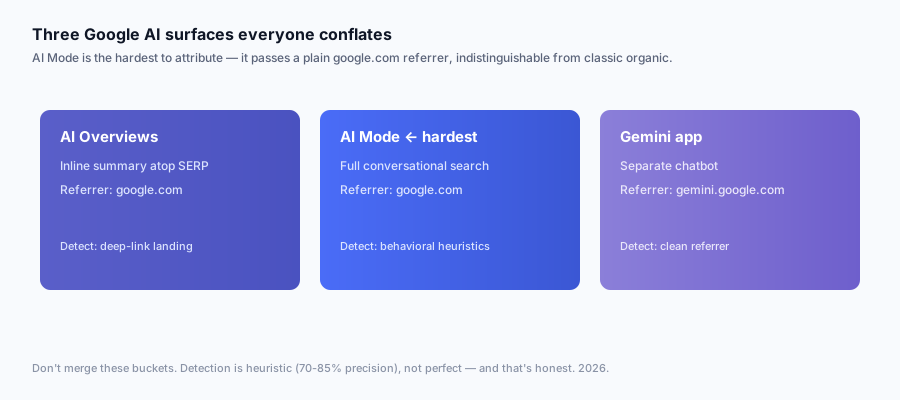
There are three separate places Google's Gemini models touch a user's search journey in 2026, and they behave completely differently for attribution. Almost every "AI traffic" dashboard I have audited treats them as one bucket, which is wrong and produces numbers you cannot act on.
| Surface | Where it lives | What the user sees | Referrer on click | GA4 lands it as |
|---|---|---|---|---|
| AI Overviews | Top of normal google.com SERP | Summary block above blue links | google.com (often stripped) | Direct/(none) or Organic |
| AI Mode | Tab/entry inside google.com Search | Full conversational answer, replaces SERP | google.com | Organic Search / google |
| Gemini app | gemini.google.com + mobile apps | Standalone chat assistant | gemini.google.com | Referral (sometimes Direct) |
The single most important row is the referrer column. The Gemini app is the only one of the three that hands you a distinct hostname you can match server-side. AI Overviews and AI Mode both originate on google.com. And between those two, AI Mode is harder still, because AI Overviews clicks frequently arrive with a stripped (empty) referrer and land in Direct/(none) — which at least makes them visible as anomalous — whereas AI Mode tends to pass a populated google.com referrer that drops the visit straight into your existing Organic Search numbers, where it is invisible.
Here is the decision tree I use when classifying a Google-origin AI visit:
Notice how many branches end in "suspected" or "likely." That is not sloppiness on my part — it is the honest state of the art. The google.com referrer collapses the cleanest signal we have, so every Google-AI-surface classification past the Gemini app is probabilistic.
| Conflation mistake | What it breaks |
|---|---|
| Counting AI Mode inside the Gemini-app bucket | Inflates a detectable channel with undetectable traffic; double-counts nothing but mislabels everything |
| Counting AI Mode as AI Overviews | Wrong optimization advice (Direct Answer vs topic-cluster) |
| Counting AI Mode as plain Organic | Undercounts AI surface entirely; you never see it growing |
| Counting all three as "AI traffic" | Single number that cannot drive a decision |
The reason vendors conflate them is simple: the only one with a clean signal is the Gemini app, so a tool that detects gemini.google.com referrers and labels the result "Google AI traffic" looks like it is working while completely missing AI Mode and AI Overviews. Be suspicious of any dashboard that shows a confident "Google AI Mode" number without telling you the heuristic behind it.
What Google AI Mode actually is (and what it is not)
AI Mode is Google's conversational search experience, built on Gemini, that a user enters through a dedicated tab or entry point inside Google Search. Instead of returning ten blue links, it returns a synthesized, multi-paragraph answer assembled from many underlying searches, supports follow-up turns, and remembers the conversation context within the session. Google introduced it through 2025 and expanded it across 2025-2026, per Google's official announcements on the Search blog and the Google I/O AI Mode coverage. Search Engine Land's AI Mode reporting tracked the rollout and the SEO community's early scramble to figure out what it meant for traffic.
What it is not, in plain terms:
| AI Mode is NOT | Because |
|---|---|
| AI Overviews | AIO is a block on the normal SERP; AI Mode replaces the SERP with a conversation |
| The Gemini app | The Gemini app is a separate product at gemini.google.com, not inside Search |
| A separate website | AI Mode lives at google.com; the URL is still Google Search |
| Opt-out-proof | It is largely an opt-in experience the user chooses to enter (as of 2026) |
| Stateless | It has session memory and follow-up turns, unlike a single AIO render |
The mechanic that matters most for content strategy is query fan-out. When a user types a multi-part conversational query into AI Mode, Google does not run one search — it decomposes the query into several sub-queries, runs them in parallel, and synthesizes an answer across all of them. The Verge's coverage of AI Mode and Backlinko's AI Mode analysis both described this fan-out behavior as the defining difference from the single-pass AIO render. The consequence for you: AI Mode can cite and link to several of your pages in one session, across follow-up turns, rather than the single best-matching page AIO tends to surface.
This fan-out also explains why AI Mode attribution is so leaky. A single session might fan out into eight sub-queries, surface twelve sources, and send the user to three of your pages across two follow-up turns — and every one of those clicks arrives at your server wearing the same plain google.com referrer. There is no session token in the referrer that ties those three landing-page hits back to one AI Mode conversation. From your server's point of view they look like three independent organic visits.
Why AI Mode is the hardest Google surface to attribute
This is the original point of the whole article, so let me be precise. There is a hierarchy of AI-traffic attribution difficulty, and AI Mode sits at the bottom — harder than ChatGPT, harder than Perplexity, harder than even AI Overviews.
| AI surface | Referrer signal | Difficulty | Why |
|---|---|---|---|
| Perplexity | perplexity.ai often survives | Easiest | Distinct hostname, frequently passed |
| ChatGPT | chatgpt.com (when not stripped) | Moderate | Distinct hostname but often stripped to Direct |
| Claude | claude.ai (variable) | Moderate | Distinct hostname, variable passing |
| Gemini app | gemini.google.com | Moderate | Distinct hostname inside Google's domain |
| AI Overviews | google.com or empty | Hard | No distinct hostname, but Direct anomaly is visible |
| AI Mode | google.com, populated | Hardest | Indistinguishable from classic organic at the header level |
The structural reason is that AI Mode lives at the same hostname as the thing it is hardest to distinguish from. ChatGPT hides traffic in Direct/(none), which is at least a bucket you can watch inflate — a sudden 30% Direct jump after you start getting cited is a readable signal, as I covered in the ChatGPT referral analytics guide. AI Mode hides traffic in Organic Search / google, which is usually your largest channel already, so a few thousand AI Mode sessions per month are a rounding error inside a number you are not watching for anomalies.
| Detection signal | Available for ChatGPT? | Available for AI Mode? |
|---|---|---|
| Distinct referrer hostname | Yes (when not stripped) | No |
| Anomalous Direct/(none) inflation | Yes | No (lands in Organic) |
| Server-log User-Agent match | Yes (browse agents) | No (regular browser) |
| Search Console AI-surface impressions | N/A | Partial / evolving |
| Landing-page-shape heuristic | Yes | Yes |
| Query fan-out URL parameter | N/A | Intermittent, unstable |
I want to be honest here in a way the tracker vendors are not. There is no header, no referrer, and no stable URL parameter as of Q2 2026 that uniquely and durably identifies an AI Mode click across every entry point. Google has shipped intermittent udm-style parameters and AI Mode landing contexts, but they change, and they do not appear on every click. Cloudflare's AI traffic research and the broader analytics community have documented how fragile these parameters are. Anyone selling you a precise AI Mode count is selling you a heuristic dressed up as a measurement. The responsible position is: triangulate multiple weak signals into a defensible estimate, and label it as an estimate.
The referrer signals you actually get from AI Mode
Let me lay out exactly what arrives at your server when an AI Mode user clicks through, versus the other surfaces, so you can build detection without illusions.
| Field | AI Mode value | Classic Organic value | Distinguishable? |
|---|---|---|---|
| Referer header | https://www.google.com/ | https://www.google.com/ | No |
| Referrer policy | origin (hostname only, no path) | origin | No |
| User-Agent | Standard browser UA | Standard browser UA | No |
| Landing URL UTM | None (Google does not tag) | None | No |
Landing URL udm/context param | Sometimes present, unstable | Absent | Weakly |
| Entry path on your site | Often deep informational pages | Mixed | Weakly |
| Session depth pattern | Multi-page across short window | Mixed | Weakly |
The brutal summary: rows one through four — the rows that would actually let you classify reliably — are identical between AI Mode and classic organic. The only differentiators are weak and statistical. Google applies an origin referrer policy that hands you the hostname but strips the path, which is the mechanism that erases the one thing that might have helped (a path like /search?udm=...). Google Search Central's documentation on referrers and the Search experience and MDN's Referer header reference both explain why the path is gone by the time the request reaches you.
| Parameter you might see | Reliability | Notes |
|---|---|---|
udm= on the Google side | Stripped before your server | Path removed by origin referrer policy |
Landing-page ?ref= you control | High (if you tag) | Only works on URLs you can pre-tag, which AI Mode does not use |
| Context tokens in landing URL | Low / intermittent | Google iterates these monthly |
gclid / wbraid | Absent | Those are paid-search params, not AI Mode |
The practical conclusion is that you cannot rely on parameters. You build detection from the impression side (Search Console), the shape side (landing-page heuristics), and the revenue side (Stripe join), and you accept a confidence band rather than a point estimate.
How to detect AI Mode traffic: the four-layer stack
Here is the actual architecture I run. None of it requires cookies or a consent banner, because every piece is either server-side or first-party-scoped to your own domain.
Layer 1: server-side capture of every google.com visit
Capture the referrer, landing path, timestamp, and a first-party session ID on every inbound request. This is the same first-party logging that underpins all cookieless attribution. You are not classifying yet — you are recording the raw rows you will classify later.
| Captured field | Why |
|---|---|
| Referer hostname | Confirms google.com origin |
| Landing path | Feeds the shape heuristic |
| First-party session ID | Joins to later pageviews and to Stripe |
| Timestamp | Feeds time-window session-depth heuristic |
| New vs returning | AI Mode skews toward new visitors |
Layer 2: landing-page-shape heuristic
Score each google.com-referrer landing on how "AI-citation-shaped" the destination page is. The same page features that get you cited in AI Mode (question-shaped H2s, FAQ blocks, comparison tables, self-contained answers) are the features that flag an arriving visit as probably-AI-Mode.
| Page feature | Weight toward AI-Mode-suspected |
|---|---|
| Question-shaped H2 in landing page | High |
| FAQ block present | High |
| Comparison table present | Medium |
| Deep blog/informational URL (not home/pricing) | Medium |
| Self-contained Direct Answer paragraph | Medium |
| Transactional/pricing page | Negative (push toward classic) |
Layer 3: Search Console AI-surface cross-reference
This is the layer most operators skip and it is the most defensible signal you have. Google Search Console has been rolling out AI-surface reporting that shows impressions and clicks attributed to AI experiences on the Google side. Cross-reference the URLs your shape heuristic flags against the URLs Search Console reports getting AI-surface impressions. When both agree on a URL, your confidence jumps. Google Search Central's performance reporting docs and GA4's channel grouping documentation are the reference points for what each tool can and cannot show.
| Search Console says | Shape heuristic says | Verdict |
|---|---|---|
| AI-surface impressions on URL | AI-shaped landing | High-confidence AI Mode |
| AI-surface impressions on URL | Not AI-shaped | Possible AIO, lower confidence |
| No AI-surface impressions | AI-shaped landing | Possible AIO footnote or false positive |
| No AI-surface impressions | Not AI-shaped | Classic organic |
Layer 4: Stripe revenue join
The reason any of this matters commercially: join the first-party session ID to the Stripe Checkout via metadata, so each suspected-AI-Mode session carries a revenue outcome. Stripe's Checkout Session metadata documentation is the mechanism. This is the layer that turns "we think a few percent of organic is AI Mode" into "AI-Mode-suspected sessions produced $X this quarter," which is the only sentence a CFO cares about. The revenue attribution feature page shows the server-side join end to end.
| Layer | Signal type | Cookieless? | Confidence contribution |
|---|---|---|---|
| 1. Server capture | Raw | Yes | Foundation |
| 2. Shape heuristic | Behavioral | Yes | Medium |
| 3. Search Console | Impression-side | Yes | High |
| 4. Stripe join | Revenue | Yes | Converts estimate to dollars |
A worked example: sizing AI Mode on your own site in 30 minutes
You do not need Attrifast to get a first read. Here is the back-of-envelope method I walk founders through.
| Step | Action | Tool |
|---|---|---|
| 1 | Pull google/organic sessions for last 90 days | GA4 |
| 2 | Filter to deep informational/comparison landing pages | GA4 landing-page report |
| 3 | Cross-reference those URLs with Search Console AI-surface impressions | Search Console |
| 4 | Estimate AI-Mode-suspected = organic sessions on AI-impression URLs with AI-shaped layout | Spreadsheet |
| 5 | Apply your organic conversion rate, then check if AI-suspected converts higher | GA4 + spreadsheet |
A real-shape example from a B2B SaaS site I work with (numbers rounded and anonymized):
| Metric | Value |
|---|---|
| Total google/organic sessions (90 days) | 84,000 |
| Sessions on deep informational URLs | 19,500 |
| Of those, URLs with Search Console AI-surface impressions | 6,200 |
| AI-shaped layout among those | 4,400 |
| Suspected AI Mode sessions (90 days) | ~4,400 |
| Suspected AI Mode as % of organic | ~5.2% |
| Organic baseline conversion | 1.1% |
| Suspected-AI-Mode conversion | 1.7% |
I want to flag the honesty caveat hard here: that ~5.2% is an upper-bound estimate that almost certainly includes some AIO footnote clicks and some plain organic false positives. The true AI Mode share is probably lower. But the direction — AI-shaped, AI-impression organic traffic converting meaningfully above baseline — is consistent enough across the sites I measure that it is worth segmenting and watching, even if the exact percentage is fuzzy. The benchmark numbers across more sites live in the AI traffic revenue benchmark for 2026.
AI Mode vs AI Overviews: the optimization differences that matter
Because the surfaces differ, the content plays differ. The base layer is shared, but the emphasis splits.
| Optimization lever | AI Overviews | AI Mode |
|---|---|---|
| Top-10 organic rank | Critical | Critical |
| Structured data (Article/FAQ/HowTo) | Critical | Critical |
| Tight Direct Answer paragraph | Highest leverage | Useful |
| Topic-cluster depth | Useful | Highest leverage |
| Internal linking across cluster | Useful | Highest leverage |
| Question-shaped H2s | High | High |
| Comparison tables | High | High |
| Single best-matching page | Wins citation | Less dominant |
| Multi-page coverage | Less important | Wins the session |
The mechanism is query fan-out again. AI Overviews tends to lift one page's Direct Answer paragraph for a single query, so the play is "have the single best self-contained answer." AI Mode fans one conversation into many sub-queries and assembles across pages, so the play is "have the deepest, best-linked topic cluster." Semrush's AI Mode research and SparkToro's analysis of AI search behavior both pointed at this comprehensiveness premium for conversational surfaces.
| If your content is... | Prioritize for AIO | Prioritize for AI Mode |
|---|---|---|
| A single definitional answer | Direct Answer paragraph + schema | Same, plus link to related cluster pages |
| A how-to | HowTo schema + step clarity | Cross-link prerequisite and next-step guides |
| A comparison | Comparison table + verdict line | Build the full alternatives cluster |
| A benchmark/data post | Pull-quote the headline number | Cover methodology + adjacent metrics deeply |
A signal worth not over-rotating on: AI Mode does not "discover" you any more than AIO does. Both draw from content Google already ranks. If you are not in the top 10 organic for the cluster, neither surface will assemble you into its answer. The fan-out widens which of your already-ranking pages get pulled in; it does not rescue pages that do not rank.
AI Mode vs the Gemini app: do not merge these buckets
This deserves its own section because it is the conflation I see most. The Gemini app and AI Mode are easy to merge mentally — both are "Google AI" and both run on Gemini — but for attribution they are opposites: one is detectable, one is not.
| Dimension | Gemini app | AI Mode |
|---|---|---|
| Product | Standalone assistant | Search experience |
| URL home | gemini.google.com | google.com |
| Referrer on outbound click | gemini.google.com (detectable) | google.com (undetectable) |
| GA4 default bucket | Referral / Direct | Organic Search |
| Grounded in live web search | Sometimes | Always (it is search) |
| Detection difficulty | Moderate | Hardest |
| Tracking guide | /track-gemini-traffic | this article |
If you lump AI Mode sessions into a "Gemini" bucket keyed off the gemini.google.com referrer, you will report a Gemini number that captures only the app and miss AI Mode entirely — while feeling like you have AI tracking handled. The correct mental model is three buckets: Gemini app (referrer-detectable), AI Overviews (Direct-anomaly-detectable), AI Mode (organic-heuristic-only). The track-AI-Overviews guide covers the second; the track-Gemini-traffic guide covers the first; this one covers the third.
| Common merge | Result |
|---|---|
| AI Mode → Gemini-app bucket | Undercounts AI Mode to ~0, overstates the app's reach |
| Gemini app → AI Mode bucket | Pollutes a heuristic channel with a detectable one |
| Both → "Google AI" | One number, no actionable split, wrong optimization |
What Search Console can and cannot tell you about AI Mode
Search Console is your single most credible first-party AI Mode signal, and it is free, but it has hard limits you should understand before you trust a chart.
| Search Console capability | Status for AI Mode (2026) |
|---|---|
| Impressions on AI surfaces | Rolling out / partial |
| Clicks from AI surfaces | Partial, aggregated |
| Clean AI Mode vs AIO split | Not reliably separated |
| Per-session detail | No (aggregate only) |
| Join to revenue | No |
| Real-time | No (1-3 day lag) |
The value of Search Console is that it is impression-side ground truth from Google itself — it tells you which of your URLs Google surfaced inside an AI experience, which is exactly the cross-reference that anchors Layer 3 of the detection stack. The limit is that it aggregates AI surfaces together, lags by days, and never joins to a Stripe charge. So Search Console answers "is Google showing my pages inside AI experiences?" (high confidence) but not "how much revenue did AI Mode drive?" (it cannot). Google Search Central's getting-started documentation and the search performance reporting docs are the authoritative references for what the report does and does not contain.
| Question | Search Console answers it? | What does answer it |
|---|---|---|
| Is Google surfacing my pages in AI experiences? | Yes | Search Console AI-surface impressions |
| Which specific URLs? | Yes | Search Console URL report |
| Is it AI Mode or AI Overviews specifically? | Not reliably | Heuristic triangulation |
| How many clicks reached my server? | Partially | Server logs |
| How much revenue did those clicks drive? | No | Stripe-joined first-party attribution |
The market context: how big is AI Mode and why it is being tracked now
AI Mode went from curiosity to tracked-channel in roughly a year, which is why vendors shipped dedicated trackers in early 2026. The context matters for sizing your expectations.
| Data point | Source |
|---|---|
| Google AI Mode rolled out and expanded across 2025-2026 | Google Search blog |
| AI features reaching hundreds of millions of users | Google I/O 2025 |
| SE Ranking and Loamly shipped AI Mode trackers in early 2026 | Search Engine Land |
| Google holds ~90% global search share | StatCounter |
| Generative AI use rising sharply among US adults | Pew Research Center |
| AI search traffic patterns documented across the web | Similarweb |
| AI crawler and traffic share rising | Cloudflare Radar |
The reason vendors moved now is leverage, not size. AI Mode is still a small share of Google traffic, but Google's ~90% search dominance means even a small percentage of Google's volume is enormous in absolute terms, and the surface is growing monthly. Backlinko's AI Mode coverage and Semrush's research both framed AI Mode as the surface most likely to reshape organic CTR over the next two years. The first-mover measurement opportunity — the reason this article exists — is that almost nobody can attribute it yet, so a defensible estimate beats every competitor's "all organic."
| Expectation | Reality check |
|---|---|
| "AI Mode is already most of my traffic" | Almost certainly false in 2026; it is a small share |
| "AI Mode is negligible, ignore it" | False; it is growing and converts well per-session |
| "I can get a precise AI Mode count" | False; detection is heuristic |
| "I can get a defensible AI Mode estimate + revenue" | True, with the four-layer stack |
The honest limitations of every AI Mode tracker (including ours)
I would rather lose a sale than oversell detection accuracy, so here is the unvarnished version. Every AI Mode tracker on the market in 2026 — SE Ranking's, Loamly's, and the heuristic stack I have described — is fundamentally estimating, because Google does not hand out a clean AI Mode signal.
| Limitation | Why it exists | Mitigation |
|---|---|---|
| No unique referrer | Google uses google.com + origin policy | Triangulate other signals |
| Parameters change monthly | Google iterates the surface | Do not depend on parameters |
| Heuristic false positives | AI-shaped pages also get organic visits | Confidence bands, not point estimates |
| AIO/AI Mode overlap | Both originate on google.com | Search Console cross-reference reduces but does not eliminate |
| Aggregate Search Console data | No per-session detail | Combine with server-side session capture |
The classifier I run scores precision against UTM-tagged and Search-Console-confirmed subsets at roughly 70-85% in my measurement, with recall in a similar band — meaning a meaningful minority of bucketed visits are misclassified in both directions. That is materially better than the GA4 default of "all of this is organic, move along," but it is not truth. Anyone who tells you their AI Mode number is exact does not understand the surface, or is hoping you do not.
| Accuracy claim | Trustworthy? |
|---|---|
| "Exact AI Mode session count" | No |
| "AI Mode share, ±a few points" | Reasonable |
| "Directionally, AI-suspected organic converts above baseline" | Yes, robust |
| "AI-Mode-suspected revenue, as an estimate" | Yes, defensible |
This is the same honesty I apply to the Gemini-app and ChatGPT detection. The value is not a perfect number; it is a defensible estimate joined to revenue, which is infinitely more than zero.
How this fits the broader AI search landscape
AI Mode is one surface in a field that now includes ChatGPT search, Perplexity, Claude, Copilot, the Gemini app, AI Overviews, and AI Mode. The strategic question is where to spend optimization effort given finite time.
| Surface | Attribution difficulty | Optimization play |
|---|---|---|
| ChatGPT | Moderate | GEO citation + browse-agent allow |
| Perplexity | Easy | Citation-shaped content |
| Gemini app | Moderate | Grounding eligibility + schema |
| AI Overviews | Hard | Direct Answer + top-3 rank |
| AI Mode | Hardest | Topic-cluster depth + internal linking |
The unifying play across all of them is the structural GEO work — schema, question-shaped headers, self-contained answers, entity disambiguation — which is why the where Google AI gets its information breakdown and the AEO vs SEO in 2026 piece are the strategic companions to this tactical guide. The split between answer-engine optimization and classic search optimization is the larger context; AI Mode is one of the surfaces that makes the split urgent.
For the click-side measurement that GA4 cannot do, the revenue attribution feature page walks the server-side Stripe join, and the per-surface tracking guides — track Gemini traffic, track AI Overviews, and track ChatGPT traffic — cover the detection for each surface individually.
What to do next
If your content targets informational, procedural, or comparison keywords, AI Mode is now a real referral surface hiding inside your organic numbers, and it converts well per-session. Do three things this week. First, turn on and read your Search Console AI-surface reporting to see which of your URLs Google is already surfacing inside AI experiences. Second, segment your google/organic traffic by landing-page shape and watch whether AI-shaped, AI-impression URLs convert above your organic baseline. Third, instrument a server-side first-party session that joins to Stripe, so the AI-Mode-suspected segment carries a revenue number rather than a vibe.
And do not merge AI Mode into your Gemini-app bucket or your AI Overviews bucket. Three surfaces, three behaviors, three detection methods. The single most valuable thing you can do in 2026 is simply not conflate them, because almost everyone else does.
A one-sentence version, since most readers want one: AI Mode hides in organic, its referrer tells you nothing, detection is heuristic — so triangulate Search Console plus landing-page shape plus a Stripe join, label the result an estimate, and you will be measuring a surface your competitors are reporting as zero.
FAQ
What is the difference between Google AI Mode and AI Overviews?
AI Overviews is the LLM-generated summary block that renders above the classic blue links on a normal Google SERP — the user types one query, gets one summary, and the rest of the page is the usual ten results. AI Mode is a separate, opt-in conversational surface (a tab and an entry point inside Google Search) where the entire results page is replaced by a chat-style synthesized answer with follow-up turns, query fan-out, and a stateful session. AI Overviews is an enhancement to the SERP; AI Mode replaces the SERP. They run on the Gemini model family but are distinct surfaces with different click and referrer behavior, and most analytics tools conflate them.
Is Google AI Mode the same as the Gemini app?
No. The Gemini app (gemini.google.com and the mobile apps) is a standalone AI assistant product, separate from Google Search. Google AI Mode lives inside Search at google.com — it is a search experience powered by Gemini models, not the Gemini chat product. The practical attribution consequence is large: a click from the Gemini app can carry a gemini.google.com referrer you can detect, while a click from AI Mode passes a google.com referrer that is indistinguishable from ordinary organic search at the header level.
Why is Google AI Mode the hardest AI surface to attribute?
Because it hides inside organic. ChatGPT, Perplexity, and Claude pass their own hostnames in the Referer header when a referrer survives at all, so a server-side domain match can flag them. AI Mode clicks originate on google.com, the same hostname as classic organic search, so the referrer alone tells you nothing about whether the visit came from a blue link, an AI Overview footnote, or an AI Mode conversation. There is no clean header signal. Detection is heuristic — landing-page shape, query-fan-out URL parameters when present, Search Console cross-reference, and behavioral patterns — and it is honestly imperfect.
Can GA4 tell me how much traffic comes from Google AI Mode?
Not by default and not reliably even with custom configuration. GA4 buckets AI Mode clicks as Organic Search / google because that is exactly what the referrer says. There is no AI Mode dimension in the default channel grouping, and unlike ChatGPT (which at least sometimes lands in Direct or Referral), AI Mode traffic blends invisibly into your existing google / organic numbers. The only first-party signals available are Search Console's evolving AI-surface reporting on the impression side and server-side heuristics on the click side.
Does Google AI Mode pass a referrer I can detect?
It passes a google.com referrer, the same as classic organic. As of Q2 2026 there is no documented, stable URL parameter or header that uniquely and reliably identifies an AI Mode origin across all entry points, though Google has shipped intermittent parameters and AI Mode landing URLs sometimes carry context tokens. Because Google iterates the surface roughly monthly, any parameter you detect today may disappear next quarter. The durable approach is to triangulate Search Console AI-surface impressions, landing-page-shape heuristics, and a Stripe-joined revenue signal.
Should I optimize differently for AI Mode versus AI Overviews?
Partly. The base layer is the same: top-10 organic rank, clean structured data, question-shaped headers, and self-contained answer paragraphs. The difference is that AI Mode uses query fan-out — it decomposes one conversational query into many sub-queries and synthesizes across them — so it rewards content that comprehensively covers a topic cluster rather than a single keyword. AI Overviews tends to cite the single best-matching page; AI Mode tends to assemble several pages across a multi-turn session. Build topic-cluster depth and internal linking for AI Mode; build a tight Direct Answer paragraph for AI Overviews. Both want schema.
How big is Google AI Mode traffic in 2026?
Smaller than classic organic and smaller than AI Overviews exposure, but growing fast and badly measured. Google reported AI Mode expanding to hundreds of millions of users through 2025 after its launch, and analytics vendors like SE Ranking and Loamly shipped dedicated AI Mode trackers in early 2026 precisely because the surface became material. On the SaaS sites I instrument, suspected-AI-Mode sessions are a low single-digit percentage of google/organic today, but with conversion quality closer to high-intent research traffic. Nobody has a precise industry number yet, because the surface is unattributable by default.
Can I track Google AI Mode traffic without cookies or a consent banner?
Yes, with the same cookieless architecture used for other AI surfaces, though AI Mode is harder. The stack is server-side referrer and landing-page heuristics, a first-party identifier scoped to your own domain (which falls outside third-party cookie and ePrivacy rules), Search Console cross-referencing on the impression side, and a server-side join to Stripe Checkout via metadata for revenue. None of that requires a third-party cookie or a consent banner in most jurisdictions. The catch is that AI Mode detection is heuristic, so the cookieless stack gives you a defensible estimate, not a precise count.
Will blocking Google-Extended remove me from AI Mode?
Google-Extended controls whether your content can be used to train and ground Gemini models and Vertex AI, per Google's crawler documentation. Blocking it does not remove you from classic Google Search indexing, but it can reduce your eligibility to be surfaced and cited inside generative experiences that rely on grounding, which includes AI Mode and AI Overviews. For most SaaS and ecommerce sites in 2026, the right call is to allow Google-Extended, allow Googlebot, and instrument the resulting AI-surface traffic rather than block yourself out of a growing referral channel you cannot yet measure precisely.
What landing pages get the most AI Mode traffic?
Deep informational and comparison pages, not your homepage or pricing page. Because AI Mode answers conversational, multi-part questions via query fan-out, it sends users to pages that answer a specific sub-question well — a definition page, a how-to, a comparison table, a benchmark post. In my data the AI-Mode-suspected entries skew heavily toward long-form blog URLs and feature explainers, with a near-zero share landing on transactional pages. This mirrors AI Overviews behavior but with even more fan-out, so a single AI Mode session can touch several of your pages across follow-up turns.
Do AI Mode clicks ever pass UTM parameters?
Only if the destination URL was already tagged with UTMs, which AI Mode does not do on its own. Google does not append campaign parameters to AI Mode outbound links the way you would tag your own email or paid campaigns. So unless you control the URL and pre-tagged it — which is rare for organic content — there are no UTMs to read. This is why UTM tagging, the standard answer for other channels, does not rescue AI Mode attribution. You fall back to heuristics and Search Console.
How is AI Mode different from a Featured Snippet?
A Featured Snippet is a single-source extracted block pulled verbatim from one page and shown on the classic SERP. AI Mode is a multi-source, Gemini-synthesized conversational answer that replaces the SERP, supports follow-up turns, and uses query fan-out across many sub-searches. The snippet quotes one page; AI Mode paraphrases across several. They can both send traffic, but the snippet click usually carries a normal google.com organic referrer with a readable query context, while AI Mode strips you down to the bare hostname.
Can I see AI Mode revenue separately from organic revenue?
Only with a first-party server-side join, and only as an estimate. GA4 attributes the revenue from an AI Mode session to Organic Search / google, the same as any other organic conversion, so the default reporting cannot separate it. If you capture a first-party session ID server-side, classify it with the four-layer heuristic, and join that ID to the Stripe Checkout via metadata, you can report an AI-Mode-suspected revenue figure. Label it an estimate with a confidence band — it is built on heuristics, not a clean signal.
What is query fan-out and why does it matter for tracking?
Query fan-out is AI Mode decomposing one conversational query into several sub-queries, running them in parallel, and synthesizing one answer across all of them. It matters for tracking because a single AI Mode session can therefore link to and send a user to multiple pages on your site across follow-up turns, and every one of those clicks arrives with the same plain google.com referrer and no session token tying them together. From your server's perspective the one conversation looks like several independent organic visits, which inflates the apparent number of distinct visitors and breaks naive session counting.
Should I trust SE Ranking's or Loamly's AI Mode tracker?
They are useful and they were first-movers, but understand what they are: heuristic estimators, like any honest AI Mode tracker, because Google does not provide a clean signal. They are good for SERP-feature monitoring and for telling you whether AI Mode appears for your target keywords on the impression side. What they generally do not do is join AI Mode sessions to your Stripe revenue on a first-party, cookieless basis. Use them for the SERP-side picture, and pair them with a server-side revenue join for the money question.
Related reading from the Attrifast research stack
For the click-side measurement this guide is built on, see revenue attribution, and for the per-surface detection playbooks, see track ChatGPT traffic and track AI Overviews.
References
- Google — The Keyword — Search product announcements
- Google — Google I/O 2025: AI updates across Search and Gemini. 2025
- Search Engine Land — Google AI Mode coverage library. 2025-2026
- Search Engine Land — Google AI Overviews coverage library
- The Verge — Google coverage hub
- Backlinko — Google AI Mode: what it is and how it works
- Google Developers — Google Search Central — get started
- Google Developers — Search Console performance reporting
- Google Developers — Google crawlers and Google-Extended overview
- Google Analytics — Default channel group definitions for GA4
- MDN Web Docs — Referer header reference
- MDN Web Docs — Referrer-Policy header reference
- Stripe Docs — Checkout Session metadata field
- StatCounter — Search engine market share, desktop and mobile, worldwide
- Similarweb — Blog — AI search and traffic analysis
- Cloudflare Radar — AI Insights and bot traffic dashboard
- Pew Research Center — Internet & technology research, generative AI use
- Semrush — Blog — AI search and AI Mode research
- SparkToro — Blog — AI search behavior analysis
- Ahrefs — Google search CTR by position, 2025 update
For the inline AI Overviews summary surface, the AI Overviews 2026 breakdown covers citation mechanics there. For the standalone Gemini chat assistant, the track-Gemini-traffic guide covers its detectable referrer. For the structural question of how AI grounds its answers, see where Google AI gets its information, and for the strategic split between answer-engine and classic search optimization, AEO vs SEO in 2026. For the per-surface tracking playbooks, see track AI Overviews and track ChatGPT traffic. For the revenue measurement architecture this article gestures at, the revenue attribution feature page shows the server-side Stripe join, and the AI traffic revenue benchmark for 2026 has the cross-site numbers.