
Part of the generative engine optimization guide, AEO Hub, and AI Search Hub.
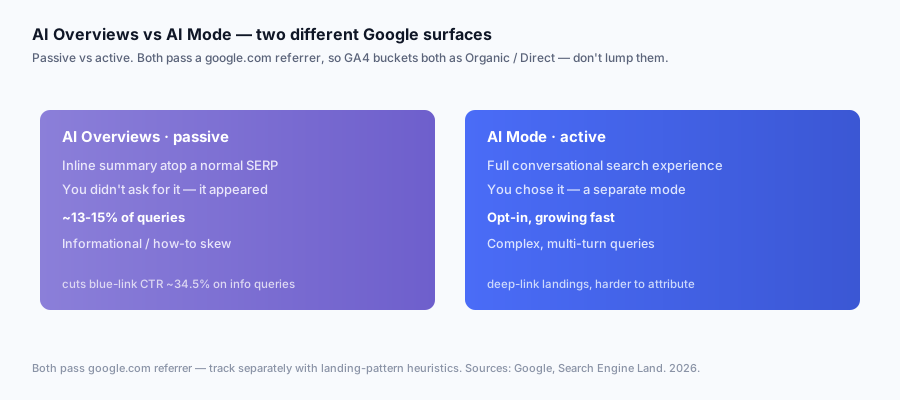
The cleanest way to keep Google's two AI search surfaces straight is one sentence I repeat to every founder who asks me which is which: AI Overviews is the answer you didn't ask for, and AI Mode is the answer you went looking for. AI Overviews shows up passively at the top of a normal search results page; you typed a query and Google decided to paste an AI summary above the blue links. AI Mode is the opposite — the user actively chooses to enter a conversational surface where the entire results page is replaced by a chat-style answer with follow-up turns and query fan-out. They both run on Gemini, they both pass a google.com referrer that makes them nearly impossible to attribute in GA4, and they behave nothing alike. Lumping them together is the most common mistake I see in 2026, and it produces numbers you cannot act on.
This is the disambiguation companion to two earlier pieces. The AI Mode tracking guide is the how-to for instrumenting AI Mode specifically; the AI Overviews 2026 breakdown covers the summary block's ranking and citation mechanics. This article does the thing neither of those does cleanly and almost nobody does at all: put the two surfaces side by side, axis by axis, so you stop confusing them — and then show why their shared google.com referrer means you have to track each one differently even though GA4 buckets both the same. I have spent the last several months watching both surfaces across attrifast.com and a handful of client SaaS properties, so the numbers here are a mix of published research and my own first-party measurement, labeled as such.
Quick Facts: the two surfaces at a glance
The fastest answer for anyone who landed here from a search and wants the disambiguation in one table: AI Overviews is the passive summary block on a normal SERP, AI Mode is the active conversation that replaces the SERP, and the only thing they share completely is that both hide from GA4 behind a google.com referrer.
| Spec | AI Overviews | AI Mode |
|---|---|---|
| What it is | AI summary block on the normal SERP | Full conversational search surface |
| Posture | Passive (you didn't ask for it) | Active (you chose to enter it) |
| Replaces the SERP? | No — sits above the blue links | Yes — replaces the results page |
| Underlying model | Gemini family | Gemini family |
| Trigger | Google's classifier, automatic | User opt-in (tab / entry point) |
| US English appearance rate | ~13-15% of SERPs (Q1 2026) | Gated by opt-in, smaller today |
| Follow-up turns / memory | No — single render | Yes — stateful session |
| Query fan-out | Limited | Yes — core mechanic |
| Sources cited per answer | 4-7 typical | More, across turns |
| Referrer on outbound click | google.com (often stripped) | google.com (usually populated) |
| GA4 default classification | Direct/(none) or Organic | Organic Search / google |
| Easiest detection wedge | Direct/(none) anomaly | Landing-page shape + Search Console |
| Best optimization lever | Tight Direct Answer paragraph | Topic-cluster depth + internal links |
| Attribution difficulty | Hard | Hardest |
If you remember nothing else, remember the posture row and the referrer row. Posture (passive vs active) is the conceptual difference that drives everything about how they behave. The shared google.com referrer is the technical reason both are invisible in default analytics. Everything below is an expansion of those two rows.
What AI Overviews actually is (the passive surface)
AI Overviews is the LLM-generated answer block that renders above the classic blue links on roughly 13-15% of US English Google SERPs as of Q1 2026, and the defining word for it is passive. The user typed an ordinary query into Google; the SERP just happened to surface an AI summary above the usual ten results. There was no opt-in, no separate destination, no conversation. It launched broadly in May 2024 after a year of labs-stage testing under the SGE (Search Generative Experience) name, per Google's official Search blog, and the appearance rate has crept up from roughly 7% at launch.
The block ships with 4-7 cited source links beside or beneath the generated text. Clicking a source takes the user to the cited page — sometimes with a Referer header, often without. There is exactly one render, no follow-up turn, and no conversation memory. The user reads the summary, maybe clicks a footnote, and either leaves satisfied (a zero-click outcome) or scrolls down to the blue links.
| AI Overviews IS | AI Overviews is NOT |
|---|---|
| A summary block on the normal SERP | A separate product or destination |
| Automatic / passive | Opt-in |
| A single render with no memory | A conversation with follow-up turns |
| Above the classic blue links | A replacement for the blue links |
| Built on Gemini | The Gemini app |
The mental model that keeps people honest: AI Overviews is an enhancement to the search results page. The page is still a Google SERP. The AI part is a layer pasted on top. When marketers say "I'm losing traffic to AI," nine times out of ten in 2026 they mean AI Overviews, because it is the surface that touches the most searches automatically.
It also helps to know the naming history, because the old labels still float around in vendor docs and confuse the comparison:
| Name | What it refers to | Status in 2026 |
|---|---|---|
| SGE (Search Generative Experience) | Labs-stage prototype, 2023-2024 | Retired name; became AI Overviews |
| AI Overviews | Production summary block | Live, ~13-15% of US SERPs |
| AI Mode | Conversational search surface | Live, opt-in, growing |
| Gemini app | Standalone assistant product | Live, separate from Search |
Conflating SGE with AI Overviews is mostly harmless (one became the other), but conflating either of them with AI Mode or the Gemini app is the mistake that breaks attribution.
What AI Mode actually is (the active surface)
AI Mode is Google's conversational search experience, built on Gemini, that a user deliberately enters through a dedicated tab or entry point inside Google Search — and the defining word for it is active. Instead of returning ten blue links with maybe a summary on top, AI Mode replaces the entire results page with a synthesized, multi-paragraph answer assembled from many underlying searches, supports follow-up turns, and remembers the conversation context within the session. Google introduced it through 2025 and expanded it across 2025-2026, per Google's Search announcements and the Google I/O 2025 AI coverage.
The mechanic that separates AI Mode from everything else is query fan-out. When a user types a multi-part conversational query into AI Mode, Google does not run one search — it decomposes the query into several sub-queries, runs them in parallel, and synthesizes one answer across all of them. Search Engine Land's AI Mode reporting and Backlinko's AI Mode analysis both described fan-out as the defining difference from the single-pass AI Overviews render.
| AI Mode IS | AI Mode is NOT |
|---|---|
| A conversational surface inside Search | The AI Overviews summary block |
| Opt-in / active | Automatic on a normal SERP |
| A stateful session with memory | A single stateless render |
| A replacement for the SERP | A layer on top of the SERP |
| Living at google.com inside Search | The standalone Gemini app |
The consequence of fan-out for content strategy is large: AI Mode can cite and link to several of your pages in one session, across follow-up turns, rather than the single best-matching page AI Overviews tends to surface. One conversation might touch your definition page, your comparison post, and your pricing explainer. That is why AI Mode rewards topic-cluster depth while AI Overviews rewards a single tight answer — a point I return to in the optimization section.
Because AI Mode is a session rather than a render, it behaves differently across a visit than AI Overviews does:
| Session behavior | AI Overviews | AI Mode |
|---|---|---|
| Memory of prior query | None | Yes, within the session |
| Refine without re-typing context | No | Yes, follow-up turns |
| Pages cited over a full visit | Typically one batch | Accumulates across turns |
| Visits per "answer" | One | Several possible |
| What your server sees | One inbound click | Several look-alike clicks |
Passive vs active: the one distinction everything else flows from
If I had to defend a single thesis in this article, it is this: AI Overviews is passive and AI Mode is active, and that one difference predicts every other difference between them. Trigger rate, query types, citation behavior, CTR impact, and optimization strategy all fall out of the passive-versus-active split. Internalize this and the rest is bookkeeping.
| Consequence | Because AI Overviews is passive | Because AI Mode is active |
|---|---|---|
| Who decides it appears | Google's classifier | The user (opt-in) |
| Exposure ceiling | Set by Google's trigger rate | Set by user adoption |
| User intent at the moment | Mid-search, maybe skimming | Committed to exploring an answer |
| Number of answers per visit | One render | Many turns |
| Pages it can send you | Usually one best match | Several across a session |
| What it competes with | The blue links below it | The entire classic SERP |
| Your control over exposure | Indirect (rank + format) | Indirect (rank + topic depth) |
Here is the search journey for each, side by side, so the divergence is visible:
Notice both paths terminate in the same node: a google.com-referrer visit to your site. That convergence at the end is the entire attribution problem. Two completely different journeys produce an identical-looking inbound click. Hold that thought; it is the bridge to the tracking half of this article.
Trigger rate: how often each one shows up
AI Overviews shows up far more often than AI Mode today, because AI Overviews is automatic and AI Mode requires the user to opt in. As of Q1 2026, AI Overviews appears on roughly 13-15% of US English SERPs per Search Engine Land tracking, with no user action required. AI Mode's exposure is gated by how many users adopt the conversational habit, which makes it a smaller surface in 2026 even though it is growing faster.
| Trigger dimension | AI Overviews | AI Mode |
|---|---|---|
| What triggers it | Google's query classifier | User opt-in |
| US English SERP appearance | ~13-15% (Q1 2026) | N/A — not a passive SERP feature |
| Growth driver | Classifier expansion | User adoption |
| Informational query | ~40% trigger | High, if user is in AI Mode |
| Procedural ("how to") | >50% trigger | High, if user is in AI Mode |
| YMYL (medical/legal/financial) | 5-8% trigger | Conservative even in AI Mode |
| Transactional / branded | <3% trigger | Lower — fan-out favors research |
| Device skew | Slightly higher on mobile | Skews toward engaged users |
The key conceptual difference: AI Overviews trigger rate is a property of the query (Google decides per search whether to render the block), while AI Mode "trigger rate" is really a property of the user (did they choose to be in AI Mode at all). You can roughly estimate AI Overviews exposure from Search Console impression patterns. You cannot estimate AI Mode exposure the same way, because it depends on adoption you do not control and Google does not report per-URL.
| Query class | AI Overviews behavior | AI Mode behavior |
|---|---|---|
| "what is X" | Frequently triggers a summary | Strong fit for conversation |
| "how to do X" | Triggers above 50% | Strong fit, fans out into steps |
| "X vs Y" | Often triggers a comparison block | Excellent fit — fan-out shines |
| "best X for Y" | Variable, commercial-sensitive | Good fit, multi-source synthesis |
| "buy X" / branded | Rarely triggers | Rare — low conversational value |
Comparison queries — the exact category this article targets — are where both surfaces are most active and where the optimization payoff is highest. A clean comparison table like the ones throughout this piece is precisely the structure both surfaces like to lift.
Query types: what each surface is good at answering
The two surfaces favor different query shapes because of the passive-active split. AI Overviews is strongest on the single, well-formed informational or procedural query — the kind a classifier can confidently flag as "good fit for a summary." AI Mode is strongest on the messy, multi-part, exploratory query that benefits from fan-out and follow-up turns.
| Query shape | Better served by | Why |
|---|---|---|
| Single factual question | AI Overviews | One render answers it cleanly |
| Multi-part exploratory question | AI Mode | Fan-out decomposes and synthesizes |
| "Compare A, B, and C on price and X" | AI Mode | Synthesis across sources per turn |
| "How do I do X step by step" | Either | AIO summarizes; AI Mode walks turns |
| Follow-up that refines a prior question | AI Mode only | AIO has no memory |
| Quick fact-check mid-search | AI Overviews | Passive, no opt-in friction |
This is why I tell content teams that AI Overviews rewards answer quality on one page and AI Mode rewards coverage across a cluster. If your site answers "what is revenue attribution" beautifully on one page, you have a shot at the AI Overview. If your site also covers "how does cookieless attribution work," "attribution vs analytics," and "how to track Stripe revenue" across linked pages, you have a shot at being cited multiple times inside one AI Mode session.
UI placement: where each appears in the SERP
Where the two surfaces physically render is the most visible difference and the one users actually feel. AI Overviews occupies the top slice of an otherwise-normal results page; AI Mode occupies the whole screen because it is a different surface entirely.
| UI aspect | AI Overviews | AI Mode |
|---|---|---|
| Location | Top of the normal SERP | Replaces the SERP |
| Blue links still visible? | Yes, below the block | No — conversation only |
| Entry mechanism | Appears automatically | Tab / entry point the user taps |
| Persistence | One render, then gone on new query | Stateful session, follow-ups |
| Source presentation | 4-7 footnotes by/under text | Linked sources across turns |
| Scroll behavior | User can scroll past to links | User stays in conversation |
The three exit nodes — footnote click, blue-link click, source click — all leave Google with a google.com referrer. Visually they could not be more different (a footnote in a summary block, a classic blue link, a source inside a conversation), but to your server they are indistinguishable. That visual-versus-technical gap is the heart of why measurement is so hard.
Citation behavior: how each picks and shows sources
AI Overviews and AI Mode both cite sources, but they cite differently because one is a single render and the other is a multi-turn synthesis. AI Overviews typically cites 4-7 sources for one query, drawn from a narrower "trusted" allowlist, and favors the page already ranking in the top three. AI Mode cites across turns, can surface more sources cumulatively, and assembles answers from several pages because of fan-out.
| Citation dimension | AI Overviews | AI Mode |
|---|---|---|
| Sources per answer | 4-7 typical, one query | More, accumulated across turns |
| Source pool | Narrower trusted allowlist | Broader, per sub-query |
| Who gets cited most | Top-3 organic rankers | Best match per sub-query |
| Pages from one site per answer | Usually one | Potentially several |
| Cite stability | Per render | Evolves through the session |
| What earns the cite | Tight, liftable answer | Cluster coverage + relevance |
Per Semrush AI Overviews research, pages in positions 1-3 are cited in AI Overviews roughly four times more often than pages in positions 4-10, and BrightEdge's generative-search research tracked how AI surfaces lean on already-strong organic pages. The implication: AI Overviews citation is mostly downstream of organic rank, while AI Mode citation is downstream of cluster coverage — being the best match for each of the many sub-queries a fan-out generates.
| If your goal is... | Then prioritize... | Which surface it helps |
|---|---|---|
| Win the single-answer cite | One liftable Direct Answer paragraph | AI Overviews |
| Win multiple cites per session | Topic-cluster depth + internal links | AI Mode |
| Win both | Rank top-3 AND cover the cluster | Both |
CTR impact: which one costs you more clicks
AI Overviews costs you more clicks in aggregate today, because it appears automatically on far more searches and pushes the blue links down the page. Per Backlinko's AI Overviews study and Ahrefs' click-through research, organic blue-link CTR drops roughly 30-40% on informational queries when an AI Overview renders, and the cited footnotes claw back only 2-4%. AI Mode, being opt-in, affects fewer total searches, but for the searches it does capture the blue-link page is gone entirely — so the CTR impact per session is near total for any page that is not cited.
| CTR dimension | AI Overviews | AI Mode |
|---|---|---|
| Blue-link CTR drop (info) | ~30-40% | Near total for that session |
| Blue-link CTR drop (commercial) | ~10-15% | Lower volume, high per-session |
| Cited footnote / source CTR | ~2-4% | Variable, across turns |
| Aggregate click impact (2026) | Larger (more searches) | Smaller (opt-in) but rising |
| Per-session click impact | Partial (links still below) | Total (no links shown) |
| Net effect if you ARE cited | Recover some traffic | Capture the session's clicks |
| Net effect if you are NOT cited | Absorb the CTR hit | Invisible for that session |
The asymmetry is the practical takeaway: AI Overviews is a volume threat (it touches many searches and shaves a slice off each), while AI Mode is an intensity threat (it touches fewer searches but takes all the clicks for each one it captures). Both make citation — not just ranking — the lever that decides whether you get traffic. This is also why zero-click search is now a revenue question, not a vanity metric: the searches you lose to an uncited AI answer never reach your analytics at all.
Mid-article reality check: both of these surfaces send you traffic that GA4 reports as Organic Search / google or Direct/(none) — never as "AI." If you are trying to prove AI search drives revenue, the default reports actively work against you. See the per-surface revenue split inside Attrifast → Start free trial
Referrer signal: the one thing they share, and why it breaks GA4
Here is the cruel irony at the center of this whole comparison: AI Overviews and AI Mode differ on every axis above, but they share the one axis that matters most for measurement — both pass a google.com referrer. Neither hands you a distinct hostname the way ChatGPT, Perplexity, or the standalone Gemini app do. So at the HTTP header level, you cannot tell an AI Overviews footnote click, an AI Mode source click, and a classic blue-link click apart.
| Referrer field | AI Overviews | AI Mode | Classic Organic | Distinguishable? |
|---|---|---|---|---|
| Referer hostname | google.com | google.com | google.com | No |
| Referer often stripped? | Yes (frequently empty) | No (usually populated) | No | Partially |
| Distinct URL parameter | None stable | Intermittent udm-style | None | No |
| UTM tags | None unless you tagged | None unless you tagged | None | No |
| User-Agent | Normal browser | Normal browser | Normal browser | No |
Contrast that with the surfaces that do give you a clean hostname, so the gap is obvious:
| AI surface | Referrer hostname | Server-side detectable by hostname? |
|---|---|---|
| Perplexity | perplexity.ai (often survives) | Yes |
| ChatGPT | chatgpt.com (when not stripped) | Yes, when present |
| Claude | claude.ai (variable) | Yes, when present |
| Gemini app | gemini.google.com | Yes |
| AI Overviews | google.com or empty | No |
| AI Mode | google.com, populated | No |
GA4 sees exactly what the referrer says. A stripped AI Overviews click with no referrer and no UTM becomes Direct/(none). A populated AI Mode click becomes Organic Search / google. Neither becomes "AI." Per Google Analytics' default channel definitions, there is no AI channel and no rule that would create one. And per the MDN Referrer-Policy reference, the stripping behavior is governed by policy headers you do not control. This is structural, not a config bug you can fix in the GA4 UI.
Every branch past the hostname check ends in "suspected" or "likely." That is not hedging for its own sake — it is the honest state of the art. The shared google.com referrer collapses the cleanest signal we have, so every Google-AI-surface classification is probabilistic.
How GA4 buckets each one (and why both vanish)
GA4 does not have an AI Overviews channel or an AI Mode channel, and it will not create one for you. The two surfaces land in different default buckets for the same root reason — Google does not pass a distinguishing signal — but the buckets differ because of the stripping difference.
| GA4 behavior | AI Overviews | AI Mode |
|---|---|---|
| Default channel | Direct/(none) (often) or Organic | Organic Search / google |
| Why | Referrer frequently stripped | Referrer populated as google.com |
| Visible as anomaly? | Yes — Direct inflation | No — blends into organic |
| Built-in AI dimension | None | None |
| Custom channel rescues it? | No | No |
| What you actually see | Unexplained Direct growth | Nothing — silent |
The paradox worth sitting with: AI Overviews is technically harder to read at the header level because the referrer is gone, yet it is more visible because the Direct/(none) anomaly is something you can watch inflate. AI Mode hands you a populated referrer that should help — but it is the wrong referrer, google.com, which actively buries the visit inside your largest existing channel. So the surface with the better referrer is the harder one to notice. This is why I rank AI Mode the hardest Google surface to attribute, with AI Overviews close behind, both covered more deeply in the dark AI traffic in GA4 piece.
| Attribution difficulty | Surface | Reason |
|---|---|---|
| Hardest | AI Mode | Indistinguishable from classic organic |
| Hard | AI Overviews | No hostname, but Direct anomaly visible |
| Moderate | Gemini app | Distinct hostname inside Google's domain |
| Moderate | ChatGPT | Distinct hostname, often stripped |
| Easiest | Perplexity | Distinct hostname, frequently passed |
How to track AI Overviews (the passive surface)
You track AI Overviews by watching for its fingerprint, because you will never get a clean referrer. The fingerprint is a correlation: anomalous Direct/(none) inflation that lines up with a Search Console pattern of impressions flat-or-up while click-through-rate falls on informational URLs. That divergence is the signature of an AI Overview eating clicks above your listing.
| AI Overviews tracking layer | What it catches | Confidence |
|---|---|---|
| Search Console impression-up / CTR-down divergence | URLs where AIO likely renders | Medium |
| Direct/(none) anomaly correlation | Stripped AIO citation clicks | Low-medium |
| Landing-page-shape heuristic | AIO-style informational entries | Low-medium |
| Manual incognito SERP check | Confirms AIO presence per query | High but unscalable |
| Server-side first-party session + Stripe join | Revenue on suspected segment | Estimate |
The practical recipe I run: use Search Console to find candidate URLs (the impression-up, CTR-down ones), confirm the top ones with a manual logged-out search to see the AI Overview block, then segment first-party server-side sessions on those URLs and join them to Stripe to put a revenue number on the suspected-AIO segment. It is an estimate with a confidence band, not a count. The full step-by-step lives on the track AI Overviews page and the get cited by Google AI Overviews guide covers the optimization side.
How to track AI Mode (the active surface)
You track AI Mode by triangulating four weak signals, because the populated google.com referrer gives you nothing on its own. No single signal is reliable; the combination is defensible. This is the harder of the two and I will not pretend the output is precise.
| AI Mode tracking layer | What it catches | Confidence |
|---|---|---|
| Search Console AI-surface impressions | URLs surfaced inside AI Mode | Medium, evolving |
| Landing-page-shape heuristic | Deep informational / comparison entries | Low-medium |
| Query fan-out URL signals | Intermittent udm-style parameters | Low, unstable |
| Multi-page session pattern | One visitor touching several pages | Low-medium |
| Server-side first-party session + Stripe join | Revenue on suspected segment | Estimate |
The recipe: segment populated-google.com organic sessions that land on deep informational or comparison URLs, cross-reference Search Console AI-surface impressions on those URLs, watch for the multi-page session shape that fan-out produces, and join the suspected segment to Stripe revenue server-side. The detailed walkthrough is in the AI Mode tracking guide, and the track Gemini traffic page covers the related-but-distinct Gemini app surface so you do not conflate them.
| Tracking question | AI Overviews answer | AI Mode answer |
|---|---|---|
| Primary anomaly to watch | Direct/(none) inflation | None — must segment organic |
| Best Search Console signal | Impression-up / CTR-down | AI-surface impressions |
| Landing-page tell | Informational entries | Deep / comparison + multi-page |
| URL parameter to look for | None stable | Intermittent udm-style |
| Revenue method | First-party + Stripe join | First-party + Stripe join |
| Honest output | Estimate with band | Estimate with band |
How to optimize for each (and where they overlap)
The base optimization layer is identical for both surfaces, and the differences are about shape. Both want you ranking top-10 organically with clean structured data, question-shaped H2 headers, and self-contained answer paragraphs. The divergence: AI Overviews lifts one best page, so optimize the individual answer; AI Mode fans out across many pages, so optimize the topic cluster.
| Optimization lever | Helps AI Overviews | Helps AI Mode |
|---|---|---|
| Top-3 organic rank | Strongly | Strongly |
| Article / FAQPage / HowTo schema | Yes | Yes |
| Question-shaped H2 headers | Yes | Yes |
| Tight Direct Answer paragraph (<120 words) | Strongly | Helps |
| Entity disambiguation (sameAs) | Yes | Yes |
| Topic-cluster depth | Helps | Strongly |
| Strong internal linking | Helps | Strongly |
| Comparison tables | Strongly | Strongly |
The unifying play is the structural GEO work — schema, headers, self-contained answers, entity disambiguation — which feeds both surfaces at once. That is why I do not let teams agonize over "should I optimize for AI Mode or AI Overviews." Build the structural foundation both reward, then add a tight Direct Answer paragraph to win the single-answer cite (AI Overviews) and cluster depth with internal links to win multiple cites per session (AI Mode). The get cited by Google AI Overviews guide goes deep on the per-page work; this comparison is about not conflating where the work points.
| Content asset | Tune for AI Overviews | Tune for AI Mode |
|---|---|---|
| Pillar definition page | Direct Answer up top | Hub linking to cluster |
| "X vs Y" comparison | Liftable comparison table | Multiple comparison angles |
| How-to guide | Numbered, self-contained steps | Linked to related how-tos |
| Glossary / FAQ | FAQPage schema | Cross-linked entities |
Honest caveats: what nobody can promise you
I want to be explicit about the limits, because the vendor marketing around these surfaces is consistently dishonest. Here is what I will not claim and what I will.
| Claim you will hear | My honest position |
|---|---|
| "We track AI Mode and AI Overviews with 100% accuracy" | False. Both pass google.com; detection is heuristic |
| "There's a referrer that always identifies AI Mode" | False. Parameters are intermittent and unstable |
| "GA4 will add AI channels soon" | Unknowable. Do not plan on it |
| "AI Overviews killed organic search" | Overstated. It shaved CTR, did not kill clicks |
| "AI Mode will definitely replace AI Overviews" | Unknowable. They serve different jobs today |
| "Our AI Mode number is precise" | A heuristic dressed up as a measurement |
What I will claim: you can build two defensible per-surface estimates with confidence bands by triangulating the signals above and joining each suspected segment to Stripe revenue server-side, cookielessly. That is the honest ceiling in 2026, and it is genuinely useful — it turns "we have no idea what AI search does for revenue" into "AI-Overviews-suspected and AI-Mode-suspected revenue are roughly X and Y, plus or minus a band." That is the difference between a vibe and a decision.
How Attrifast handles both surfaces
Attrifast does not pretend the google.com referrer says something it does not. What it does is run the per-surface heuristics described above on a first-party, cookieless basis and join the result to your Stripe revenue, so you get an AI-Overviews-suspected and an AI-Mode-suspected revenue figure side by side — each labeled as an estimate, not an audit number. It is a $15/mo Stripe-native tool, the tracking script is about 4kb, there is no third-party cookie, and there is no consent banner required in most jurisdictions because the identifier is scoped to your own domain.
| What you get | How |
|---|---|
| AI-Overviews-suspected revenue | Direct anomaly + Search Console + landing shape, Stripe-joined |
| AI-Mode-suspected revenue | Populated-google.com organic segment + AI-surface impressions, Stripe-joined |
| Per-surface confidence band | Heuristic confidence surfaced honestly |
| Cookieless, no consent banner | First-party identifier scoped to your domain |
| Stripe-native revenue | Checkout metadata join |
The whole pitch is the revenue attribution feature: GA4 gives you a single "Organic / google" or "Direct" number that hides both AI surfaces; Attrifast splits out the suspected AI portion and attaches dollars to it. I built it because I was doing this join by hand for my own SaaS and it was miserable.
What to do this week
If your content targets informational, procedural, or comparison keywords, both AI surfaces are already touching your traffic and GA4 is hiding both. Do four things. First, stop using one "AI traffic" bucket — split AI Overviews from AI Mode in your mental model, because they need different optimization. Second, turn on and read Search Console's AI-surface reporting to see which URLs Google is surfacing. Third, watch your Direct/(none) bucket for the AI Overviews anomaly and segment your populated-google.com organic for the AI Mode shape. Fourth, instrument a first-party server-side session that joins to Stripe so each suspected segment carries a revenue number, not a guess.
Here is the week-one checklist as a table, so you can paste it into your own doc:
| Action | Surface it serves | Effort |
|---|---|---|
| Split AI Overviews from AI Mode in your reporting model | Both | Low |
| Turn on Search Console AI-surface reporting | Both | Low |
| Watch Direct/(none) for the AIO anomaly | AI Overviews | Low |
| Segment populated-google.com organic by landing shape | AI Mode | Medium |
| Instrument first-party session + Stripe join | Both | Medium |
| Add a tight Direct Answer paragraph to top pages | AI Overviews | Medium |
| Build out topic-cluster internal linking | AI Mode | Higher |
And the one-sentence version, since most readers want one: AI Overviews is the passive summary you didn't ask for and AI Mode is the active conversation you went looking for — they differ on every axis except the google.com referrer that hides both from GA4, so track each with its own heuristic, join both to Stripe, and label the output an estimate.
FAQ
What is the difference between Google AI Mode and AI Overviews?
AI Overviews is the AI summary block that renders above the classic blue links on a normal Google SERP — the user types one query, gets one passive summary they did not ask for, and the rest of the page is the usual ten results. AI Mode is a separate, opt-in conversational surface inside Google Search that the user actively chooses to enter, where the entire results page is replaced by a chat-style synthesized answer with follow-up turns, query fan-out, and session memory. The one-line version: AI Overviews is passive and enhances the SERP; AI Mode is active and replaces the SERP. They run on the same Gemini model family but have different trigger rates, query types, citation behavior, and click economics.
Are AI Mode and AI Overviews the same thing?
No, and treating them as the same is the most common 2026 measurement and SEO mistake I see. AI Overviews appears automatically on a subset of normal searches as a summary above the links — you never asked for it, it just shows up. AI Mode is a deliberate destination: the user taps an AI Mode tab or entry point and converses with Google. AI Overviews is one render with no memory; AI Mode is a stateful session with follow-up turns and query fan-out across many sub-searches. The only thing they fully share is that both pass a google.com referrer, which is exactly why people conflate them in analytics.
Which appears more often, AI Mode or AI Overviews?
AI Overviews appears far more often because it is passive and automatic — it shows up on roughly 13-15% of US English SERPs as of Q1 2026 with no user action. AI Mode appears only when a user actively chooses to enter it, so its exposure is gated by opt-in behavior rather than by Google's classifier, which makes it a smaller surface today. The asymmetry matters for measurement: AI Overviews exposure is something you can roughly estimate from Search Console impression divergence, while AI Mode exposure depends on adoption you do not control.
Do AI Mode and AI Overviews pass different referrers?
No — and that is the cruel part. Both pass a google.com referrer (often stripped to empty on AI Overviews, usually populated on AI Mode). Neither hands you a distinct hostname the way ChatGPT, Perplexity, or the standalone Gemini app do. So at the HTTP header level you cannot tell an AI Overviews citation click, an AI Mode citation click, and a classic blue-link click apart — all three look like Organic Search / google to GA4. The behavioral difference is the only wedge: AI Overviews clicks more often arrive stripped and land in Direct/(none), while AI Mode clicks usually arrive populated and blend into organic.
Should I optimize for AI Mode and AI Overviews differently?
The base layer is identical: top-10 organic rank, clean structured data, question-shaped H2 headers, and self-contained answer paragraphs. The difference is shape. AI Overviews tends to lift the single best-matching page for one query, so a tight Direct Answer paragraph under 120 words near the top of a page that already ranks top-3 wins it. AI Mode uses query fan-out, so it rewards comprehensive topic-cluster depth and strong internal linking, because a single session can cite several of your pages across follow-up turns. Optimize the individual answer for AI Overviews; optimize the topic cluster for AI Mode.
Does AI Overviews or AI Mode hurt my organic clicks more?
AI Overviews is the bigger near-term click-through-rate threat because it appears automatically on far more searches and pushes the blue links down. Per Backlinko and Ahrefs research, organic blue-link CTR drops roughly 30-40% on informational queries when an AI Overview renders, and the cited footnotes claw back only 2-4%. AI Mode, being opt-in, affects fewer total searches, but when a user is inside AI Mode the classic blue-link page is gone entirely, so for that session the CTR impact on uncited pages is near total. AI Overviews costs you more clicks in aggregate; AI Mode costs you more per session for the searches it captures.
Is AI Mode the same as the Gemini app?
No. The Gemini app (gemini.google.com and the mobile apps) is a standalone AI assistant product, separate from Google Search. AI Mode lives inside Search at google.com — it is a search experience powered by Gemini models, not the Gemini chat product. This matters for attribution: a click from the Gemini app can carry a gemini.google.com referrer you can detect server-side, while an AI Mode click passes a plain google.com referrer indistinguishable from ordinary organic. There are really three Google-adjacent AI surfaces — AI Overviews, AI Mode, and the Gemini app — and conflating any two of them is the most common AI-traffic measurement mistake I audit in 2026.
Why does my Direct/(none) bucket inflate from AI Overviews but not AI Mode?
Because the two surfaces strip the referrer differently in practice. AI Overviews citation clicks frequently arrive with the Referer header stripped to empty, and GA4 with no referrer and no UTM tags buckets them as Direct/(none) — which at least makes them visible as an anomaly you can watch inflate. AI Mode clicks usually arrive with a populated google.com referrer, so GA4 drops them straight into Organic Search / google, where a few thousand sessions are a rounding error inside your largest channel. That is the paradox: AI Overviews is technically harder to read because the referrer is gone, but the Direct anomaly makes it more visible, whereas AI Mode hands you a referrer that actively hides it inside organic.
How do I track AI Mode and AI Overviews separately in GA4?
You cannot do it cleanly in default GA4, because Google does not give you a distinct signal. What you can do is triangulate per surface. For AI Overviews: watch for anomalous Direct/(none) inflation that correlates with Search Console impression-up-CTR-down divergence on informational URLs. For AI Mode: segment populated-google.com organic sessions by landing-page shape, cross-reference Search Console AI-surface impressions, and watch for multi-page sessions consistent with query fan-out. Then join each suspected segment to Stripe revenue server-side via a first-party session ID. The output is two defensible estimates with confidence bands, not two precise counts.
Can I see revenue from AI Mode and AI Overviews separately?
Only with a first-party server-side join, and only as two labeled estimates. GA4 attributes the revenue from both surfaces to Organic Search / google (or to Direct, for stripped AI Overviews clicks), so default reporting cannot split them. If you capture a first-party session ID server-side, classify each session with the per-surface heuristics, and join that ID to the Stripe Checkout via metadata, you can report an AI-Overviews-suspected and an AI-Mode-suspected revenue figure side by side. Label both with confidence bands — they are built on heuristics, not clean signals.
Will AI Mode eventually replace AI Overviews?
Nobody outside Google knows, and I would not bet a content strategy on either dying. The more defensible read in 2026 is that they serve different jobs and will coexist: AI Overviews answers the passive, single-shot informational query at the top of a normal search, and AI Mode serves the user who wants to converse, refine, and explore. Google has shipped both aggressively and described them as complementary. The strategic implication is that you should optimize for both surfaces rather than guess which one wins, because the underlying GEO work feeds both at once.
What is query fan-out and why does it only matter for AI Mode?
Query fan-out is AI Mode decomposing one conversational query into several sub-queries, running them in parallel, and synthesizing one answer across all of them. AI Overviews does not fan out the same way — it is a single-pass render for one query. Fan-out matters because it means a single AI Mode session can cite and send a user to several of your pages across follow-up turns, which is why AI Mode rewards topic-cluster depth while AI Overviews rewards a single liftable answer. It also breaks naive session counting, because one conversation can produce several google.com-referrer visits that look like independent organic sessions to your server.
Do AI Mode or AI Overviews clicks ever pass UTM parameters?
Only if the destination URL was already tagged with UTMs, which neither surface does on its own. Google does not append campaign parameters to AI Overviews footnote links or AI Mode source links the way you would tag your own email or paid campaigns. So unless you control the URL and pre-tagged it — rare for organic content — there are no UTMs to read on either surface. This is why UTM tagging, the standard fix for other channels, does not rescue attribution for either AI surface. You fall back to per-surface heuristics and Search Console.
How is AI Overviews different from a Featured Snippet?
A Featured Snippet is a single-source block pulled verbatim from one page and shown on the classic SERP. AI Overviews is a multi-source, Gemini-generated summary that paraphrases across 4-7 cited pages. The snippet quotes one page; AI Overviews synthesizes several. Both sit on the normal SERP above or near the blue links, but the snippet usually carries a readable query context on the click while AI Overviews strips you down to the bare hostname. AI Mode is a further step beyond both — a full conversation that replaces the SERP rather than sitting on it.
Which surface should a small SaaS or e-commerce site prioritize?
Prioritize the structural GEO work that feeds both, then weight slightly toward AI Overviews in 2026 because it touches more searches today. Concretely: get the page ranking top-3, add a tight Direct Answer paragraph and schema (this wins AI Overviews), then build out the surrounding topic cluster with strong internal links (this positions you for AI Mode as it grows). For a $15/mo budget the highest-leverage move is not chasing one surface — it is instrumenting a first-party Stripe-joined session so you can actually see which AI surface drives revenue for your specific site, rather than optimizing blind.
Related reading from the Attrifast research stack
To dive deeper, explore how Attrifast splits AI-suspected revenue out of your Organic and Direct buckets.