GDPR enforcement[6][7], CNIL crackdowns, and Chrome's cookie deprecation[11] have made privacy-first analytics the default choice for serious operators in 2026 — not a niche preference. But most comparisons stop at traffic analytics. This guide covers all eight major cookieless and GDPR compliant analytics tools, including the one category gap every other list misses: which tools actually track revenue, not just clicks.
We've onboarded customers off Plausible, Fathom, Matomo, and Pirsch — and into and out of Attrifast. The honest comparison below is from those migrations, not a vendor checklist.
Updated March 2026 · 16 min read
TL;DR
All 8 tools here are GDPR compliant — but most only track traffic, not revenue.
Cookieless tools (Type 3) capture 30–40% more data than consent-based tools because they require no consent banner.
Plausible, Fathom, Simple Analytics, Umami, and Pirsch are excellent for privacy-first traffic analytics — but cannot connect to Stripe.
Attrifast is the only cookieless tool that combines GDPR compliance with actual revenue attribution from Stripe, starting at $15/month.
Matomo self-hosted is the only open-source option with e-commerce revenue tracking — but requires significant engineering setup.
By the numbers
€139M — combined CNIL fines under Art. 82 (the French ePrivacy implementation) Dec 2022–Dec 2024[7].
60%+ rejection rate when a cookie banner shows a clear "Reject all" button on the first layer[8].
68.9% of visitors close or disregard the banner entirely[9].
7 days — Safari ITP's expiry on JavaScript-set first-party cookies[11].
29.5% of internet users use ad blockers (~1.77B people), most of which target cookie-based GA4[19].
10M events — GA4 standard property cap before reports start sampling[16].
Source: Verified from each vendor's pricing page or independent third-party review (see sources)
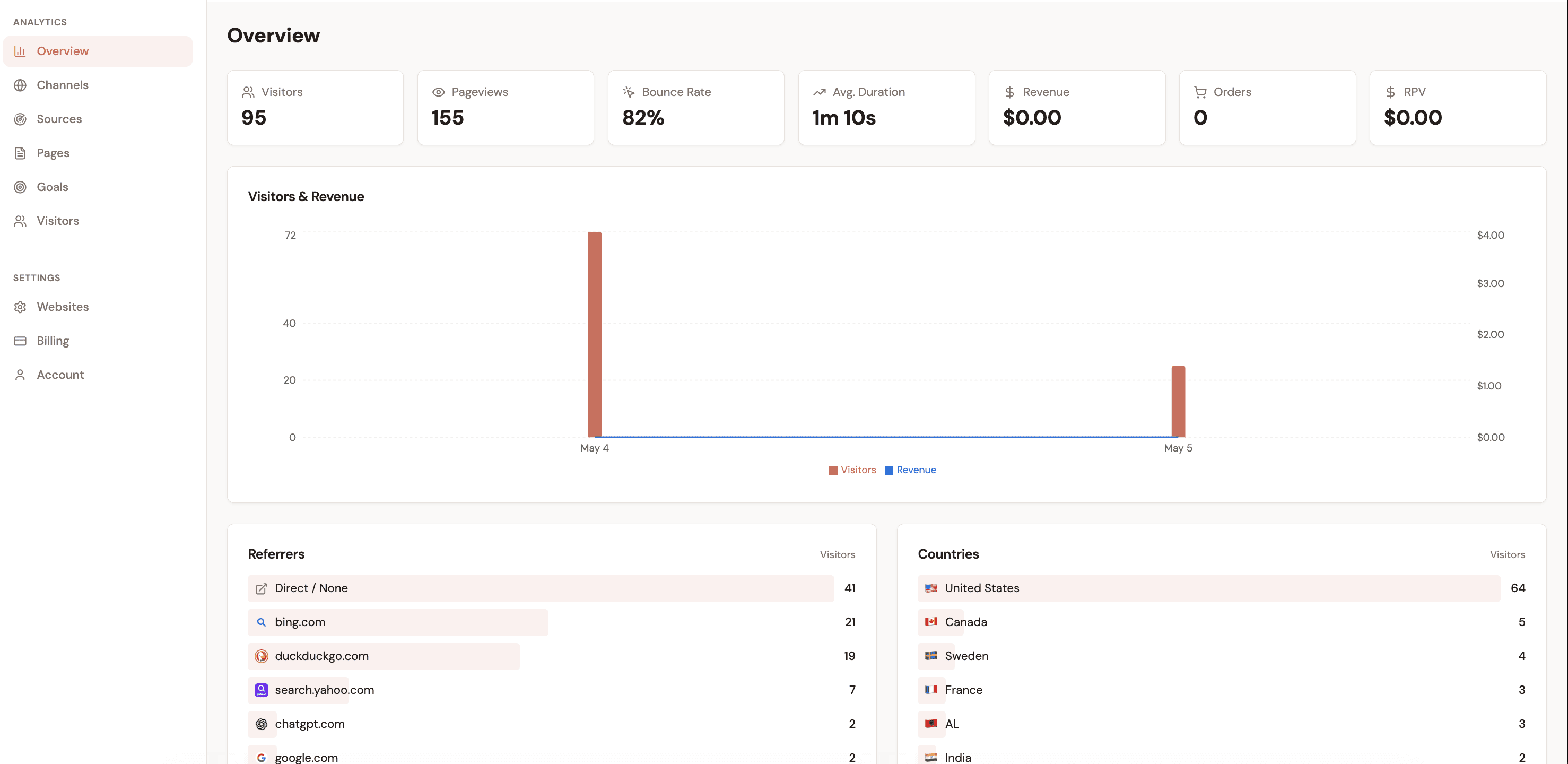
Privacy-first analytics actually shipped — Visitors, Pageviews, Revenue, Orders, and RPV all collected without cookies. ePrivacy Art. 5(3)[6] not triggered, no consent banner needed.
Why privacy-first analytics matters in 2026
The case for cookieless analytics is no longer purely ethical. It is operational. Four converging forces have made traditional cookie-based analytics actively unreliable and legally exposed for businesses operating in or serving the EU.
GDPR enforcement
Multiple EU data protection authorities have ruled standard Google Analytics implementations non-compliant. Austria (Jan 2022), France (Feb 2022), Italy (Jun 2022), Denmark (Sep 2022). Each ruling cited the same violations: US data transfers and cookies set without valid consent. Total GDPR fines exceeded €4 billion by 2024.
Consent rejection rates
When you show a compliant consent banner — one that makes rejecting as easy as accepting — 30 to 40 percent of EU visitors decline analytics cookies. That data gap is permanent and structural. It is not a bug in your implementation. It is what happens when you give users an honest choice.
Chrome cookie deprecation
Google began phasing out third-party cookies in 2024. Combined with Safari ITP (which has capped JS-set first-party cookies at 24 hours since 2020) and Firefox Enhanced Tracking Protection, cookie-based analytics is now unreliable across all major browsers — not just privacy-focused ones.
CNIL and 2026 EU Digital Omnibus
The French CNIL intensified audits on analytics consent flows in 2025, issuing formal orders against dark-pattern cookie banners. The proposed EU Digital Omnibus Directive extends GDPR-style obligations to B2B data flows, broadening the compliance surface further.
Privacy regulation timeline: 2018 to 2026
Eight years of compounding regulatory pressure — and the trajectory is not slowing down.
2018
GDPR enforced
EU General Data Protection Regulation comes into force. Analytics cookies require explicit, prior consent.
2020
Schrems II / CCPA
EU–US Privacy Shield invalidated. California Consumer Privacy Act takes effect. US data transfers enter legal limbo.
2022
DPA rulings on GA
Austrian, French, Italian, and Danish DPAs rule standard Google Analytics implementations violate GDPR — US data transfers, cookies without valid consent.
2023
EU–US DPF + Meta €1.2bn fine
EU–US Data Privacy Framework adopted, but faces anticipated Schrems III challenge. Meta fined a record €1.2 billion for EU–US data transfers.
2024
Chrome cookie deprecation begins
Google phases out third-party cookies. Cookie-based attribution now unreliable across all major browsers. CNIL issues updated guidance on cookieless.
2025
CNIL stricter enforcement
French DPA intensifies audits on analytics consent flows. Pre-ticked boxes and buried reject buttons result in formal orders and fines.
2026
EU Digital Omnibus Directive
Proposed regulation extends GDPR-style obligations to B2B data. Cookieless, consent-free analytics becomes the dominant compliant architecture.
The 3 types of privacy-compliant analytics
Not all "GDPR compliant" analytics tools work the same way. There are three distinct architectures, each with a different compliance posture, data quality profile, and operational trade-off.
Type 1
Consent-based analytics
Consent required
Yes
Collects data using cookies, but asks for permission first via a consent management platform (CMP). Compliant when implemented correctly. Loses 30–40% of traffic that declines.
Verdict: Legally viable with a proper CMP, but operationally painful. Every new DPA guidance cycle risks requiring CMP updates. Data loss from consent rejection is structural, not fixable.
Type 2
Anonymized analytics
Consent required
Yes
Collects data via cookies but anonymizes IP addresses and truncates identifiers. Still requires consent under ePrivacy because a cookie is set — but some DPAs accept Legitimate Interests.
Examples: Matomo (cloud, cookies enabled), Piwik PROData loss: 20–30%
Verdict: Better than consent-based but still cookie-dependent. Legitimate Interests as a legal basis for analytics is contested across DPAs — French CNIL and German DPAs have conflicting guidance.
Type 3
Cookieless analytics
Consent required
No
Uses server-side session hashing instead of browser storage. No cookie is set, so ePrivacy is not triggered and no consent banner is required. Captures 100% of traffic.
Verdict: The cleanest compliance path in 2026. No cookie = no ePrivacy obligation = no data loss. The trade-off is session-scoped tracking — cross-session attribution requires a login event.
Privacy-first analytics tools compared
Eight tools evaluated on GDPR compliance, revenue tracking capability, attribution depth, setup time, and whether a consent banner is required. Pricing verified from each vendor's public pricing page[1][2][3][4]as of March 2026.
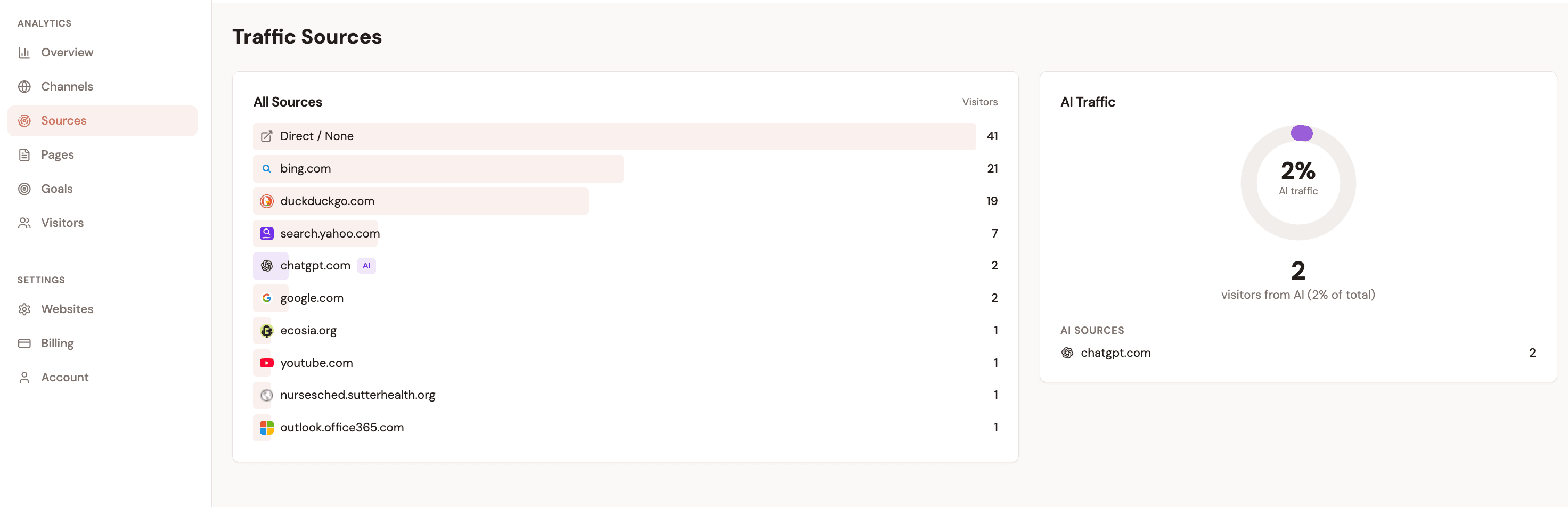
Cookieless source attribution at work. Bing, ChatGPT, DuckDuckGo all surface as distinct rows — no consent banner shown to visitors, no personal data stored[5].
Tool
Price
GDPR
Revenue Tracking
Attribution
Setup Time
Consent Required
AttrifastBest pick
$0–15/mo
< 5 min
Plausible Analytics
$9–19/mo
< 10 min
Fathom Analytics
$14–54/mo
< 10 min
Simple Analytics
$9–19/mo
< 10 min
Umami
Free (self-hosted) / $9–20/mo cloud
30–60 min (self-hosted)
Pirsch
$6–24/mo
< 10 min
Matomo
Free (self-hosted) / $23–54/mo cloud
2–4 hours (self-hosted)
PostHog
Free to $450+/mo
30–60 min
"Consent Required" column shows whether a GDPR consent banner is needed for EU visitors. Check = no banner needed. Cross = banner required.
Attrifast$0–15/mo
GDPR: YesRevenue: YesNo consent: Yes
Plausible Analytics$9–19/mo
GDPR: YesRevenue: NoNo consent: Yes
Fathom Analytics$14–54/mo
GDPR: YesRevenue: NoNo consent: Yes
Simple Analytics$9–19/mo
GDPR: YesRevenue: NoNo consent: Yes
UmamiFree (self-hosted) / $9–20/mo cloud
GDPR: YesRevenue: NoNo consent: Yes
Pirsch$6–24/mo
GDPR: YesRevenue: NoNo consent: Yes
MatomoFree (self-hosted) / $23–54/mo cloud
GDPR: YesRevenue: YesNo consent: Yes
PostHogFree to $450+/mo
GDPR: YesRevenue: NoNo consent: No
Individual tool reviews
Each tool reviewed on what it actually delivers — not just what the marketing page says.
Attrifast
Privacy-first revenue attribution for Stripe
$0–15/mo
Best overall
Attrifast is the only cookieless tool in this comparison that combines GDPR-compliant traffic analytics with actual revenue attribution. Server-side session hashing means no cookies, no consent banner, and zero data loss. Connect Stripe and immediately see which channels drive revenue — not just clicks.
Strengths
Connects directly to Stripe — shows revenue per channel, not just traffic
Cookieless by design: no consent banner, captures 100% of sessions
EU-processed data, no personal data stored at any point
SMB-priced: starts at $15/month — 5–10x cheaper than enterprise tools
Limitations
Session-scoped: cannot link Tuesday visit to Thursday return without login event
Focused on revenue attribution — not a full product analytics suite
Best for: SaaS founders and e-commerce operators who need to know which channels generate revenue, without GDPR overhead.
Plausible Analytics
Simple, cookieless web analytics from the EU
$9–19/mo
Plausible is the category benchmark for privacy-first web analytics. EU-owned, EU-hosted, cookieless, no personal data stored. Its dashboard is deliberately simple — pageviews, sessions, referrers, and custom goals. Where it falls short: it has no native Stripe integration, so you see traffic but not what that traffic is worth.
Strengths
Best-in-class privacy credentials: EU-owned, EU-hosted, open source
No consent banner required under GDPR or ePrivacy
Clean, fast dashboard with no learning curve
Limitations
No revenue or conversion value tracking without custom events and extra work
No native Stripe integration
Traffic analytics only — cannot tell you which channel drives the most revenue
Best for: Content sites, blogs, and early-stage products that need compliant traffic analytics but not revenue attribution.
Fathom Analytics
Privacy analytics with EU isolation routing
$14–54/mo
Fathom's standout feature is EU Isolation — EU visitors' data never leaves EU servers, even if Fathom's infrastructure is US-based for non-EU traffic. This directly addresses the DPA ruling scenario where US data residency was cited as the violation. Like Plausible, Fathom is cookieless and consent-free, but its analytics depth is limited to traffic metrics.
Strengths
EU Isolation feature addresses the exact DPA ruling scenarios from 2022
Cookieless, no consent banner, GDPR-compliant by architecture
Simple pricing, predictable costs
Limitations
No revenue attribution — you cannot connect Stripe revenue
Higher entry price than Plausible for similar feature depth
Limited custom event flexibility for conversion funnels
Best for: Agencies and businesses managing client analytics who need clean privacy compliance with minimal setup.
Simple Analytics
Netherlands-based minimalist analytics
$9–19/mo
Simple Analytics takes a deliberate minimalism approach — the less data collected, the fewer GDPR obligations arise. Based in the Netherlands, EU-hosted, cookieless. Its analytics surface is intentionally shallow: referrers, pageviews, countries, devices. Good for compliance simplicity; not suited to any revenue attribution use case.
Strengths
Extremely minimal data collection — lowest GDPR obligation surface of any tool here
Netherlands-based, EU-hosted, open source
Import your historical GA data during migration
Limitations
Shallowest analytics depth of any tool compared here
No revenue tracking, no conversion value, no Stripe integration
Custom events require manual implementation
Best for: Bloggers, NGOs, and businesses where analytics breadth is secondary to maximum privacy minimalism.
Umami
Open-source cookieless analytics you can self-host
Free (self-hosted) / $9–20/mo cloud
Umami is an open-source cookieless analytics platform that you can run on your own infrastructure — giving you complete data sovereignty. The self-hosted version is free. Cloud version starts at $9/month. GDPR-compliant by design when self-hosted in the EU. Requires a database and hosting setup, which adds engineering time for non-technical founders.
Strengths
Free when self-hosted — no ongoing SaaS cost
Full data sovereignty on EU infrastructure
Cookieless, no consent banner required
Active open-source community, growing feature set
Limitations
Self-hosting requires engineering time, database management, and ongoing maintenance
No native revenue attribution or Stripe integration
Cloud version is limited compared to self-hosted
Best for: Engineering-led teams who want maximum data control and are comfortable managing their own infrastructure.
Pirsch
German-made privacy analytics
$6–24/mo
Pirsch is a German cookieless analytics tool with EU hosting, no cookies, and no consent requirement. Its pricing is the most competitive in the cookieless segment. It offers a clean dashboard with pageviews, referrers, custom events, and funnels. No revenue tracking or payment platform integrations. A solid Plausible alternative for cost-conscious teams.
Strengths
Most affordable cookieless tool: starts at $6/month
German-based and EU-hosted — strong data residency story
Cookieless, no consent banner, GDPR-compliant
Funnel tracking included in all plans
Limitations
No revenue attribution — cannot connect Stripe, or any payment provider
Smaller ecosystem and fewer integrations than Plausible or Fathom
Best for: Budget-conscious operators who need GDPR-compliant traffic analytics without revenue tracking.
Matomo
Open-source GA alternative with cookieless mode
Free (self-hosted) / $23–54/mo cloud
Matomo is the most feature-complete open-source GA alternative. Self-hosted in the EU with cookieless mode enabled, it is GDPR-compliant without a consent banner. It supports e-commerce revenue tracking and attribution out of the box. The catch: self-hosting requires real engineering effort, and cloud pricing is enterprise-level for teams needing advanced features.
Strengths
Most complete feature set of any privacy-first tool: funnels, attribution, e-commerce revenue
Cookieless mode available — no consent banner when enabled
Full data sovereignty when self-hosted on EU infrastructure
Open source — no vendor lock-in
Limitations
Self-hosting is a significant engineering commitment — database, server, updates, backups
Cloud pricing at feature parity is expensive for SMBs
Consent required if cookieless mode is not explicitly enabled
Revenue tracking requires manual Matomo e-commerce API implementation
Best for: Engineering teams willing to self-host who need a full GA replacement with e-commerce analytics.
PostHog
Product analytics platform with EU cloud option
Free to $450+/mo
PostHog is a product analytics suite — feature flags, session recordings, A/B testing, funnels, and retention analysis. Its EU Cloud option stores data in the EU. However, PostHog uses cookies for session tracking and requires a consent banner for EU visitors. It is not a revenue attribution tool — it has no native Stripe integration and is priced for product teams, not marketing attribution.
Requires a consent banner — loses 30–40% of EU visitor data
Not a revenue attribution tool — no Stripe integration
Pricing scales steeply with event volume
Significant setup time for full feature use
Best for: Product teams who need session recording and feature flag management alongside analytics — not for marketing attribution.
Which tool is right for you? A decision framework
Work through these three questions to find the right fit for your use case.
1
Do you need to know which marketing channels generate revenue (not just traffic)?
Yes — I need revenue data
Continue to question 2. You need a tool with Stripe integration. Most privacy-first tools do not have this.
No — traffic is enough
Plausible for the best overall privacy + simplicity combination. Pirsch for the lowest price.Umami if you want full data sovereignty with self-hosting.
2
Do you need full product analytics (session recordings, feature flags, A/B tests) or just attribution?
Full product analytics suite
PostHog (EU Cloud) for the widest feature set. Accept the consent banner requirement and ~30% EU data loss. Consider running Attrifast in parallel for revenue attribution.
Revenue attribution focus
Continue to question 3. You want to know which channel drives paying customers — this is a much more specific need.
3
Do you have engineering resources to self-host and maintain infrastructure?
Yes — we have engineering capacity
Matomo self-hosted on EU infrastructure with cookieless mode and the e-commerce API. Most powerful option for engineering-led teams who want full data sovereignty and revenue tracking.
No — we need a managed SaaS
Attrifast. Cookieless, GDPR-compliant, connects to Stripe and Shopify in under 5 minutes. Shows you which channels generate revenue, not just visits. Starts at $15/month.
How Attrifast combines privacy compliance with revenue attribution
The gap in the privacy analytics market is not traffic reporting — Plausible, Fathom, and others handle that well. The gap is connecting privacy-compliant traffic data to actual revenue. Knowing that Google organic drove 1,200 sessions last month is interesting. Knowing it drove $18,400 in Stripe revenue is actionable.
Attrifast is built specifically for this: GDPR-compliant attribution from first click to paid invoice, without cookies, without a consent banner, and without a team of engineers to set it up.
Cookieless session tracking
Server-side session hashing uses a truncated IP prefix, user agent, and a daily rotating salt. No cookie is set. The ePrivacy Directive is not triggered. No consent banner is required. The hash cannot be reversed — it is not personal data under GDPR Article 4.
Direct Stripe integration
Connect your Stripe account in under 5 minutes. Attrifast maps payment events back to the originating traffic session — so when a customer from a Google Ads click converts three days later, the revenue is attributed to that channel.
Revenue per channel dashboard
Instead of seeing sessions per source, you see revenue per source. Google Ads: $4,200. Organic search: $18,400. Twitter: $320. This is the data that determines where your next marketing dollar should go.
EU-processed, no personal data stored
Attrifast processes data in the EU and stores no personal data at any point. No DPA ruling scenario applies. No Schrems III risk. The compliance posture is structural — not dependent on configuration choices or consent management updates.
SMB pricing
Enterprise revenue attribution tools (Triple Whale, Northbeam, Rockerbox) start at $300–500/month and are built for large media budgets. Attrifast starts at $15/month — designed for bootstrapped SaaS founders and Shopify operators, not enterprise marketing teams.
Migration guide: from GA4 to a privacy-first analytics tool
Switching from Google Analytics 4 is less disruptive than most teams expect. A 2–4 week parallel-running period validates data quality before you make the cut.
1
Audit what you actually use in GA4
List the reports your team opens weekly. For most SMBs, this is: traffic by source/medium, top landing pages, conversion events, and revenue (if tracked). The majority of GA4 features go unused. Knowing what matters prevents scope creep during migration.
2
Choose your privacy-first tool
Need revenue attribution: Attrifast. Need traffic analytics only, simplest setup: Plausible. Need full data control with engineering capacity: Matomo self-hosted. Need cheapest option: Pirsch at $6/month. Use the decision framework above if you are still unsure.
3
Install and run both tools in parallel for 2–4 weeks
Add the new tool's tracking snippet alongside your existing GA4 tag. Both will collect data simultaneously. The cookieless tool will typically show more sessions than GA4 — because consent-rejecting visitors are no longer excluded. This is correct, not a bug.
4
Understand the data gap
Your privacy-first tool will show 20–40% more sessions than GA4 if you run a compliant consent banner. This represents real visitors that your GA4 instance was losing. When you switch primary reporting, your "traffic" will appear to increase — because you are now seeing all of it.
5
Switch primary reporting
Designate the new tool as your primary analytics source. Update dashboards, automated reports, and weekly reviews. Train your team on the new interface — most privacy-first tools are significantly simpler than GA4.
6
Handle Google Ads and remaining GA4 dependencies
If you rely on GA4 conversion import for Google Ads bidding, retain a minimal GA4 property with Consent Mode v2 enabled and maximum data minimization. Remove it from primary reporting but keep it for ad platform integration until you evaluate alternatives like the Google Ads API.
7
Update your privacy policy and cookie banner
Remove the analytics cookie declaration if you are going fully cookieless. Update your privacy policy to name the new provider, describe what data is collected (session hashes, not personal data), and state retention period. If removing the consent banner, remove the analytics section entirely — not just the cookie name.
1In 2026, GDPR, CNIL, Chrome's cookie deprecation, and the EU Digital Omnibus Directive have converged to make cookieless analytics the compliance-first default for SMBs.
2Three architectures exist: consent-based (30–40% data loss), anonymized (contested legal basis), and cookieless (0% data loss, no consent needed).
3Most privacy-first tools — Plausible, Fathom, Pirsch, Simple Analytics — solve compliance but not revenue attribution. You know how many visits, not how much money.
4Attrifast is the only tool in this comparison that combines cookieless GDPR compliance with direct Stripe revenue attribution at SMB pricing ($0–15/mo).
5Migrating from GA4 to a privacy-first tool typically reveals MORE data, not less — because consent-rejecting visitors are no longer excluded from your analytics.
Frequently asked questions
What are privacy-first analytics tools?
Privacy-first analytics tools are web analytics platforms designed to collect traffic and conversion data without using cookies, without storing personal data, and without requiring visitor consent under GDPR or the ePrivacy Directive. They typically use server-side session hashing — combining a truncated IP prefix, user agent string, and a daily rotating salt — to identify sessions without creating persistent user profiles. Examples include Plausible, Fathom, Simple Analytics, Umami, Pirsch, and Attrifast.
Can I use analytics without a consent banner under GDPR?
Yes, if your analytics tool is cookieless. The ePrivacy Directive (not GDPR) is what triggers the consent banner requirement — specifically, the rule that non-essential cookies require prior informed consent. If your tool uses server-side session hashing instead of setting any cookie, the ePrivacy Directive is not triggered, and no consent banner is required for analytics purposes. GDPR still applies to any personal data processing, but session hashes using truncated IPs and rotating salts are not personal data under Article 4 GDPR.
Which privacy-first analytics tool tracks revenue?
Attrifast is the only privacy-first, cookieless tool in 2026 that natively connects to Stripe to track actual revenue per marketing channel. Tools like Plausible, Fathom, Simple Analytics, Umami, and Pirsch are traffic analytics tools — they track sessions, pageviews, and referrers, but they cannot tell you which channel generated $4,200 in Stripe revenue last month. Matomo offers e-commerce revenue tracking when self-hosted with the e-commerce API, but requires significant engineering setup.
How does cookieless tracking work technically?
When a visitor arrives, the server receives the HTTP request before any JavaScript runs. A cookieless system extracts three attributes: the truncated IP address (last octet removed to prevent individual identification), the user agent string, and a cryptographic salt that rotates every 24 hours. These are hashed together to create a session identifier. Because the salt changes daily, the same visitor gets a completely different hash the next day — there is no cross-session profile. The hash cannot be reversed to identify an individual, so it is not personal data under GDPR Article 4. No cookie is written to the browser.
Is Plausible Analytics GDPR compliant?
Yes. Plausible Analytics is GDPR-compliant by design. It is EU-owned (Estonian company), EU-hosted (Hetzner in Germany/Finland), cookieless, stores no personal data, and does not require a consent banner. It has published a detailed legal assessment confirming compliance under GDPR and the ePrivacy Directive. Its limitation is not compliance — it is analytics depth. Plausible tracks traffic but does not track Stripe revenue or provide marketing channel attribution against actual payment data.
What is the difference between GDPR compliant analytics and privacy-first analytics?
All privacy-first analytics tools aim to be GDPR compliant, but not all GDPR-compliant analytics tools are privacy-first. GDPR compliance can be achieved through proper consent management — collecting cookies with a valid consent banner, DPA agreements, and EU data storage. Privacy-first tools go further: they eliminate cookies entirely, store no personal data, and require no consent banner. The practical difference is data loss: consent-based tools lose 30–40% of EU visitors who decline; cookieless tools capture 100% because no consent is needed.