Buyer's Guide

The simple marketing attribution tool that actually works for small businesses

Vincent Ruan
Vincent RuanFounder, Attrifast ·

You do not need a 6-week implementation, a $38,400/year HubSpot Enterprise contract, or a Segment setup that takes three engineering sprints. You need to know which marketing channel is sending you paying customers. This guide covers exactly what a simple marketing attribution tool needs — and which ones deliver it without the enterprise overhead.

Updated March 2026 · 13 min read
TL;DR
  • 80% of businesses need attribution for fewer than 5 marketing channels — enterprise tools are severe overkill.
  • A simple attribution tool needs exactly 5 things: source tracking, revenue matching, channel comparison, RPV metric, and 5-minute setup.
  • HubSpot Enterprise costs $38,400/year. Segment takes 3 engineering sprints. Neither is built for founders.
  • Attrifast ($9.99–29/mo) does the whole job in 5 minutes — one script tag, OAuth payment connection, revenue by channel.

Why most attribution tools are overengineered for 90% of businesses

The marketing attribution software market is dominated by enterprise vendors who built their products for Fortune 500 marketing teams. HubSpot's attribution features live behind their Enterprise tier — starting at $3,200 per month. Mixpanel's advanced attribution requires data engineers to define event taxonomies and implement custom tracking. Segment, the data infrastructure layer most enterprise attribution tools sit on top of, routinely takes three engineering sprints just to get the initial setup right.

The sales pitches from these vendors use words like "multi-touch attribution windows," "media mix modeling," "cross-device identity resolution," and "incrementality testing." These are real concepts with real value — at scale. A company spending $500K per month on ads across 15 channels genuinely benefits from that sophistication. A bootstrapped SaaS founder spending $3K per month across four channels does not.

$38,400
HubSpot Enterprise per year (minimum)
3 sprints
Typical Segment implementation time
6 weeks
Enterprise attribution onboarding cycles

The result is a market full of tools built for enterprise buyers, priced for enterprise budgets, and wrapped in enterprise complexity — sold to founders who just need one answer: which channel is driving revenue? That mismatch is why "simple marketing attribution tool" is an underserved search query. Nobody owns this positioning because everyone is too busy adding features to charge more.

The 5 things a simple attribution tool actually needs

Strip away everything an enterprise vendor sells and you are left with five non-negotiable capabilities. A tool that delivers all five is sufficient for the vast majority of SMB marketing decisions.

01

Traffic source tracking

Capture where each visitor came from: organic search, paid ads, email, social, direct, referral. UTM parameter parsing is essential. This is table stakes — even free tools do this.

02

Revenue matching to payment events

Connect the browser session that landed on your site to the actual Stripe charge. This is the hard part — it requires bridging browser-side data with server-side payment events. Most analytics tools skip this entirely.

03

Channel comparison in one view

See all your channels side by side: revenue, conversion count, and visitors. Not in separate reports. Not requiring five clicks. One table, all channels, immediately actionable.

04

Revenue per Visitor (RPV) metric

Visitors alone are misleading. A channel that sends 10,000 visitors but zero paying customers is worthless. RPV (revenue divided by visitors) normalizes channel performance so you can compare high-traffic and low-traffic channels fairly.

05

Setup under 5 minutes

If implementation requires an engineering sprint, you will not do it. If the onboarding calls take six weeks, your data will be three months stale by the time you see it. A simple attribution tool ships value before your first cup of coffee is finished.

Key insight: 80% of businesses need attribution for fewer than 5 marketing channels. If your entire paid strategy is Google Search and you are active on two social platforms and have an email list, a simple attribution tool gives you the same decision-making power as an enterprise platform — for 1% of the cost.

The marketing attribution complexity spectrum

Every attribution tool falls somewhere on the spectrum from "dead simple" to "requires a dedicated analytics team." Here is where the major tools land — with price and setup time to match.

Google Analytics (basic)
Free
30 min setup

Traffic visibility only

Plausible
$9–19/mo
5 min setup

Privacy-first traffic stats

AttrifastRecommended
$9.99–29/mo
5 min setup

Revenue attribution, Stripe

PostHog
Free–$450+/mo
1–2 hrs setup

Product analytics + event tracking

Mixpanel
$24–833+/mo
2–4 hrs setup

Product analytics, funnel analysis

HubSpot Pro
$800–3,200+/mo
1–3 weeks setup

CRM + marketing suite

Northbeam
$1,000–5,000+/mo
2–4 weeks setup

Enterprise MMM + MTA

Salesforce Mktg Cloud
$1,250–3,750+/mo
4–12 weeks setup

Enterprise CRM + attribution

Simple (1–3)
Moderate (4–6)
Complex (7–10)

6 easy attribution tools compared for simplicity

Evaluated across setup time, learning curve, price, native revenue tracking, and GDPR compliance. The simplicity score (1–10) weights ease of implementation and time to first revenue insight equally.

Attrifast10/10
Setup Time

5 min

Price

$9.99–29/mo

Revenue Tracking
GDPR Native
Plausible9/10
Setup Time

5 min

Price

$9–19/mo

Revenue Tracking
GDPR Native
Fathom9/10
Setup Time

5 min

Price

$14–54/mo

Revenue Tracking
GDPR Native
PostHog5/10
Setup Time

1–2 hrs

Price

Free–$450+/mo

Revenue Tracking
GDPR Native
Mixpanel4/10
Setup Time

2–4 hrs

Price

$24–833+/mo

Revenue Tracking
GDPR Native
HubSpot2/10
Setup Time

1–3 weeks

Price

$800–3,200+/mo

Revenue Tracking
GDPR Native

Note: Plausible and Fathom score high on simplicity but do not connect to payment processors. They are excellent traffic analytics tools, not revenue attribution tools. Attrifast is the only tool in this comparison that scores high on both simplicity and native revenue tracking.

From zero to revenue attribution in 3 steps

This is the actual Attrifast setup flow. Not a simplified version for marketing copy — the real thing. Five minutes from signup to a dashboard showing revenue by channel.

Enterprise attribution tool
6 weeks
Time to first insight
  • Week 1: Sales calls and procurement
  • Week 2–3: Contract negotiation
  • Week 4: Engineering kickoff
  • Week 5: Integration and testing
  • Week 6: First data in dashboard
Attrifast
5 minutes
Time to first insight
  • Minute 1: Sign up, no credit card needed
  • Minute 2: Paste script tag in your site head
  • Minute 3: Connect Stripe
  • Minute 4: First sessions appear
  • Minute 5: Revenue by channel live

Step 1: Paste one script tag

60 seconds

Copy a single 4KB script tag from your Attrifast dashboard and paste it into your site's <head>. Works with any website — Webflow, WordPress, custom code. No engineering team required.

Step 2: Connect your payment provider

2 minutes

Click "Connect Stripe" and authorize via OAuth. Attrifast immediately starts matching browser sessions to actual payment events server-side — no webhooks to configure, no API keys to paste.

Step 3: See revenue by channel

Instant

Your dashboard immediately shows revenue, conversions, and Revenue per Visitor (RPV) broken down by marketing channel. Organic, paid, email, social, direct — all compared side by side. No configuration needed.

What simple revenue attribution actually looks like

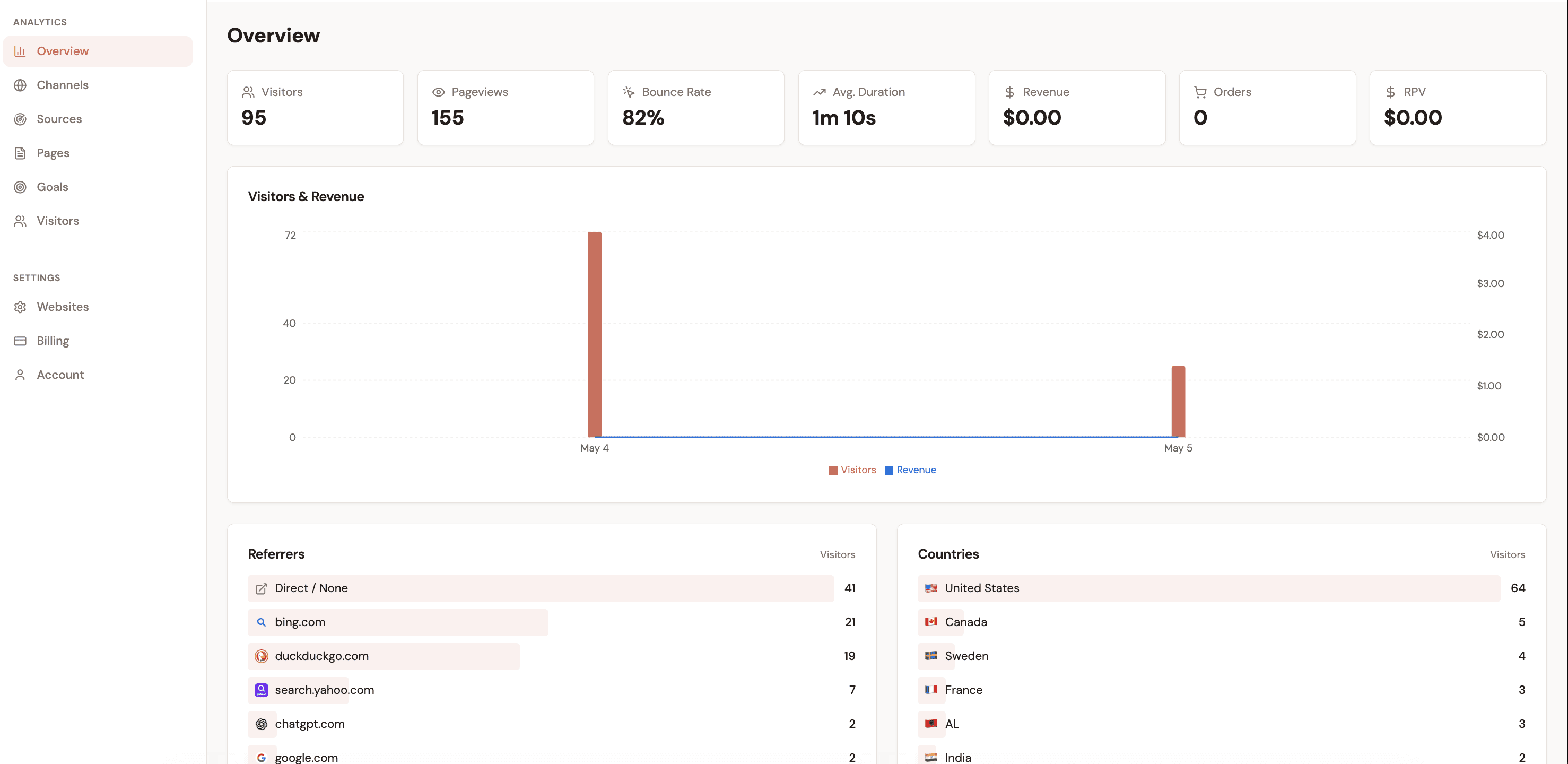
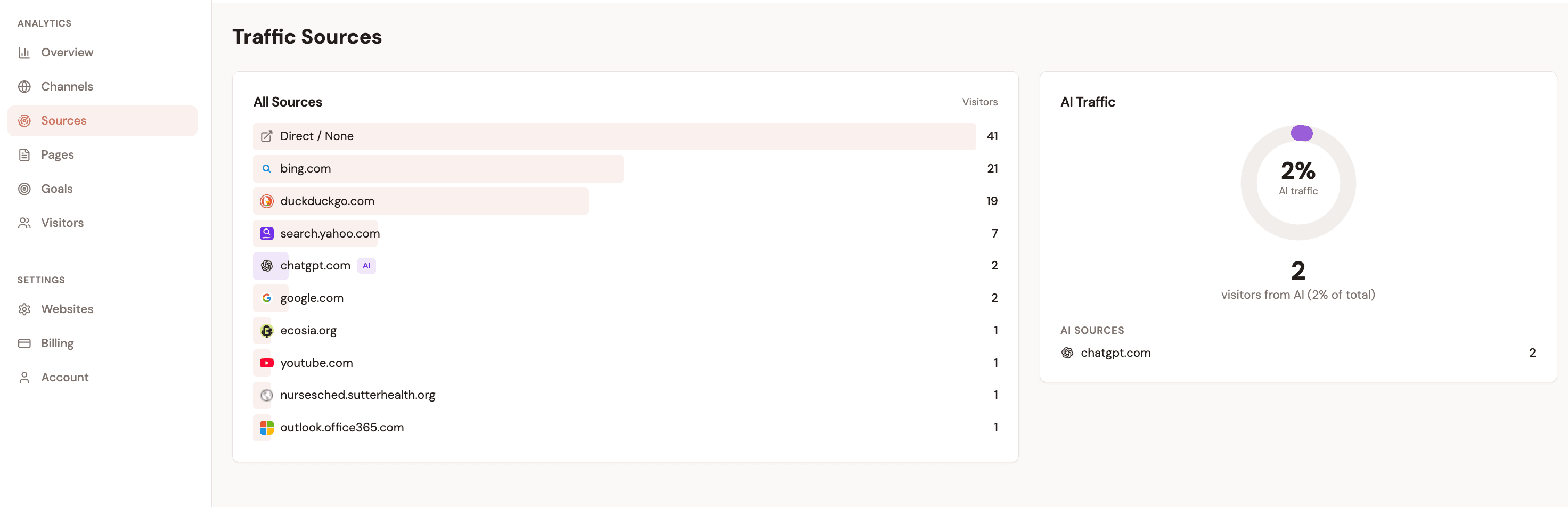
This is a representative Attrifast dashboard. No setup required, no data engineers needed, no seven-tab interface to navigate. One view with the metrics that matter.

Revenue by channel
$37,270last 30 days
Last 30 days
Total revenue
$37,270
Conversions
108
Avg RPV
$2.82
Organic Search
Revenue
$14,820
40%
4,100 visitors42 conversions
Email
Revenue
$9,340
25%
1,820 visitors28 conversions
Paid Search
Revenue
$6,120
16%
3,300 visitors18 conversions
Direct
Revenue
$4,890
13%
1,200 visitors14 conversions
Social
Revenue
$2,100
6%
2,800 visitors6 conversions
Cookie-free · GDPR compliant · No consent banner required

This is all the attribution data most founders will ever need. Email drives the highest revenue per visitor ($5.13 RPV) despite being the second-lowest traffic channel. Paid search sends 3,300 visitors but converts at a fraction of email. These are the insights that change budget decisions — and they require zero configuration to surface.

What you actually give up by choosing simple attribution

Simplicity has real tradeoffs. Here is an honest accounting of what a simple marketing attribution tool does not do — and why that is fine for the majority of small businesses.

This section exists because too many vendors hide limitations in fine print. You should know exactly what you are trading before you commit.

No multi-touch attribution windows

Multi-touch attribution assigns credit across multiple touchpoints in a customer journey. For businesses under 500 conversions per month, the statistical sample is too small for multi-touch to produce reliable signals. First-touch attribution is more actionable at this scale.

Not a meaningful limitation for 90% of SMBs

No custom event pipelines

Enterprise tools let you define custom events like "user watched video for 30 seconds." This is valuable for complex product analytics. It is overkill if your question is simply "which channel sent the visitor who bought."

Not a meaningful limitation for 90% of SMBs

No product analytics

Mixpanel and PostHog show you what users do inside your product — which features they use, where they drop off. Attrifast shows you which channel brought them. These are different questions. If you need product analytics, pair a simple attribution tool with a dedicated product tool.

Not a meaningful limitation for 90% of SMBs

No media mix modeling

Media mix modeling (MMM) uses statistical regression to estimate the incremental impact of channels on revenue over time. It requires months of data and significant ad spend to be meaningful. Businesses under $50K/month in ad spend gain nothing from MMM.

Not a meaningful limitation for 90% of SMBs

The straightforward conclusion

A simple attribution tool is not a compromise. For a business running fewer than five active marketing channels and under 10,000 conversions per month, it is the correct tool. The limitations above only become relevant at a scale most bootstrapped businesses will spend years reaching. Start with what solves the problem today.

When to upgrade beyond a simple attribution tool

Simplicity is not forever — it is the right starting point. Here is the decision tree for knowing when you have genuinely outgrown a simple attribution tool and are ready for something more capable.

1

You hit 10,000+ conversions per month

At this volume, multi-touch attribution models become statistically meaningful. With enough data, you can reliably distinguish first-touch from last-touch and measure assisted conversions. Under this threshold, multi-touch noise exceeds its signal.

Next step: Consider adding Northbeam, Triple Whale, or a custom BigQuery pipeline.
2

You run campaigns across 8+ channels simultaneously

Simple attribution tools handle 5–7 channels cleanly. When you are running paid social, display, podcast ads, influencer, affiliate, organic, email, and direct mail simultaneously, media mix modeling starts to add genuine value.

Next step: Consider Northbeam or Rockerbox at this scale.
3

You hire a dedicated analytics engineer

Simple tools are designed for founders without engineering support. The moment you have an analytics engineer, they will have the bandwidth to implement and maintain more sophisticated tooling — and the training to use it effectively.

Next step: Build a custom Segment + BigQuery + dbt pipeline or use Amplitude.
4

Your sales cycle exceeds 90 days

First-touch attribution breaks down for long B2B sales cycles where a prospect might touch your brand 15 times over six months. Tools like Dreamdata and Ruler Analytics are built specifically for long-cycle B2B attribution.

Next step: Consider Dreamdata or Ruler Analytics for B2B long-cycle attribution.

The honest reality: Most bootstrapped founders who start with a simple attribution tool will still be using it at $1M ARR. The triggers above are real, but they affect a small percentage of SMBs. If you are not hitting those thresholds, the complexity of an enterprise tool costs more than it returns.

Setup time by attribution tool (minutes to first dashboard)

Source: Vendor docs and onboarding guides; SegMetrics, Wicked Reports, HubSpot setup guides

Attribution without the enterprise headache

Paste one script tag. Connect Stripe. See which channels drive revenue in 5 minutes. No engineers, no contracts, no complexity.

Start free trial →

Loved by 500+ users