1Third-party cookie deprecation is permanent and complete. Any analytics stack still dependent on third-party cookies is operating on a broken foundation. The migration to first-party and server-side approaches is not optional — it is already overdue.
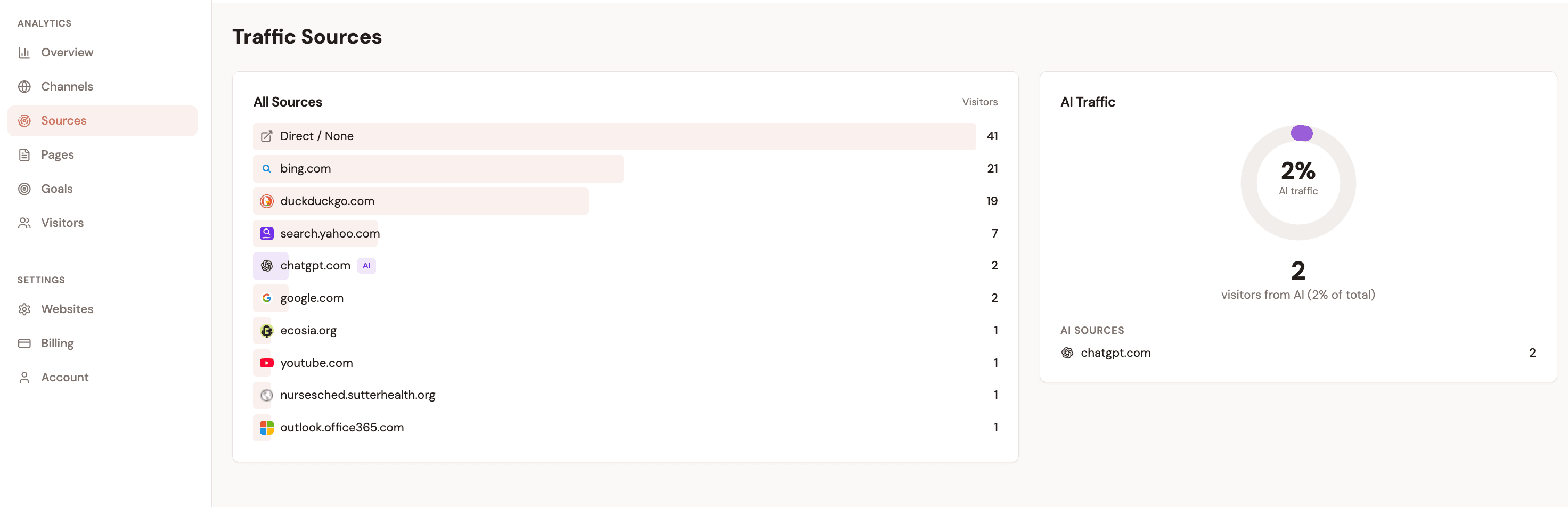
2AI engines are a real traffic channel that most tools are blind to. ChatGPT, Perplexity, Claude, and Gemini send standard HTTP referrer headers. Tools that do not parse and attribute these referrers are systematically undercounting a high-converting traffic source.
3Privacy regulation coverage now reaches most of the internet-using world. GDPR covers the EU (450M people), US state laws now cover 65%+ of US residents, and similar frameworks are active in Brazil, Canada, India, and 60+ other jurisdictions.
4Vanity metrics are losing budget authority. Finance teams and founders are demanding revenue attribution, not session counts. Analytics tools that cannot answer "which channel drives paying customers" are being cut in budget reviews.
5GA4's market share is declining. 31% of GA4 users were actively evaluating alternatives in early 2026. The market is fragmenting into specialist tools: privacy analytics, revenue analytics, product analytics, and AI attribution.
6Server-side tracking is the new baseline. Client-side JavaScript trackers are structurally disadvantaged by ad blockers, browser privacy modes, and ITP. Hybrid and server-side approaches now define the accuracy ceiling for modern analytics.
7Tool consolidation is a growing mandate. SMB marketing teams are being asked to reduce their analytics stack from six tools to two or three. Tools that answer multiple questions (traffic + revenue + privacy compliance) are winning evaluations.
8The accuracy gap between cookie-free and cookie-dependent tools will only widen. As privacy infrastructure matures, cookieless tools achieve 90-100% accuracy. Cookie-dependent tools are on a downward trend toward 40-50% — making them worse than useless for budget decisions.